
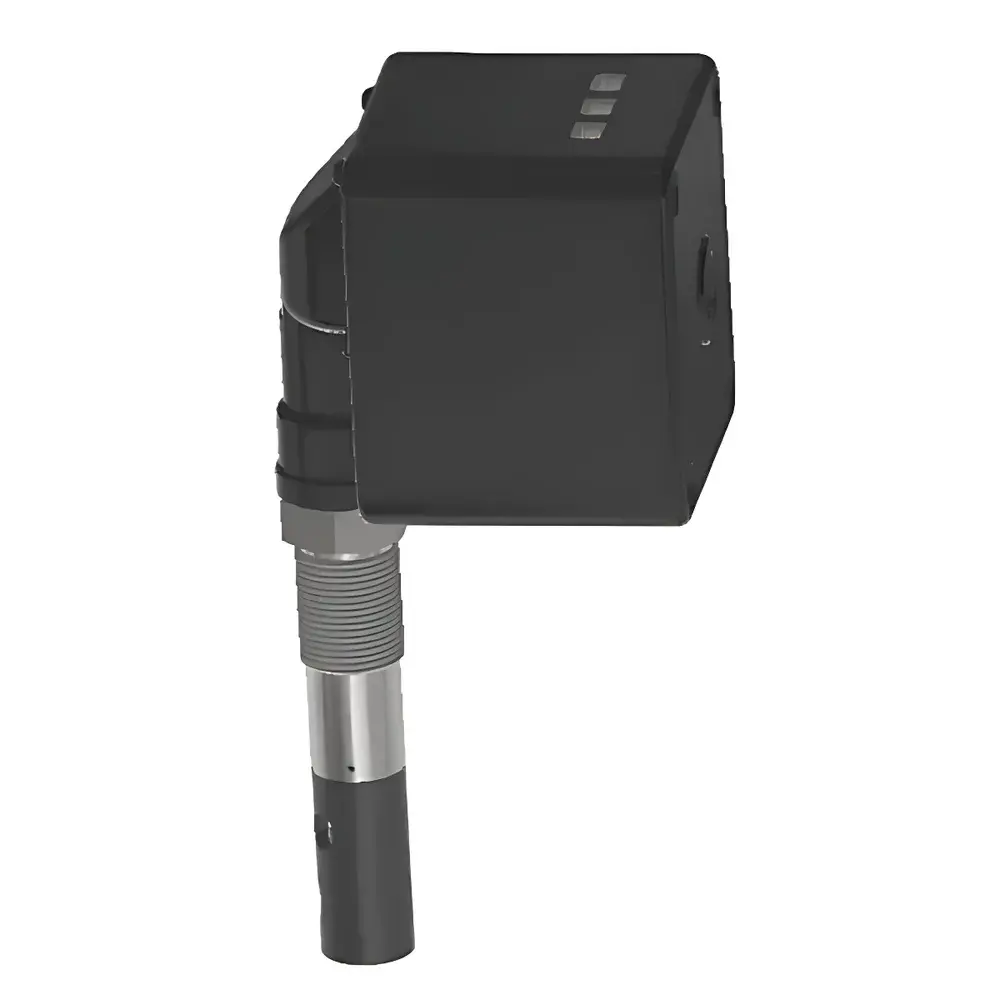
Crankcase Oil Mist Detector PERIC Custom Model 11
| Brand | PERIC |
|---|---|
| Origin | Hebei, China |
| Manufacturer Type | Manufacturer |
| Country of Origin | Domestic (China) |
| Model | Custom Model 11 |
| Pricing | Upon Request |
| Measurement Principle | Infrared Light Scattering |
| Range | 0–5 mg/L |
| Resolution | 0.01 mg/L |
| Adjustable Alarm Threshold | 0.9–2.5 mg/L |
| Communication Interface | RS485 |
| Power Supply | 24 VDC |
Overview
The PERIC Custom Model 11 Crankcase Oil Mist Detector is an industrial-grade, safety-critical monitoring instrument engineered for continuous, real-time detection of oil mist concentration in marine diesel engine crankcases and high-risk rotating machinery enclosures. It operates on the principle of infrared light scattering—where a collimated IR beam interacts with suspended oil droplets in the sampled air stream, generating a scattered light signal proportional to particle number concentration and size distribution within the operational range. This physical measurement method provides rapid, non-intrusive, and maintenance-lean quantification of oil mist accumulation—a key early indicator of bearing wear, lubrication failure, or piston ring blow-by. Designed to meet the mandatory installation requirements stipulated in SOLAS Chapter II-2 Regulation 15.2.3 and the China Classification Society (CCS) “Rules for Classification and Construction of Steel Sea-Going Ships”, the detector supports compliance for medium- and high-speed marine propulsion engines exceeding 2250 kW output or cylinder bore diameters greater than 300 mm.
Key Features
- Infrared light scattering optical architecture optimized for hydrocarbon-based oil aerosols (e.g., ISO VG 32–68 lubricants), delivering stable response across temperature gradients from −25 °C to +70 °C ambient.
- Dual configuration options: in-situ (probe-mounted directly on crankcase access port) and extractive (sample drawn via heated stainless-steel tubing to minimize condensation), enabling deployment flexibility in confined or high-vibration environments.
- Adjustable alarm threshold (0.9–2.5 mg/L) with hysteresis logic to prevent nuisance tripping during transient load changes; alarm output is relay-isolated (SPDT, 250 VAC/2 A) and compatible with third-party fire & gas control panels.
- RS485 Modbus RTU interface supporting standard register mapping for integration into vessel-wide monitoring systems (e.g., NMEA 2000 gateways, Siemens Desigo, or ABB Ability platforms); optional analog 4–20 mA output available upon request.
- Robust IP66-rated aluminum alloy housing with marine-grade anodized finish, certified for EMC compliance per IEC 60945 and vibration resistance per IEC 60068-2-6.
Sample Compatibility & Compliance
The detector is validated for use with mineral, semi-synthetic, and fully synthetic crankcase lubricants commonly employed in low- and medium-speed trunk-piston engines and high-speed four-stroke auxiliary generators. It does not require calibration against reference oil mist standards traceable to NIST or PTB, but supports field verification using calibrated aerosol generators (e.g., Palas MFP-3000) per ISO 21501-4. The device conforms to classification society type-approval prerequisites including CCS, BV, LR, and DNV GL guidance notes for crankcase explosion prevention systems. While not intrinsically safe (Ex d/Ex e rated), it is intended for installation in non-hazardous zones (Zone 2/Class I Div 2) as defined in IEC 60079-0 and NFPA 496.
Software & Data Management
No embedded GUI or local display is provided; configuration and diagnostics are performed via serial terminal or OEM-supplied configuration utility (Windows-based, USB-to-RS485 adapter required). All operational parameters—including zero offset, span gain, alarm setpoints, and communication baud rate—are stored in non-volatile EEPROM with write-protection logic. Event logging includes timestamped alarm activations, sensor fault codes (e.g., optical path obstruction, power brownout), and periodic self-test results. Audit trail functionality meets basic GLP data integrity expectations; full 21 CFR Part 11 compliance requires integration with a validated SCADA or MES platform providing electronic signatures and change control.
Applications
- Continuous crankcase monitoring on main propulsion engines aboard container ships, bulk carriers, and LNG carriers.
- Retrofit installations on legacy vessels undergoing class renewal surveys requiring SOLAS-compliant explosion risk mitigation.
- Condition-based monitoring of turbocharger housings, gearboxes, and compressor crankcases in offshore power generation modules.
- Integration into Class-approved Engine Room Monitoring Systems (ERMS) with centralized alarm annunciation and remote diagnostic capability.
- Supporting predictive maintenance programs by correlating oil mist trends with vibration analysis, lube oil spectrometry, and thermal imaging data.
FAQ
What measurement standard does this detector follow?
It implements light scattering physics aligned with ISO 21501-4 for airborne particle characterization, adapted for oil mist aerosols via empirical correlation to gravimetric reference methods (ASTM D1317).
Is factory calibration traceable to national metrology institutes?
Calibration is performed using internally developed oil mist reference generators; NIST-traceable calibration certificates are available as an optional service through authorized third-party labs.
Can the device operate in high-humidity or salt-laden environments?
Yes—the optical chamber features hydrophobic coating and active purge airflow (optional) to mitigate condensation and salt deposition; housing meets ISO 9227 neutral salt spray testing for 500 hours.
Does it support redundant communication paths?
Standard RS485 is single-channel; dual-port RS485 or fiber-optic media converters may be integrated at system level, but are not built into the base unit.
What maintenance intervals are recommended?
Optical window cleaning every 6 months; full functional verification annually or per class survey cycle; no consumables or replaceable light sources required within 10-year design life.







