
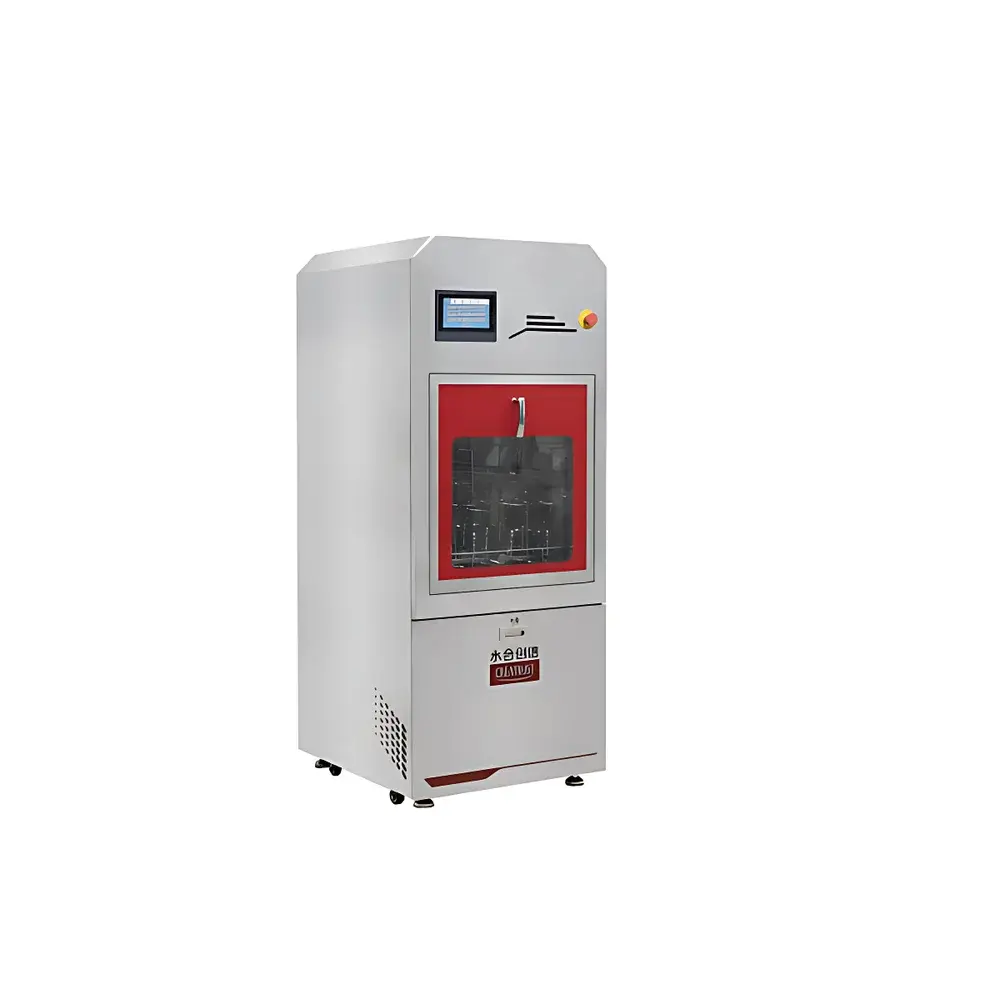
CREATRUST CTLW-220 Fully Automatic Laboratory Glassware Washer
| Brand | CREATRUST |
|---|---|
| Origin | Shandong, China |
| Model | CTLW-220 |
| Chamber Volume | 220 L |
| Heating Power | 5 kW / 15 kW |
| External Dimensions (L×W×D) | 690 × 790 × 1810 mm |
| Voltage | 220 V / 50–60 Hz or 380 V / 50–60 Hz |
| Water Circulation Flow Rate | 800 L/min |
| Max. Operating Power | 6.5 kW / 16.5 kW |
| Water Consumption per Cycle | 15 L |
| Noise Level | <55 dBA |
| Inlet Water Pressure | 0.3–1.0 MPa |
| Construction | Interior Chamber – SUS316L stainless steel |
Overview
The CREATRUST CTLW-220 is a fully automated laboratory glassware washer engineered for precision cleaning, thermal disinfection, and controlled drying of reusable labware in regulated environments. It operates on a validated, closed-loop cleaning process grounded in fluid dynamics principles—utilizing high-pressure, temperature-stabilized spray nozzles, multi-point water distribution, and programmable thermal profiles to ensure consistent removal of organic residues, particulates, and microbiological contaminants. Designed for compliance-critical workflows, the CTLW-220 supports Good Laboratory Practice (GLP), Good Manufacturing Practice (GMP), and ISO 15189-accredited laboratories across pharmaceutical R&D, clinical diagnostics, environmental testing, public health institutes, and industrial QC labs. Its architecture integrates hardware-level redundancy (dual temperature sensors, electronic door interlocks, flow monitoring) with software traceability features to meet audit requirements under FDA 21 CFR Part 11 and EU Annex 11.
Key Features
- Patented TWINS in-situ cleaning & drying system enables simultaneous or sequential execution of wash, rinse, disinfection, and drying phases without manual intervention.
- SUS316L chamber construction ensures corrosion resistance against aggressive detergents, acidic/alkaline solutions, and repeated thermal cycling—critical for long-term integrity in high-throughput labs.
- European-sourced high-efficiency circulation pump delivers stable 800 L/min flow at consistent pressure, enabling reproducible mechanical action across all load configurations.
- Optimized nozzle geometry—including angled flat-jet rotating arms and side-cut cleaning columns—guarantees full 360° coverage of interior surfaces, including narrow-bore tubes and complex geometries such as volumetric flasks and HPLC vials.
- Adjustable-height rack support system accommodates heterogeneous loads: from 20-position syringe racks to 120-position injection vial carriers, plus dedicated fixtures for Petri dishes, pipettes, tubing, and beakers.
- Dual-stage temperature control (wash & dry cycles) with independent PID regulation ensures precise thermal delivery—±1 °C accuracy over full operating range (30–93 °C wash; 40–120 °C dry).
- HEPA-filtered forced-air drying system maintains ISO Class 5 air quality during drying, preventing recontamination of sterilized surfaces.
- PLC-based control architecture with 7-inch color touchscreen interface supports intuitive programming, real-time status visualization, and multilevel access control (3-tier password protection).
- Integrated self-diagnostic subsystem logs faults (e.g., low flow, overheating, door seal failure) with audible alerts and on-screen error codes for rapid troubleshooting.
Sample Compatibility & Compliance
The CTLW-220 accommodates standard and custom labware up to 658 mm height, including GC/HPLC autosampler vials (2–20 mL), culture tubes (13–18 mm OD), conical centrifuge tubes (15–50 mL), Erlenmeyer flasks (50–1000 mL), volumetric flasks (10–1000 mL), and borosilicate glassware with ground-glass joints. Optional rack configurations enable secure positioning of delicate items such as capillary columns, microtiter plates, and silicone tubing. All cleaning programs are developed and verified per ASTM E3068–17 (Standard Guide for Validation of Automated Laboratory Glassware Washers) and align with ISO 13485:2016 requirements for medical device manufacturing support equipment. The system supports validation documentation packages—including IQ/OQ/PQ protocols—and generates audit-ready records when equipped with optional data logging modules.
Software & Data Management
The embedded control firmware supports customizable cycle development via modular step sequencing: pre-rinse, main wash, intermediate rinse, final rinse, thermal disinfection (≥80 °C for ≥5 min), and HEPA-filtered drying. Each program stores parameters (temperature setpoints, dwell times, detergent dosage, pump speed) with timestamped execution logs. Optional USB export functionality allows CSV-formatted cycle reports—including start/end time, energy/water consumption, fault events, and operator ID—to be transferred for LIMS integration or regulatory submission. When configured with the data storage module, the system retains ≥10,000 complete cycle histories with tamper-evident timestamps and user authentication metadata—fully compliant with ALCOA+ data integrity principles and FDA 21 CFR Part 11 electronic record requirements.
Applications
- Pharmaceutical QC/QA labs performing residual solvent analysis, dissolution testing, and stability studies requiring trace-level cleanliness verification (e.g., USP <1051>).
- Clinical microbiology and virology units processing biosafety level 2 (BSL-2) specimens where thermal decontamination (≥90 °C hold) is mandated prior to reuse.
- Environmental testing laboratories handling EPA Method 500/600-series sample containers contaminated with hydrocarbons, pesticides, or heavy metals.
- Reference material producers requiring certified cleanware for CRM preparation under ISO Guide 34.
- Academic research cores supporting metabolomics, proteomics, and elemental analysis workflows where carryover contamination compromises LC-MS/ICP-MS sensitivity.
FAQ
What standards does the CTLW-220 comply with for validation and regulatory use?
It supports IQ/OQ/PQ execution per ASTM E3068–17 and aligns with ISO 13485, ISO 15189, and FDA 21 CFR Part 11 when equipped with data logging and user access controls.
Can the system validate cleaning efficacy for specific analytes like residual APIs or endotoxins?
Yes—through customizable thermal and chemical profiles, combined with documented cycle repeatability and optional residue testing support (e.g., TOC, conductivity, or ATP swabbing post-cycle).
Is remote monitoring or network connectivity available?
The base configuration includes local touchscreen operation; Ethernet or RS485 interfaces are available as factory-installed options for SCADA/LIMS integration.
What maintenance intervals are recommended for critical components?
The circulation pump and HEPA filter require inspection every 500 cycles; heating elements and temperature sensors should be calibrated annually per internal SOP or third-party metrology service.
Does the CTLW-220 support detergent dosing automation?
Yes—integrated peristaltic pumps allow programmable, volume-accurate dispensing of alkaline, neutral, or enzymatic detergents during designated wash phases.



