
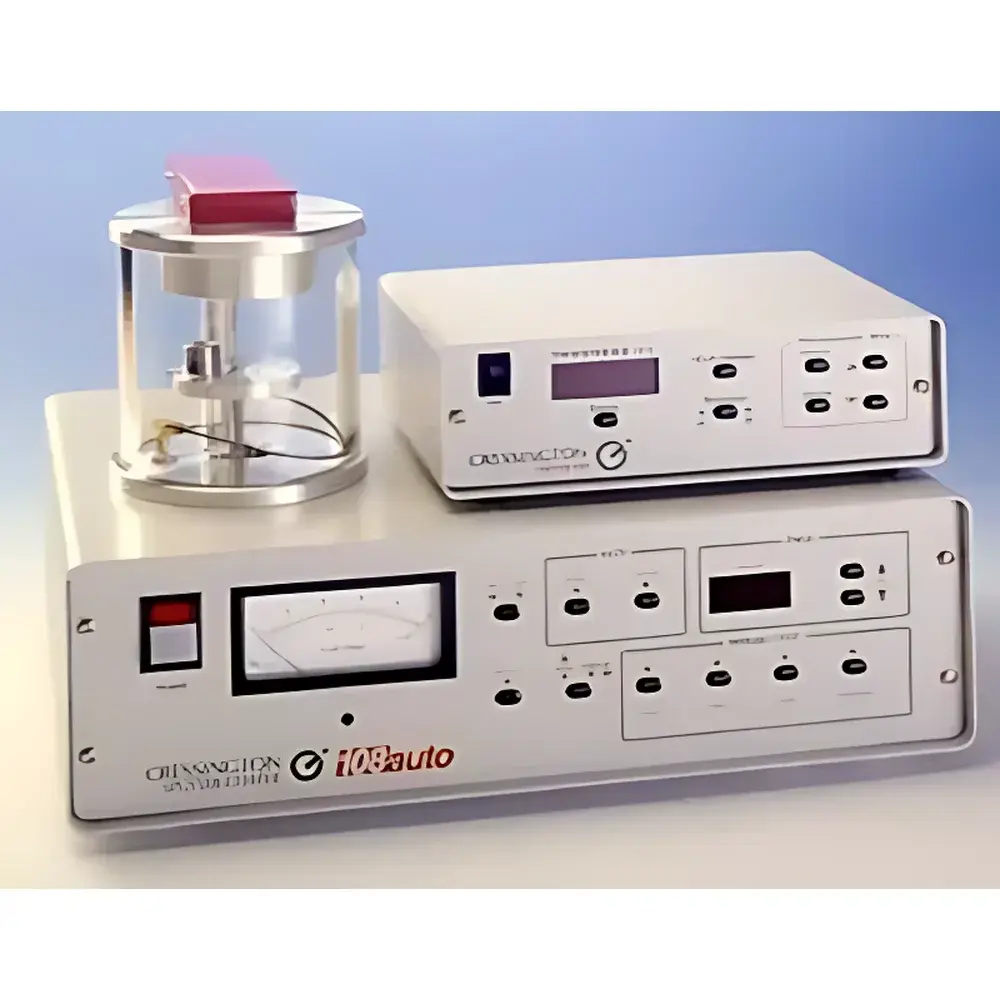
Cressington 108Auto Ion Sputter Coater
| Brand | Cressington |
|---|---|
| Origin | United Kingdom |
| Model | 108Auto |
| Target Materials | Au, Pt, Au/Pd, Pt/Pd, Ag |
| Target Diameter | 57 mm |
| Control Mode | Auto/Manual |
| Chamber Dimensions | 120 mm × 120 mm |
| Sample Stage | 63 mm diameter, 12 SEM stub slots |
| Sputtering Gas | Argon / Air |
| Vacuum System | Integrated two-stage rotary vane pump (base pressure ≤ 5 × 10⁻² mbar) |
| Film Thickness Control | Time-based deposition with real-time current monitoring |
| Power Supply | DC magnetron sputtering, 0–40 mA adjustable |
| Cooling | Passive cold-stage design (no active cooling required) |
Overview
The Cressington 108Auto Ion Sputter Coater is a compact, benchtop magnetron sputtering system engineered for high-reproducibility conductive coating of non-conductive specimens prior to scanning electron microscopy (SEM), energy-dispersive X-ray spectroscopy (EDS), and electron probe microanalysis (EPMA). It operates on the principle of DC magnetron sputtering: argon ions, accelerated in a low-pressure plasma environment (typically 5–20 mbar), bombard a metallic target (e.g., Au, Pt, or Au/Pd), ejecting atoms that condense uniformly onto the sample surface. Unlike thermal evaporation, this cold-process deposition minimizes beam-sensitive specimen damage—critical for biological tissues, polymers, ceramics, and nanomaterials—while delivering sub-5 nm grain-size, continuous, low-resistivity films essential for high-resolution imaging and quantitative elemental analysis.
Key Features
- Automated operation with programmable sputtering time (0.1–999 s), current limit (0–40 mA), and gas flow control—enabling repeatable, operator-independent coating protocols.
- Cold-stage architecture eliminates thermal distortion and carbon migration during deposition, preserving native morphology and minimizing charging artifacts in beam-sensitive samples.
- Integrated vacuum system features a dual-stage rotary vane pump delivering stable base pressure ≤ 5 × 10⁻² mbar, with optional turbomolecular pump upgrade for ultra-high purity coatings.
- Optimized magnetic field geometry ensures uniform ion flux across the full 57 mm target surface, yielding ±3% thickness variation over a 63 mm diameter stage with 12 standard SEM stub positions.
- Modular design supports rapid target exchange without breaking vacuum; compatible with interchangeable targets including Au, Pt, Au/Pd (60/40), Pt/Pd (80/20), and Ag for tailored secondary electron yield and X-ray transparency.
- Front-panel LED display with intuitive menu navigation and password-protected parameter locking—compliant with GLP documentation requirements for lab audit trails.
Sample Compatibility & Compliance
The 108Auto accommodates a wide range of specimen geometries—including bulk solids, powders on adhesive tabs, filter membranes, and cross-sectioned TEM lamellae—within its 120 mm × 120 mm chamber. Its 63 mm rotating sample stage enables even coverage of irregular topographies without manual repositioning. The system meets ISO 14644-1 Class 5 cleanroom compatibility standards when operated in controlled environments. All electrical and vacuum components conform to CE, UKCA, and RoHS directives. For regulated laboratories, the time-stamped sputtering log (accessible via USB export) supports 21 CFR Part 11-compliant data integrity when paired with validated LIMS integration.
Software & Data Management
While the 108Auto operates via embedded firmware without external PC dependency, its firmware version (v3.2+) supports CSV-formatted session logs exportable via USB flash drive. Each log records date/time stamp, target material ID, sputtering duration, average current, final chamber pressure, and operator ID (if configured). This structured metadata enables traceability across batches, facilitates root-cause analysis during QA/QC investigations, and satisfies internal SOPs aligned with ISO/IEC 17025 accreditation requirements for testing laboratories.
Applications
- Routine SEM sample preparation for geological thin sections, fractured metals, and composite materials requiring high secondary electron emission.
- Low-k dielectric and polymer film characterization where thermal stability limits evaporation-based metallization.
- Biological cryo-SEM workflows: sputter-coating frozen-hydrated specimens at −140°C stage temperatures without ice recrystallization.
- Preparation of reference standards for EDS quantification—Au/Pd coatings provide optimal ZAF correction stability across light-to-heavy element ranges.
- Electrode fabrication for in situ electrochemical SEM cells, leveraging Pt or Ag targets for catalytic functionality and electrical continuity.
FAQ
What vacuum level is required for stable sputtering?
Stable DC magnetron discharge initiates at ~5 mbar argon; optimal uniformity is achieved between 8–15 mbar. The integrated pump achieves ≤ 5 × 10⁻² mbar base pressure within 90 seconds.
Can I use reactive gases like oxygen or nitrogen?
No—the 108Auto is configured exclusively for inert sputtering (Ar or air). Reactive sputtering requires separate mass flow controllers, RF power supplies, and chamber passivation not supported by this platform.
Is film thickness measurable in real time?
Thickness is inferred from time-current product (coulombs) calibrated against quartz crystal microbalance (QCM) reference runs; no in-situ QCM is included but can be retrofitted as an accessory.
How often does the target require replacement?
At 20 mA and 30 s per cycle, a 57 mm Au target yields > 1,200 coatings before erosion compromises uniformity—typically 6–12 months under routine lab use.
Does the system support GMP/GLP audit compliance?
Yes—parameter locking, timestamped logs, and firmware revision tracking meet ALCOA+ data integrity principles; full validation packages available upon request for regulated environments.



