
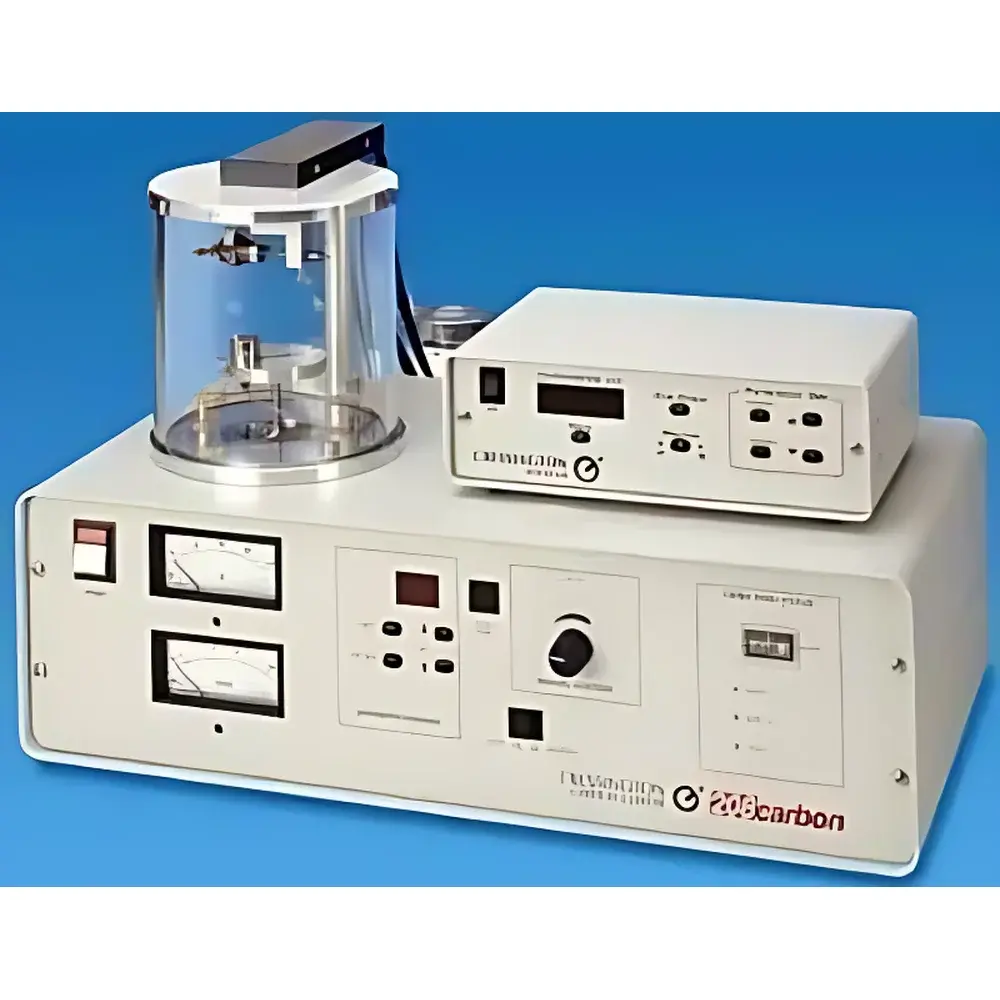
Cressington 208C Molecular Pump Ultra-High Vacuum Carbon Coater
| Brand | Cressington |
|---|---|
| Origin | United Kingdom |
| Manufacturer Type | Authorized Distributor |
| Origin Category | Imported |
| Model | Cressington 208C |
| Target Price Range | USD 38,000–64,000 (FOB) |
| Evaporation Source | High-Purity Graphite Rod |
| Rod Dimensions | OEM Standard Graphite Rod (No Cutting Required) |
| Control Mode | Auto/Manual Dual Mode |
| Chamber Diameter | 150 mm |
| Adjustable Chamber Heights | 3 Positions |
| Sample Stage Diameter | 100 mm |
| Deposition Method | Thermal Evaporation under Ultra-High Vacuum (No Sputtering Gas Required) |
Overview
The Cressington 208C Molecular Pump Ultra-High Vacuum Carbon Coater is a precision-engineered thermal evaporation system designed for the reproducible preparation of ultra-thin, conductive carbon films on electron microscopy specimens. Unlike ion sputter coaters that rely on plasma-driven argon bombardment, the 208C operates exclusively via resistive heating of high-purity graphite rods under ultra-high vacuum (UHV) conditions—typically achieving base pressures below 5 × 10⁻⁷ mbar using its integrated turbomolecular pump. This UHV environment minimizes hydrocarbon contamination and eliminates oxidation during deposition, resulting in amorphous, low-resistivity carbon films with exceptional uniformity and minimal topographic shadowing. The system is purpose-built for applications demanding atomic-level surface fidelity, including high-resolution scanning electron microscopy (SEM), transmission electron microscopy (TEM) grid coating, and X-ray microanalysis (EDS/WDS) specimen preparation.
Key Features
- Integrated molecular pump system enabling stable ultra-high vacuum (<5 × 10⁻⁷ mbar), critical for clean carbon film nucleation and reduced background contamination
- OEM-standard high-purity graphite rod source—no machining or pre-conditioning required—ensuring consistent evaporation rate and stoichiometric film composition
- Three-position adjustable chamber height (70 mm, 90 mm, 110 mm) to optimize deposition geometry for diverse sample geometries and resolution requirements
- 100 mm diameter rotating sample stage with programmable rotation speed (0–60 rpm), ensuring radial uniformity across multi-specimen mounts
- Dual-mode control interface: intuitive manual operation for rapid setup and fully automated sequence programming (time, current ramp, rotation, shutter actuation)
- Robust stainless-steel vacuum chamber with ISO-KF 100 flange compatibility and bake-out capability up to 120 °C for extended UHV stability
Sample Compatibility & Compliance
The 208C accommodates standard SEM stubs (up to 25 mm), TEM grids (200–300 mesh), bulk cross-sections, and fragile biological specimens mounted on aluminum stubs or carbon planchettes. Its cold-wall design and absence of plasma generation eliminate thermal stress, making it suitable for beam-sensitive materials—including polymers, frozen-hydrated sections, and organic thin films. The system complies with ISO 14644-1 Class 5 cleanroom handling protocols when operated in controlled environments. All vacuum components meet ASTM F2782-10 (Standard Specification for High-Vacuum Components) and are certified for use in GLP-compliant laboratories. Full audit trail logging—including vacuum history, deposition parameters, and operator ID—is available when paired with optional Cressington LogMaster software, supporting FDA 21 CFR Part 11 compliance for regulated QA/QC workflows.
Software & Data Management
The 208C’s embedded controller supports parameter storage for up to 99 user-defined methods, each including filament current ramp profiles, deposition time, rotation speed, and shutter timing. Optional LogMaster software provides real-time monitoring, remote operation via Ethernet, and export of timestamped deposition logs in CSV and PDF formats. All data files include metadata such as chamber pressure trace, thermocouple feedback, and interlock status—enabling full traceability per ISO/IEC 17025 requirements. Integration with laboratory information management systems (LIMS) is supported through OPC UA protocol, facilitating automated record retention in centralized QA databases.
Applications
- Conductive carbon overcoating of non-conductive SEM specimens to prevent charging artifacts at accelerating voltages ≥1 kV
- Ultra-thin (2–5 nm) carbon support films for TEM grid preparation, optimized for low electron scattering and high mechanical stability
- Carbon replica preparation for high-resolution TEM analysis of etched surfaces and crystallographic defects
- Calibration standard fabrication—e.g., carbon-coated Si wafers for EDS detector efficiency validation
- Preparation of XPS-compatible carbon reference layers for charge referencing in surface chemical analysis
FAQ
Does the 208C require sputtering gas or plasma ignition?
No—the 208C performs pure thermal evaporation under ultra-high vacuum and does not utilize argon or any other process gas.
What vacuum level is achieved prior to deposition?
Base pressure reaches ≤5 × 10⁻⁷ mbar within 15 minutes after chamber venting, verified by integrated Bayard-Alpert gauge.
Can the system deposit materials other than carbon?
The 208C is optimized for graphite evaporation; alternative sources (e.g., gold, platinum) require separate hardware configurations (e.g., 208HR model) and are not compatible with this carbon-dedicated platform.
Is the graphite rod replaceable without breaking vacuum?
Rod replacement requires chamber venting; however, the quick-release anode assembly enables sub-5-minute source exchange with minimal downtime.
How is film thickness monitored during deposition?
The 208C does not include an in-situ quartz crystal microbalance (QCM); thickness is controlled empirically via calibrated time–current curves validated against TEM cross-section measurements.



