
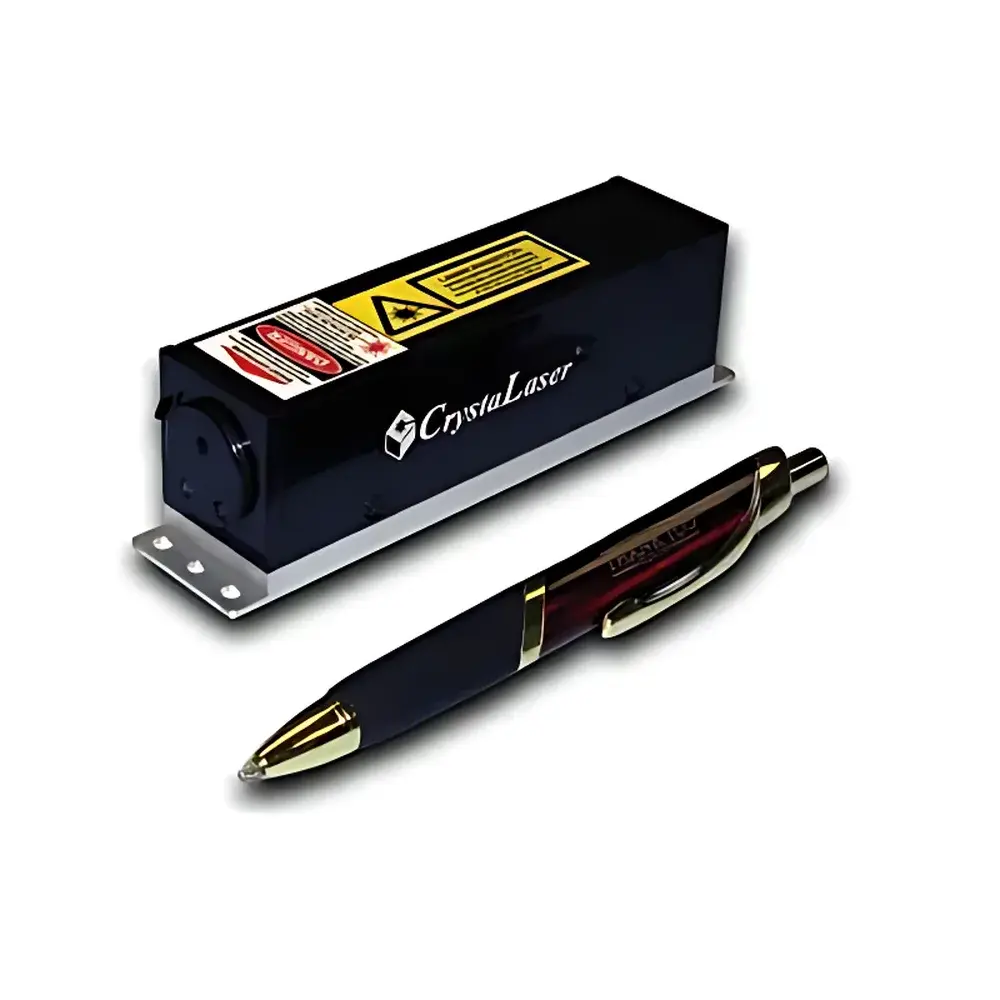
CrystaLaser CL561/CL555/CL593 Continuous-Wave Diode-Pumped Solid-State Yellow-Orange Lasers
| Brand | CrystaLaser |
|---|---|
| Origin | USA |
| Model Series | CL561, CL555, CL593 |
| Wavelengths | 561 nm, 555 nm, 593 nm |
| Output Power Options | 5–200 mW (model-dependent) |
| Transverse Mode | TEM₀₀, M² < 1.1 |
| Beam Diameter (1/e²) | 0.7 mm (standard) |
| Full-Angle Beam Divergence | 1.1 mrad (reducible with expander) |
| Intensity Noise (RMS) | 2% (10 Hz–10 kHz), ~20% (100 kHz–1 MHz) |
| Power Stability (RMS) | <2% over 8 h |
| ultra-stable variants | 0.5% or 0.25% over 24 h |
| Beam Pointing Stability | <0.02 mrad at constant temperature |
| Polarization | Linear |
| extinction ratio standard 50 | 1, optional >100:1 |
Overview
The CrystaLaser CL561, CL555, and CL593 series are continuous-wave (CW), diode-pumped solid-state (DPSS) lasers engineered for high spectral purity and spatial coherence in the yellow-orange visible spectrum. Operating at precisely stabilized wavelengths of 561 nm, 555 nm, and 593 nm respectively, these lasers leverage intracavity frequency-doubling of Nd-doped vanadate or YAG crystals to generate narrow-linewidth output without gas discharge or dye media. Unlike traditional He–Ne or argon-ion lasers, this DPSS architecture delivers superior wall-plug efficiency, compact footprint, and long-term reliability—making it suitable for integration into OEM instrumentation, confocal microscopy platforms, flow cytometry systems, and quantum optics experiments requiring stable, low-noise visible excitation.
Key Features
- TEM₀₀ fundamental transverse mode with M² < 1.1 ensures diffraction-limited focusability and high coupling efficiency into single-mode fibers or microscope objectives.
- Beam diameter (1/e²) of 0.7 mm at aperture enables compatibility with standard optomechanics; optional beam expanders (2×, 3×, 5×) allow tailored collimation for extended working distances or reduced divergence (<0.3 mrad achievable).
- Intensity noise performance meets demanding requirements for quantitative fluorescence imaging: ≤2% RMS (10 Hz–10 kHz bandwidth), supporting photon-counting and time-resolved measurements.
- Power stability is characterized under controlled thermal conditions: <2% RMS drift over 8 hours; factory-calibrated ultra-stable configurations provide 0.5% or 0.25% RMS stability over 24 hours—validated per ISO 11554 for laser power stability testing.
- Beam pointing stability <0.02 mrad (measured at constant ambient temperature per ANSI Z136.1 guidelines) minimizes alignment drift during long-duration acquisitions or multi-channel synchronization.
- Linear polarization with standard 50:1 extinction ratio; high-extinction (>100:1) option available for applications requiring precise polarization control, such as ellipsometry or polarized Raman spectroscopy.
Sample Compatibility & Compliance
These lasers are designed for use with standard optical tables, kinematic mounts, and modular photonic assemblies compliant with ISO 10110 surface specification standards. No sample contact or consumables are involved—operation is non-invasive and maintenance-free beyond periodic alignment verification. The units conform to IEC 60825-1:2014 Class 3B laser safety requirements and include integrated key-switch interlock, emission indicator LED, and shutter-compatible TTL modulation input. Documentation supports GLP/GMP-aligned lab environments, including traceable calibration certificates (NIST-traceable power meter validation) and CE marking for EU deployment. While not FDA-cleared as a medical device, the lasers meet essential requirements for research-grade instrumentation referenced in ASTM E275 and ISO/IEC 17025-compliant calibration laboratories.
Software & Data Management
Each laser integrates analog (0–5 V) and digital (TTL) modulation inputs for external intensity control and synchronization with acquisition hardware (e.g., cameras, PMTs, DAQ systems). Optional RS-232 or USB-C interface enables remote parameter monitoring—including real-time power readback, temperature status, and fault logging—via CrystaLaser’s proprietary LaserControl Suite (Windows/Linux compatible). All communication protocols support audit-trail generation for 21 CFR Part 11 compliance when deployed in regulated QC/QA workflows. Data export formats include CSV and HDF5, facilitating integration with Python-based analysis pipelines (e.g., using NumPy, SciPy, or LabVIEW-compatible drivers).
Applications
- Confocal and super-resolution microscopy: 561 nm excitation of mCherry, tdTomato, and Alexa Fluor 555; 593 nm for Cy3.5 and ATTO 590 with minimal cellular autofluorescence.
- Flow cytometry: Multi-laser excitation panels requiring spectrally distinct yellow-orange lines with low temporal jitter and high inter-laser coherence.
- Optical trapping and holographic tweezers: Stable, low-noise beams enable precise momentum transfer and long-duration particle manipulation.
- Spectroscopic calibration sources: Narrow linewidth (<1 MHz typical) and wavelength accuracy ±0.1 nm support grating and etalon characterization.
- Quantum optics experiments: Pumping of nonlinear crystals for SPDC or serving as local oscillators in heterodyne detection schemes requiring phase stability and polarization fidelity.
FAQ
What cooling method is used?
These lasers employ thermoelectric (Peltier) cooling with closed-loop temperature stabilization—no water chillers or forced-air ducting required.
Is warm-up time specified?
Full spectral and power stabilization is achieved within ≤15 minutes from cold start at 23 °C ambient, per manufacturer’s operational qualification protocol.
Can the lasers be fiber-coupled?
Yes—standard FC/PC or FC/APC fiber launch options are available with coupling efficiency >65% (SMF-28, NA 0.14); custom multimode coupling also supported.
Do you offer OEM packaging?
OEM modules include chassis-mount versions with integrated driver, EMI shielding, and custom pinout headers—designed for seamless integration into analytical instruments per IPC-610 Class 2 standards.
What is the expected lifetime of the pump diodes?
Rated mean time to failure (MTTF) exceeds 10,000 hours under nominal operating conditions, validated by accelerated life testing per Telcordia GR-468-CORE.



