
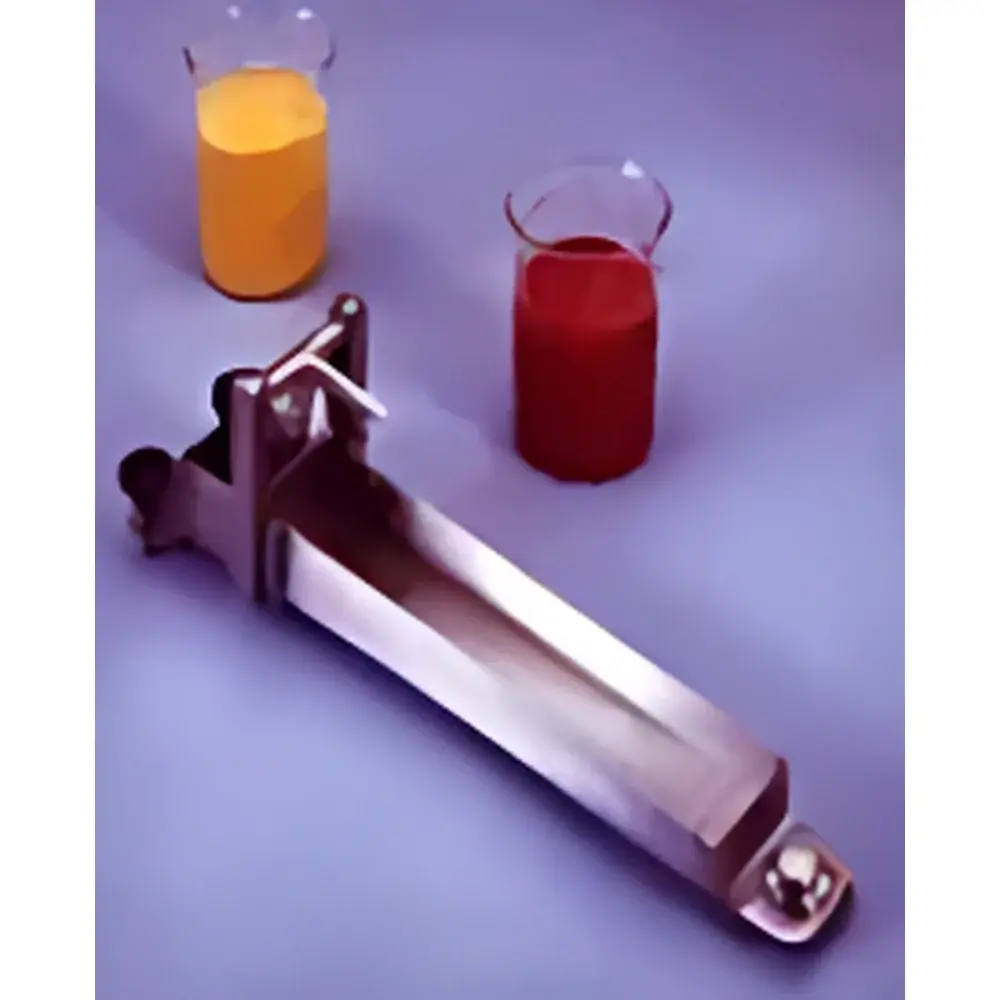
CSC Viscometer – Precision Efflux Viscometer for Semi-Solid Food Products
| Origin | USA |
|---|---|
| Manufacturer Type | Authorized Distributor |
| Origin Category | Imported Instrument |
| Model | CSC |
| Price Range | USD 140–1,400 (FOB) |
| Instrument Type | Efflux Viscometer |
| Viscosity Range | 0.1–1000 Pa·s (equivalent shear-thinning semi-solids, calibrated via standardized efflux time) |
Overview
The CSC Viscometer is a gravity-driven efflux viscometer engineered for consistent, operator-independent measurement of apparent viscosity and flow behavior in highly structured, non-Newtonian semi-solid food matrices. Unlike rotational or capillary viscometers, the CSC operates on the principle of controlled gravitational discharge through a precision-machined orifice under standardized head pressure—making it particularly suitable for products exhibiting yield stress, thixotropy, and minimal free-flow characteristics. Developed by CSC Instruments (founded 1886, USA), this instrument adheres to classical ASTM D1200 and ISO 2431 methodologies adapted for high-viscosity food systems. Its design prioritizes repeatability across production shifts and QC laboratories where rapid pass/fail assessment of batch consistency is critical—without requiring complex calibration curves or rheological modeling.
Key Features
- Construction from electropolished 316L stainless steel ensures corrosion resistance, cleanability, and compliance with FDA 21 CFR Part 117 and EU Regulation (EC) No. 1935/2004 for food contact surfaces.
- Integrated bubble-level vial mounted directly on the base plate enables real-time verification of horizontal alignment; two adjustable leveling feet allow sub-degree tilt correction for gravitational consistency.
- Sealed sample reservoir with spring-actuated gate valve minimizes air entrapment and ensures reproducible fill volume and initiation timing—critical for eliminating operator-induced variability in efflux onset.
- Precision-etched scale on the flow channel (0.5 cm graduation intervals) supports visual confirmation of discharge height and facilitates correlation with empirical flow time–viscosity relationships defined per product matrix.
- No external power supply, electronics, or software required—ideal for GMP environments with strict electromagnetic interference (EMI) controls or decentralized lab settings lacking IT infrastructure.
Sample Compatibility & Compliance
The CSC Viscometer is validated for routine use with high-yield-stress, low-mobility food suspensions including tomato paste, tahini, fruit spreads, soy protein isolates, acid-set yogurts, and fermented dairy concentrates. It is not intended for low-viscosity liquids (< 0.1 Pa·s), thermally unstable emulsions, or particulate-laden slurries exceeding 200 µm median particle size. Method transfer and validation documentation—including repeatability (RSD ≤ 3.2% across n=6 replicates, per internal SOP FV-07) and intermediate precision (inter-operator RSD ≤ 4.8%)—are available upon request. The instrument supports GLP-compliant recordkeeping when paired with paper-based test logs meeting ISO/IEC 17025:2017 Annex A.2 requirements for manual instrumentation.
Software & Data Management
The CSC Viscometer operates as a stand-alone mechanical instrument and does not include embedded firmware, connectivity ports, or proprietary software. All measurements are recorded manually as efflux time (seconds) and converted to apparent viscosity using product-specific calibration tables derived from reference standards traceable to NIST SRM 2490c (silicone oil series) and internal food matrix reference materials. Laboratories implementing electronic lab notebooks (ELN) or LIMS may digitize results via structured templates compliant with 21 CFR Part 11 audit trail requirements—provided handwritten raw data (including operator ID, ambient temperature, and lot number) is retained for minimum 5 years per FDA guidance.
Applications
- QC release testing of tomato concentrate batches against specification limits (e.g., 12–18 s efflux at 25 °C per customer-defined method).
- Monitoring thermal denaturation effects during soy protein isolate drying—tracking viscosity drift as an indicator of aggregation onset.
- Comparative shelf-life studies of acidified dairy gels, correlating efflux time increase with syneresis inhibition performance.
- Raw material qualification for sesame paste suppliers, ensuring minimum flow stability prior to roasting and grinding integration.
- Process troubleshooting in jam manufacturing lines—identifying deviations linked to pectin degradation or sugar inversion.
FAQ
Is the CSC Viscometer compliant with ISO or ASTM standards?
Yes—the instrument implements the core physical principles of ASTM D1200 (for Ford cups) and ISO 2431 (efflux time measurement), adapted for semi-solids via documented method validation protocols.
Can it measure dynamic viscosity in Pa·s units directly?
No—it reports efflux time (s); conversion to apparent viscosity requires product-specific calibration using reference materials and linear or polynomial regression models.
What maintenance is required?
Daily rinsing with warm water and food-grade ethanol; quarterly inspection of orifice diameter (0.8 mm nominal) using optical comparator; annual verification against master gauge block set.
Does it support temperature control?
No—ambient temperature must be stabilized at 20–25 °C per test method; optional external water-jacketed sample conditioning sleeves are available as accessories.
Is training provided with purchase?
Yes—on-site or virtual operator certification includes SOP development, uncertainty budgeting (GUM-compliant), and GLP documentation review.



