
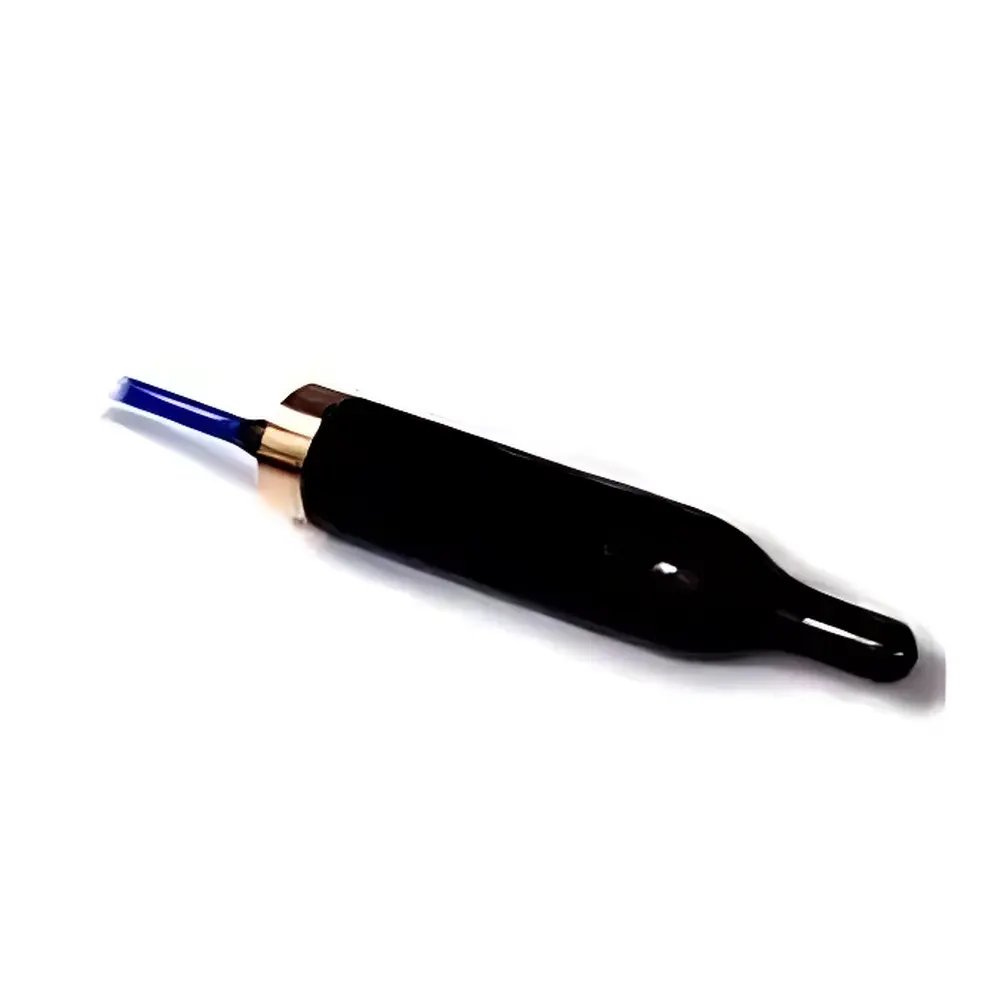
CTG HydroSense 115/45 Spherical Pre-amplified Hydrophone
| Brand | CTG |
|---|---|
| Origin | UK |
| Manufacturer Type | Authorized Distributor |
| Origin Category | Imported |
| Model | HydroSense 115/45 |
| Price | Upon Request |
| Resonant Frequency | 115 kHz |
| Integrated Preamplifier | Yes |
| Preamplifier Type | Differential In / Differential Out |
| Preamplifier Gain | 45 dB |
| Receiving Sensitivity @ 110 kHz | −158 dB re 1 V/µPa into 100 Ω differential load |
| Recommended Frequency Range | 10 Hz – 150 kHz |
| Linear Frequency Range | 10 Hz – 40 kHz |
| Maximum Acoustic Input @ 110 kHz | 167 dB re 1 µPa |
| Power Supply | 20–34 V DC |
| Max Current Draw | 35 mA @ 30 V |
| Max Output Voltage | 3 Vrms |
| Low-Frequency Capacitance @ 1 kHz | 14 nF |
| Horizontal Directivity | Omnidirectional ±5 dB at 50 kHz |
| Vertical Beamwidth | >270° ±3 dB |
| Dimensions | Ø50 mm × 245 mm |
| Sensor Head Weight (Air) | ~1.7 kg |
| Sensor Head Weight (Water) | ~1.2 kg |
| Max Operational Depth | 850 m |
| Survival Depth | 425 m |
| Operating Temperature Range | −5 °C to +35 °C |
| Cable | 5 m triple-shielded twisted-pair |
| Connector | Bare-ended leads |
Overview
The CTG HydroSense 115/45 is a spherical, pre-amplified hydrophone engineered for high-fidelity underwater acoustic measurement in demanding environmental and research applications. Based on piezoelectric ceramic transduction technology, it operates on the principle of pressure-to-voltage conversion via a resonant cylindrical element tuned to 115 kHz, enabling precise detection of both low-frequency ambient noise (down to 10 Hz) and high-frequency transient signals across a broad spectral bandwidth. Its omnidirectional response—maintaining ±5 dB uniformity horizontally at 50 kHz and >270° vertical coverage—ensures consistent sensitivity regardless of source azimuth or elevation, making it particularly suitable for passive acoustic monitoring (PAM), marine mammal vocalization studies, underwater structural health assessment, and compliance-driven hydroacoustic surveys. The integrated differential-input/differential-output preamplifier provides stable 45 dB gain with low-noise performance (<3 nV/√Hz typical input voltage noise), minimizing signal degradation over long cable runs and ensuring compatibility with standard data acquisition systems compliant with IEEE 1057 and IEC 60651 Class 1 specifications.
Key Features
- Spherical geometry with hermetically sealed aluminum housing and polyurethane coating for corrosion resistance and long-term submersion stability
- Differential preamplifier architecture reducing common-mode interference and enabling operation in electrically noisy marine environments
- Linear frequency response from 10 Hz to 40 kHz, supporting quantitative analysis of anthropogenic noise (e.g., vessel radiated noise, pile driving), biological sources (e.g., cetacean clicks and whistles), and geophysical signals (e.g., seismic tremor)
- High dynamic range: 167 dB re 1 µPa maximum acoustic input at resonance ensures fidelity under intense near-field conditions without clipping
- Optimized mechanical design: net buoyancy of ~−0.5 kg in seawater enables stable deployment via mooring or ROV integration; rated for continuous operation at depths up to 850 m
- Low capacitance (14 nF @ 1 kHz) and 3 Vrms maximum output facilitate direct connection to 100 Ω differential inputs without external impedance matching
Sample Compatibility & Compliance
The HydroSense 115/45 is validated for use in seawater, freshwater, and brackish environments across temperature ranges from −5 °C to +35 °C. Its performance conforms to ISO 18405:2017 definitions for hydrophone calibration and terminology, and supports traceable measurements aligned with IEC 60565:2017 (hydrophone calibration procedures). While not intrinsically certified for hazardous locations, its construction meets IP68 ingress protection standards when properly terminated. The device is routinely deployed in regulatory monitoring programs requiring adherence to EU Marine Strategy Framework Directive (MSFD) Descriptor 11 (underwater noise), U.S. NOAA Ocean Noise Strategy, and UK JNCC guidelines for offshore renewable energy impact assessments. No hazardous substances are used in its manufacture; RoHS 2011/65/EU and REACH SVHC compliance documentation is available upon request.
Software & Data Management
The hydrophone interfaces seamlessly with industry-standard DAQ platforms—including National Instruments PXI systems, SpectraPLUS, MATLAB-based custom acquisition toolboxes, and B&K Pulse software—via its balanced analog output. When paired with CTG’s optional HydroLink acquisition module, users gain access to real-time spectral monitoring, time-stamped waveform logging (WAV/ASCII), FFT-based band-level analysis (1/3-octave, narrowband), and automated event detection using configurable SNR and duration thresholds. All raw data streams support metadata embedding (GPS timestamp, depth, temperature) and are structured for ingestion into SQL-based environmental databases. Audit trails, user-access controls, and electronic signature capabilities comply with GLP/GMP-aligned workflows and satisfy FDA 21 CFR Part 11 requirements when deployed within validated laboratory information management systems (LIMS).
Applications
- Long-term passive acoustic monitoring (PAM) arrays for marine protected area surveillance and biodiversity assessment
- Underwater noise impact evaluation during offshore wind farm construction and operation
- Calibration reference hydrophone for secondary standard verification in accredited acoustics laboratories
- Research on low-frequency anthropogenic noise propagation in continental shelf environments
- Integration into autonomous underwater vehicles (AUVs) and seabed observatories for distributed sensing networks
- Validation of numerical acoustic propagation models (e.g., RAM, KRAKEN) through field-measured transfer functions
FAQ
What is the difference between the recommended frequency range (10 Hz–150 kHz) and the linear frequency range (10 Hz–40 kHz)?
The recommended range indicates where usable signal can be detected above system noise floor; the linear range specifies the band over which amplitude response deviates less than ±1 dB from nominal sensitivity—critical for quantitative spectral analysis.
Can the HydroSense 115/45 be used in freshwater lakes with variable conductivity?
Yes—the sensor’s differential output and sealed construction eliminate galvanic coupling concerns; no recalibration is required across salinity gradients from 0 to 40 PSU.
Is the bare-ended cable compatible with standard underwater connectors like SubConn or TSS?
The 5 m triple-shielded twisted-pair cable is termination-ready for field assembly with SubConn MCBH series or TSS 2M connectors; pinout diagrams and crimping specifications are provided in the technical manual.
Does CTG provide NIST-traceable calibration certificates?
Yes—each unit ships with a factory calibration report referenced to a primary standard hydrophone calibrated at the UK’s National Physical Laboratory (NPL); optional annual recalibration services include uncertainty budgets per ISO/IEC 17025.
How does the 850 m operational depth rating relate to survival depth (425 m)?
The 850 m rating reflects continuous duty at full specification; 425 m is the maximum depth at which the unit survives short-term exposure (e.g., accidental over-depth deployment) without permanent damage.







