
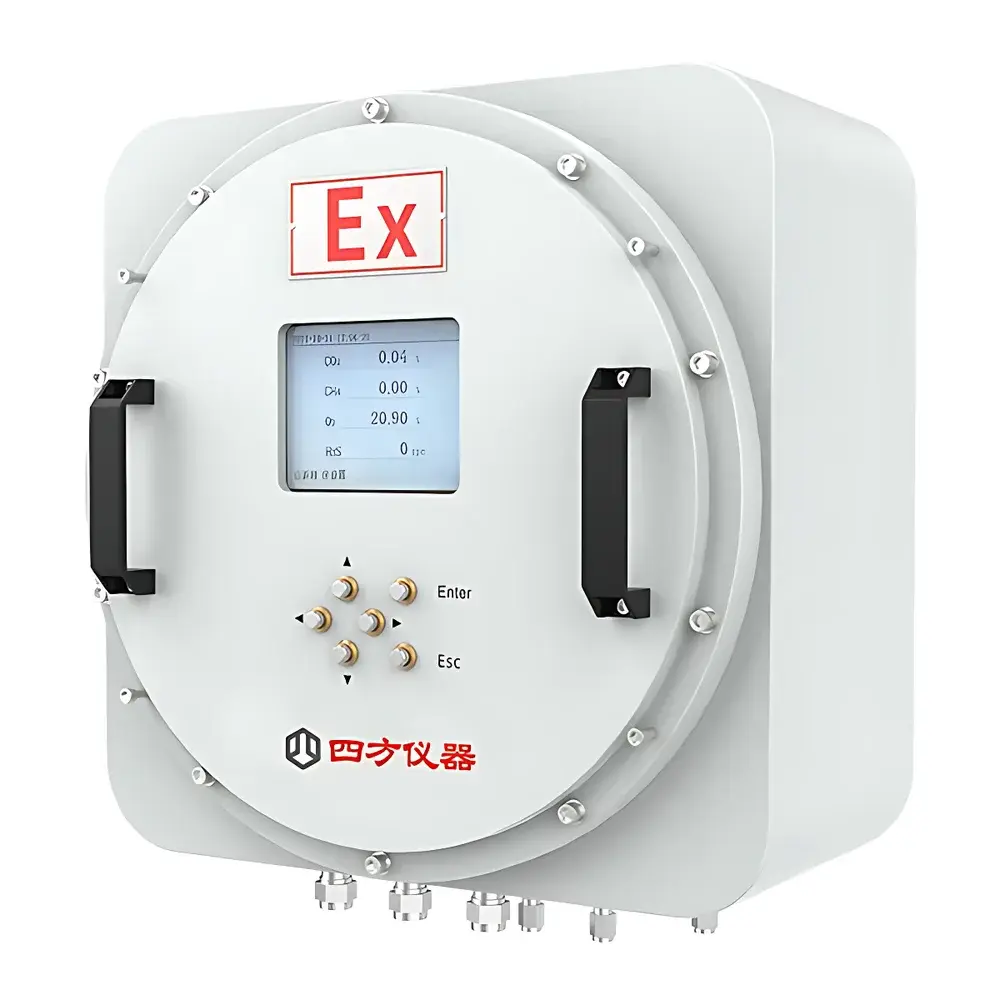
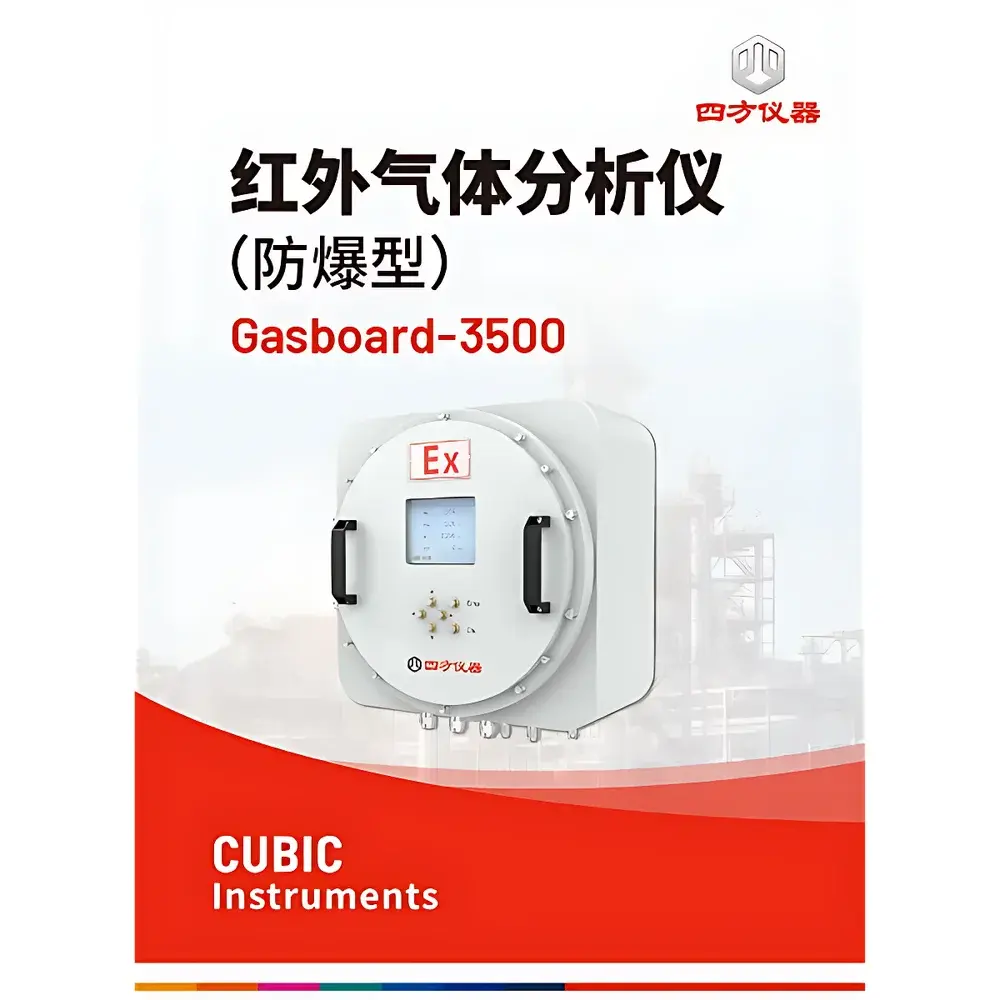
CUBIC Gasboard-3500 Intrinsically Safe Multicomponent Gas Analyzer for Biogas Fermentation Monitoring
| Brand | CUBIC INSTRUMENTS |
|---|---|
| Origin | Hubei, China |
| Model | Gasboard-3500 |
| Measurement Principle | Non-Dispersive Infrared (NDIR) & Electrochemical Detection (ECD) |
| Configuration | Fixed Online Analyzer |
| Response Time | T90 < 15 s (NDIR) |
| Repeatability | ≤2% FS |
| Measured Gases | CO, CO₂, CH₄, C₃H₈, O₂, H₂S |
| Explosion Protection Rating | Ex d IIC T6 / Ex tb IIIC T80°C Db |
| Output Interfaces | RS-485, RS-232, 4–20 mA, Ethernet |
| Power Supply | AC 220 V, 50 Hz |
| Sample Flow Rate | 0.7–1.2 L/min |
| Sample Pressure | 2–50 kPa |
| Display | LCD |
Overview
The CUBIC Gasboard-3500 is an intrinsically safe, fixed-position multicomponent gas analyzer engineered for continuous, real-time monitoring of biogas composition in anaerobic digestion, fermentation, and thermal decomposition processes. It integrates dual-sensing modalities: non-dispersive infrared (NDIR) spectroscopy for quantitative analysis of CO, CO₂, CH₄, and C₃H₈, and electrochemical detection (ECD) for selective measurement of O₂ and H₂S. This hybrid architecture ensures minimal cross-sensitivity between analytes—critical for accurate stoichiometric evaluation of microbial metabolic activity and process efficiency. Designed for deployment in hazardous locations classified under ATEX/IECEx Zone 1 and Zone 21, the instrument features a flameproof enclosure (Ex d IIC T6) and dust-ignition-proof construction (Ex tb IIIC T80°C Db), enabling reliable operation in biogas upgrading plants, wastewater treatment facilities, landfill gas recovery systems, and pilot-scale bioenergy research labs.
Key Features
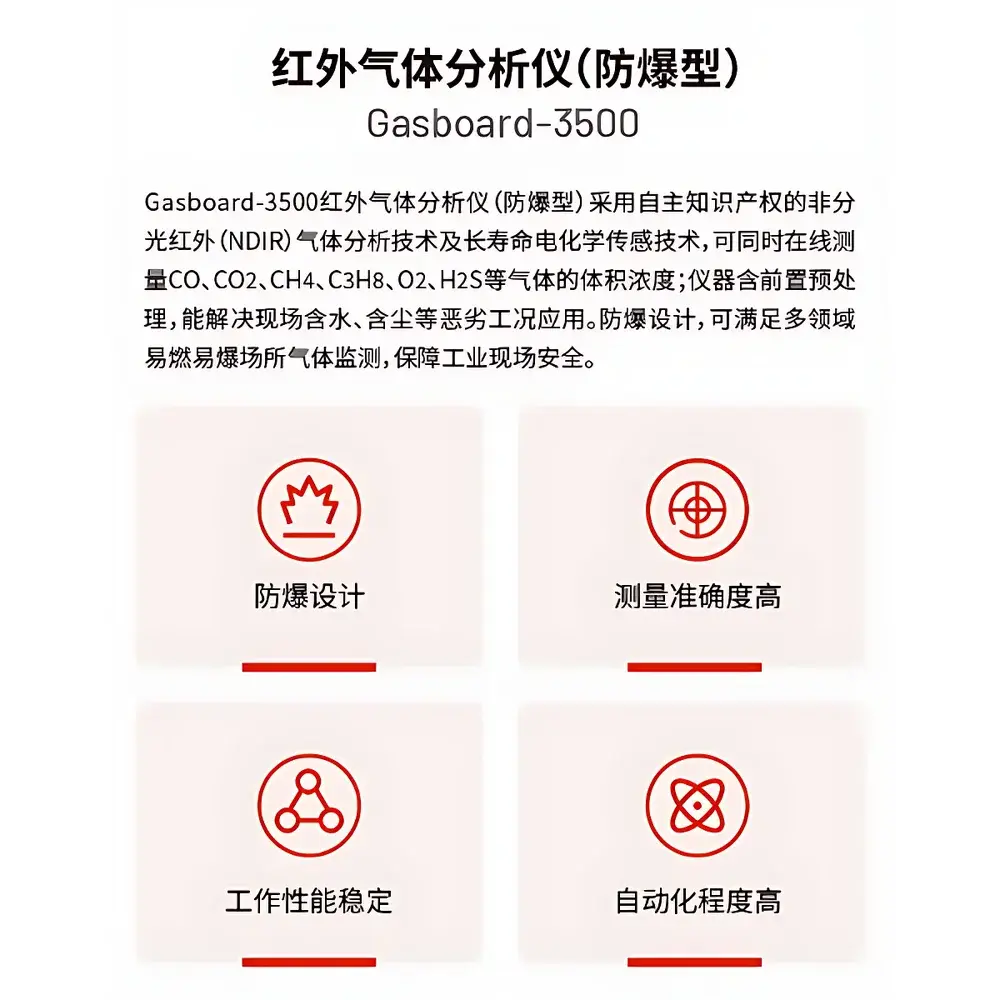
- Intrinsically safe and explosion-proof design compliant with IEC 60079-0, -1, and -31 standards—certified to Ex d IIC T6 and Ex tb IIIC T80°C Db for use in flammable gas and combustible dust environments.
- Dual-technology sensing platform: NDIR modules optimized for hydrocarbon and acid gas detection; ECD cells calibrated for O₂ and H₂S with temperature-compensated signal processing to maintain accuracy across ambient fluctuations.
- Integrated sample conditioning system featuring particulate filtration, condensate removal, and pressure regulation—enabling stable operation under high-humidity, high-dust conditions typical of raw biogas streams without external pre-treatment skids.
- Auto-zero function via built-in zero-air pump using ambient air as reference, eliminating need for bottled calibration gases during routine operation; supports periodic span verification per ISO 14644-1 and EN 14181 QA/QC protocols.
- Robust sensor architecture with dual-channel signal processing for drift compensation; wetted parts constructed from 316L stainless steel and PTFE to resist corrosion from H₂S, organic acids, and condensate.
- High-reliability industrial interface suite: isolated 4–20 mA analog outputs, Modbus RTU over RS-485, ASCII protocol over RS-232, and Ethernet-enabled TCP/IP communication for integration into DCS, SCADA, or cloud-based asset management platforms.
Sample Compatibility & Compliance
The Gasboard-3500 is validated for direct analysis of untreated or mildly conditioned biogas containing up to 70% relative humidity and particulate loadings ≤5 mg/m³. Its NDIR optical path employs gold-coated reflective chambers and thermoelectrically stabilized detectors to mitigate water vapor interference—particularly critical for CO₂ and CH₄ quantification in moist fermentation off-gas. All measurement channels meet repeatability requirements per ISO 6145-1 (gas mixture preparation) and performance criteria outlined in EPA Method 3A and ASTM D1945 for hydrocarbon gas analysis. The device supports GLP-compliant data integrity through timestamped event logging, sensor health diagnostics, and configurable audit trails—fully compatible with FDA 21 CFR Part 11 requirements when deployed with validated software infrastructure.
Software & Data Management
Local operation is managed via a backlit monochrome LCD with intuitive menu navigation supporting real-time concentration display, alarm status, and diagnostic codes. Remote configuration, firmware updates, and historical data retrieval are enabled via embedded web server or Modbus TCP. Data export supports CSV and XML formats with UTC timestamps and measurement uncertainty metadata. When integrated into enterprise-level environmental monitoring systems, the analyzer provides structured telemetry aligned with ISA-95 Level 0–2 data models—facilitating automated reporting for regulatory submissions (e.g., EU Directive 1999/32/EC, US Clean Air Act Subpart HH). Optional OPC UA server module enables secure interoperability with MES and digital twin platforms.
Applications
- Real-time biogas quality control in municipal wastewater treatment plants—tracking CH₄/CO₂ ratio to optimize digester loading rate and hydraulic retention time.
- Process safety monitoring in anaerobic co-digestion facilities handling agricultural waste, food residues, and sewage sludge—detecting CO accumulation and H₂S breakthrough before reaching occupational exposure limits (OSHA PEL: 20 ppm).
- Thermal value calculation (HHV/LHV) based on measured CH₄, CO, H₂, and CO₂ concentrations—supporting compliance with EN 15440 and ISO 6976 for biomethane injection into natural gas grids.
- Research-grade gas profiling in academic laboratories conducting kinetic studies of methanogenic archaea or syntrophic bacterial consortia under varying substrate compositions.
- Continuous emissions monitoring (CEM) for combustion feed gas in combined heat and power (CHP) units—ensuring stoichiometric air-to-fuel ratios and minimizing NOₓ formation.
FAQ
What certifications does the Gasboard-3500 hold for hazardous area installation?
It carries full ATEX and IECEx certification: Ex d IIC T6 Gb for gas atmospheres and Ex tb IIIC T80°C Db for combustible dust environments—validating suitability for Zone 1 and Zone 21 installations.
Can the analyzer operate without external sample conditioning?
Yes—the integrated preprocessor handles dew point suppression, particulate filtration, and pressure stabilization, permitting direct connection to raw biogas lines with inlet moisture content up to 90% RH.
How is measurement traceability maintained for regulatory reporting?
Each unit ships with factory calibration certificates traceable to NIST SRMs; on-site verification follows ISO 17025-accredited procedures using certified gas standards, with full audit logs stored internally for GLP/GMP review.
Is remote firmware update supported?
Yes—secure over-the-air (OTA) updates are delivered via HTTPS or Modbus TCP, preserving configuration integrity and supporting version-controlled change management per IEC 62443-3-3.
What maintenance intervals are recommended for long-term stability?
Sensor verification every 6 months and optical path cleaning annually; no consumables required beyond standard filter replacement every 3–6 months depending on site particulate load.
Related Products







