
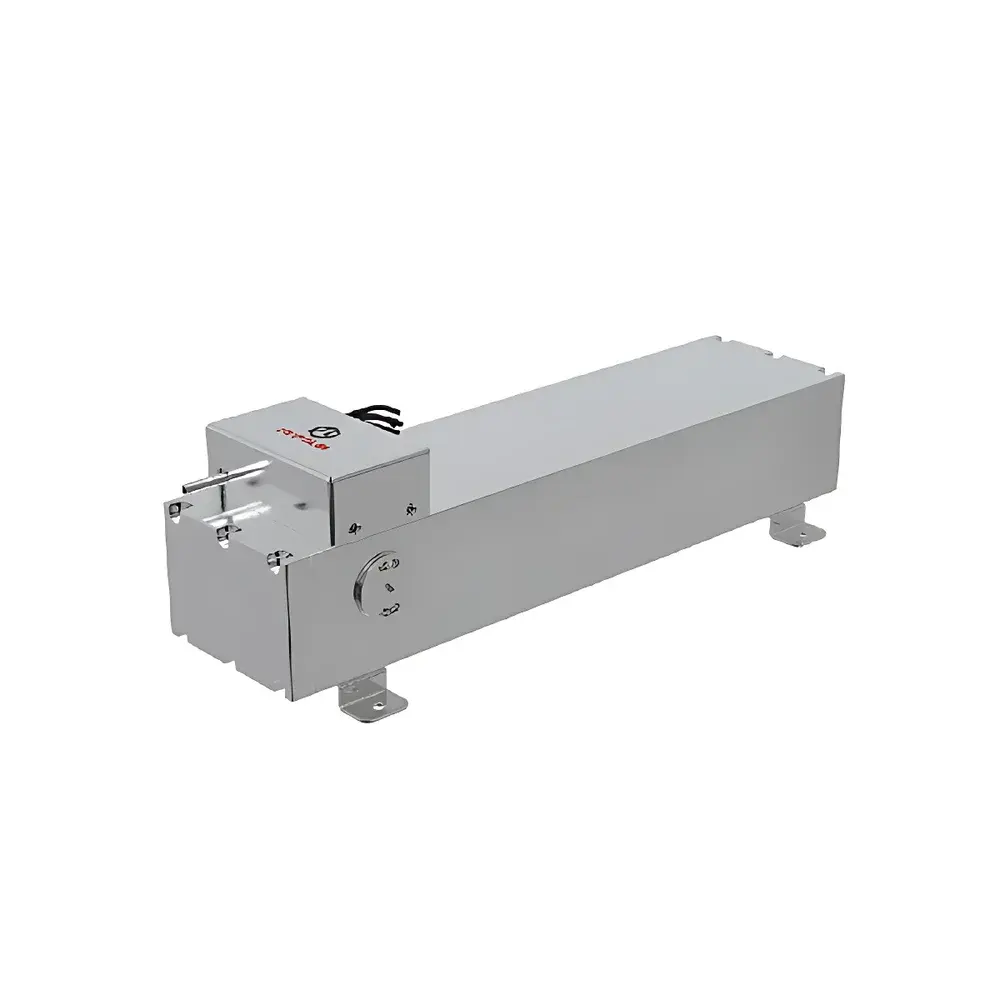
CUBIC INSTRUMENTS Gasboard-2502 TDLAS-Based Laser Methane Sensor Module
| Brand | CUBIC INSTRUMENTS |
|---|---|
| Origin | Hubei, China |
| Model | Gasboard-2502 |
| Instrument Type | Online |
| Detection Principle | Tunable Diode Laser Absorption Spectroscopy (TDLAS) |
| Target Analyte | CH₄ |
| Measurement Range | 0–1000 ppm |
| Resolution | 0.1 ppm |
| Accuracy | ±(5 ppm + 2% of reading) |
| Warm-up Time | <10 s |
| Operating Temperature | −20 °C to +60 °C |
| Relative Humidity | 0–98% RH (non-condensing) |
| Operating Pressure | 80–120 kPa |
| Supply Voltage | 3.2–5.5 VDC |
| Current Consumption | <100 mA (@25 °C, 3.3 V) |
| Communication Interface | TTL (3.3 V logic level) |
| Dimensions (L×W×H) | 278 × 97 × 84 mm |
| Storage Conditions | −40 °C to +85 °C, 0–98% RH (non-condensing) |
Overview
The CUBIC INSTRUMENTS Gasboard-2502 is a compact, OEM-ready laser methane sensor module engineered for continuous, real-time CH₄ monitoring in industrial, environmental, and safety-critical applications. It employs Tunable Diode Laser Absorption Spectroscopy (TDLAS), a physics-based optical detection method that exploits the unique near-infrared absorption line of methane at ~1653 nm. Unlike electrochemical or catalytic bead sensors, TDLAS delivers inherent selectivity—eliminating cross-sensitivity to CO₂, H₂O vapor, CO, VOCs, and particulate-laden atmospheres. The module integrates a temperature-stabilized distributed feedback (DFB) laser diode, a high-finesse multi-pass gas cell with proprietary anti-fouling surface treatment, and an embedded microcontroller running adaptive temperature compensation algorithms. This architecture ensures stable baseline performance across wide ambient fluctuations, enabling reliable operation in unconditioned field enclosures, biogas pipelines, landfill wellheads, and urban natural gas distribution networks.
Key Features
- High-selectivity TDLAS detection with zero interference from water vapor, carbon dioxide, hydrogen sulfide, or common hydrocarbons
- Sub-ppm resolution (0.1 ppm) and metrologically traceable accuracy of ±(5 ppm + 2% of reading) over full 0–1000 ppm range
- Ultra-fast thermal stabilization: functional measurement capability achieved within <10 seconds after power-on
- Robust mechanical design featuring IP65-rated housing, corrosion-resistant internal optics mount, and condensation-resistant optical path geometry
- Low-power operation (<100 mA @ 3.3 V) optimized for battery-backed or solar-powered remote deployments
- Modular footprint (278 × 97 × 84 mm) with standardized TTL serial interface (3.3 V logic) supporting factory calibration, zero/span adjustment, and diagnostic readout
- No consumables, no moving parts, no periodic sensor replacement—designed for >5-year operational lifetime under continuous duty
Sample Compatibility & Compliance
The Gasboard-2502 is validated for direct sampling of ambient air, process gas streams, and low-pressure vent emissions without external conditioning—provided gas temperature remains within operating limits and condensate formation is prevented. Its optical path is insensitive to particulate loading up to ISO 12103-1 A4 dust concentration levels. While not certified to ATEX or IECEx standards in its base configuration, the module complies with CE marking requirements for electromagnetic compatibility (EN 61326-1) and low-voltage directive (2014/35/EU). When integrated into certified system-level enclosures, it supports compliance with EPA Method 21 (leak detection), ISO 19880-1 (hydrogen fueling station safety), and EN 16873 (biogas quality monitoring). Data integrity aligns with GLP principles through onboard non-volatile memory storing calibration history, firmware version, and cumulative operational hours.
Software & Data Management
The module communicates via asynchronous UART (TTL-level) at configurable baud rates (default 115200 bps), transmitting ASCII-formatted data packets containing CH₄ concentration, internal temperature, laser drive current, signal-to-noise ratio (SNR), and status flags. CUBIC provides a Windows-based PC utility for initial setup, field recalibration using certified reference gases, and firmware updates. For system integrators, comprehensive AT-command documentation and open-source Python/C++ driver libraries are available under NDA. All calibration events—including date, operator ID, reference gas lot number, and deviation metrics—are logged with timestamp and stored in write-protected EEPROM, satisfying audit trail requirements per FDA 21 CFR Part 11 when deployed in regulated biogas upgrading or landfill LFG recovery facilities.
Applications
- Continuous leak detection along natural gas transmission mains and city distribution grids
- Real-time CH₄ concentration monitoring in biogas upgrading plants (pre-/post-membrane separation)
- Landfill gas extraction wellhead screening and flare efficiency verification
- Indoor air quality (IAQ) monitoring in agricultural facilities (e.g., dairy barns, manure storage)
- OEM integration into portable survey instruments, UAV-mounted gas mappers, and fixed-area perimeter monitors
- Research-grade emission quantification in controlled environmental chambers and soil flux studies
FAQ
Does the Gasboard-2502 require zero gas or span gas for routine operation?
No—its TDLAS architecture eliminates the need for periodic zero/span calibration under stable environmental conditions. However, annual verification against NIST-traceable CH₄ standard gas is recommended for regulatory reporting.
Can the module operate in high-humidity environments without desiccant or sample drying?
Yes—the optical design incorporates water vapor spectral rejection and active dew-point compensation; validated performance up to 98% RH (non-condensing) without external dryers.
Is analog output (e.g., 4–20 mA) available?
Not natively—the module outputs digital TTL serial data only. System integrators may add external DAC modules compliant with IEC 61000-6-2 immunity standards.
What is the maximum allowable gas flow rate through the sample chamber?
Recommended flow rate is 0.5–2.0 L/min. Excessive velocity (>3 L/min) may induce pressure-induced spectral broadening and reduce measurement stability.
How is long-term drift managed over the 5-year service life?
Drift is mitigated via dual-wavelength referencing, real-time laser wavelength lock to methane’s absorption peak, and on-board thermal modeling that corrects for cavity length variation with temperature.
Related Products







