
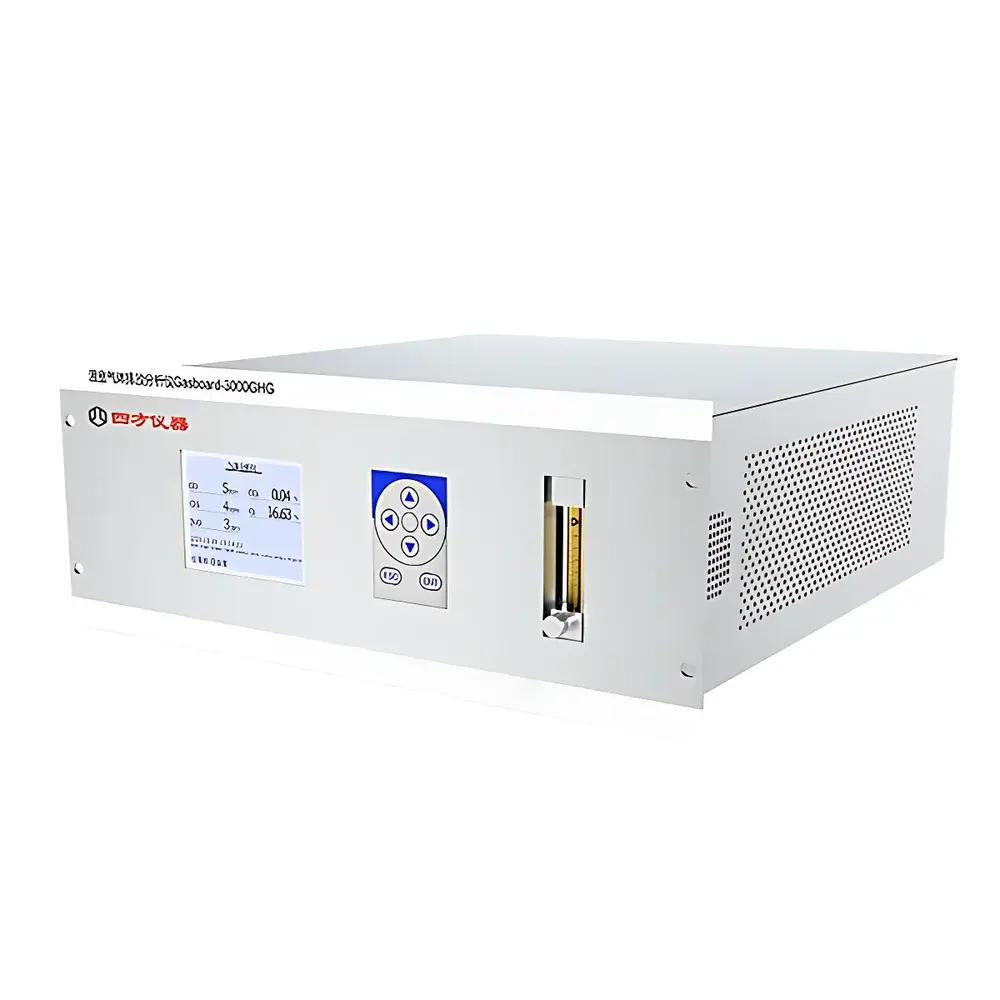
CUBIC INSTRUMENTS Gasboard-3000GHG Online Greenhouse Gas Analyzer
| Brand | CUBIC INSTRUMENTS |
|---|---|
| Origin | Hubei, China |
| Model | Gasboard-3000GHG |
| Instrument Type | Online Analyzer |
| Detection Principle | Micro-flow NDIR & Dual-beam NDIR (CO₂/CH₄/N₂O/CO), Electrochemical (O₂) |
| Measured Gases | CO₂, CH₄, N₂O, CO, O₂ |
| CH₄ Range | 0–1000 ppm, Resolution: 1 ppm |
| Repeatability | ≤ ±1% F.S. |
| Accuracy | ±1% F.S. (micro-flow NDIR), ±2% F.S. (dual-beam NDIR & ECD) |
| Response Time (T90) | < 25 s |
| Sample Flow Rate | 0.7–1.2 L/min |
| Inlet Pressure | 2–50 kPa |
| Power Supply | 100–240 VAC, max 300 W (heating), stable 100 W |
| Output | RS-485/RS-232, 4–20 mA |
Overview
The CUBIC INSTRUMENTS Gasboard-3000GHG is a high-integrity, online multi-gas analyzer engineered for continuous, real-time quantification of key greenhouse and combustion-related gases—including carbon dioxide (CO₂), methane (CH₄), nitrous oxide (N₂O), carbon monoxide (CO), and oxygen (O₂)—in industrial flue gas, biogas, landfill emissions, and ambient monitoring applications. Its core measurement architecture integrates two complementary infrared technologies: proprietary micro-flow non-dispersive infrared (NDIR) sensing—protected under international patent PCT/CN2018100767—and dual-beam NDIR, both optimized to deliver high specificity and low cross-sensitivity in complex, humid, and particulate-laden sample streams. Unlike conventional single-beam NDIR systems, the micro-flow design employs a patented “split-chamber” reference configuration within a single optical path, enabling intrinsic compensation for thermal drift, moisture-induced absorption artifacts, and source intensity fluctuations. This architecture ensures long-term baseline stability (< ±1% F.S. repeatability over 30 days) without requiring frequent zero/span calibration—a critical advantage for unattended operation in remote or hazardous environments.
Key Features
- Simultaneous, real-time analysis of up to five gases (CO₂, CH₄, N₂O, CO, O₂) in a single compact chassis
- Micro-flow NDIR channels for CH₄ (0–1000 ppm), N₂O (0–1000 ppm), and low-range CO₂ (0–500 ppm), each with 1 ppm resolution and ±1% F.S. accuracy
- Dual-beam NDIR modules for high-concentration CO₂ (0–100%) and mid-to-high range CO (0–5%), delivering ±2% F.S. accuracy with enhanced immunity to optical contamination
- Electrochemical O₂ sensor (0–25%, 0.01% resolution) compliant with ISO 7213 and ASTM D1946 for combustion efficiency assessment
- Integrated sample conditioning: built-in particulate filter (≤1 µm), condensate trap, and pressure-regulated inlet (2–50 kPa)
- Full diagnostic suite with real-time sensor health monitoring, fault logging, and self-calibration verification per IEC 61508 SIL 2 functional safety guidelines
- Dual-output interface: isolated 4–20 mA analog channels + RS-485 Modbus RTU for seamless integration into DCS, SCADA, or EPA-compliant CEMS platforms
Sample Compatibility & Compliance
The Gasboard-3000GHG is validated for use with hot, wet, and particulate-laden flue gases following standard pretreatment (cooling to <40 °C, removal of liquid water, filtration to <1 µm). It meets the physical and operational requirements of EPA Method 3A (CO₂, O₂), Method 10 (CO), and ISO 14064-3 Annex B for GHG emission quantification. While not certified to UL 61010-1 or ATEX as a standalone unit, its modular sensor architecture allows integration into explosion-proof enclosures (e.g., Class I, Div 2) when deployed in refineries or chemical plants. The system supports GLP-aligned data integrity protocols, including timestamped raw signal logs, operator audit trails, and configurable alarm thresholds—all traceable to NIST-traceable calibration standards.
Software & Data Management
The analyzer operates with embedded firmware supporting local configuration via web-based GUI (HTTPS-enabled) and remote supervision through optional CUBIC CloudLink™ software. All measurements are time-stamped with UTC synchronization (NTP-compatible) and stored onboard (≥30 days at 1-min intervals). Data export complies with EPA 40 CFR Part 75 Appendix B formatting for electronic reporting to regulatory portals. For laboratory-grade validation, the system provides raw detector voltage outputs and temperature-compensated absorbance ratios—enabling third-party algorithmic reprocessing per ASTM D6522 or ISO 13861. Audit logs record all parameter changes, calibration events, and firmware updates in accordance with FDA 21 CFR Part 11 requirements for electronic records and signatures.
Applications
- Continuous Emissions Monitoring Systems (CEMS) for coal-fired power plants, cement kilns, and waste incinerators under EU Directive 2010/75/EU and China’s GB 13223–2011
- Biogas upgrading control in anaerobic digesters and landfill gas recovery facilities (CH₄ purity verification per ISO 11564)
- Process optimization in nitric acid and adipic acid production—where N₂O abatement is mandated by the Kyoto Protocol and UNFCCC reporting frameworks
- Stack testing for fugitive methane emissions in oil & gas upstream operations (EPA OOOOa compliance support)
- Research-grade flux measurements in eddy covariance towers and soil respiration chambers
FAQ
What gas detection principles does the Gasboard-3000GHG employ?
It uses micro-flow NDIR for low-concentration CH₄, N₂O, and CO₂; dual-beam NDIR for high-range CO₂ and CO; and electrochemical sensing for O₂.
Is the analyzer suitable for humid flue gas without external drying?
Yes—the micro-flow NDIR architecture incorporates inherent moisture interference suppression; however, sample gas must be free of liquid condensate and filtered to ≤1 µm.
Can the instrument meet EPA or EU regulatory reporting requirements?
It supports data formatting and traceability needed for EPA 40 CFR Part 75 and EU MRV reporting, though final certification requires site-specific QA/QC validation per EN 15267.
What maintenance intervals are recommended for long-term field deployment?
Optical components require no routine cleaning; annual verification against NIST-traceable span gases and quarterly zero checks are recommended per ISO 14064-3 guidance.
Does the system support remote firmware updates and diagnostics?
Yes—via secure HTTPS web interface or Modbus TCP, with rollback capability and cryptographic signature verification.
Related Products







