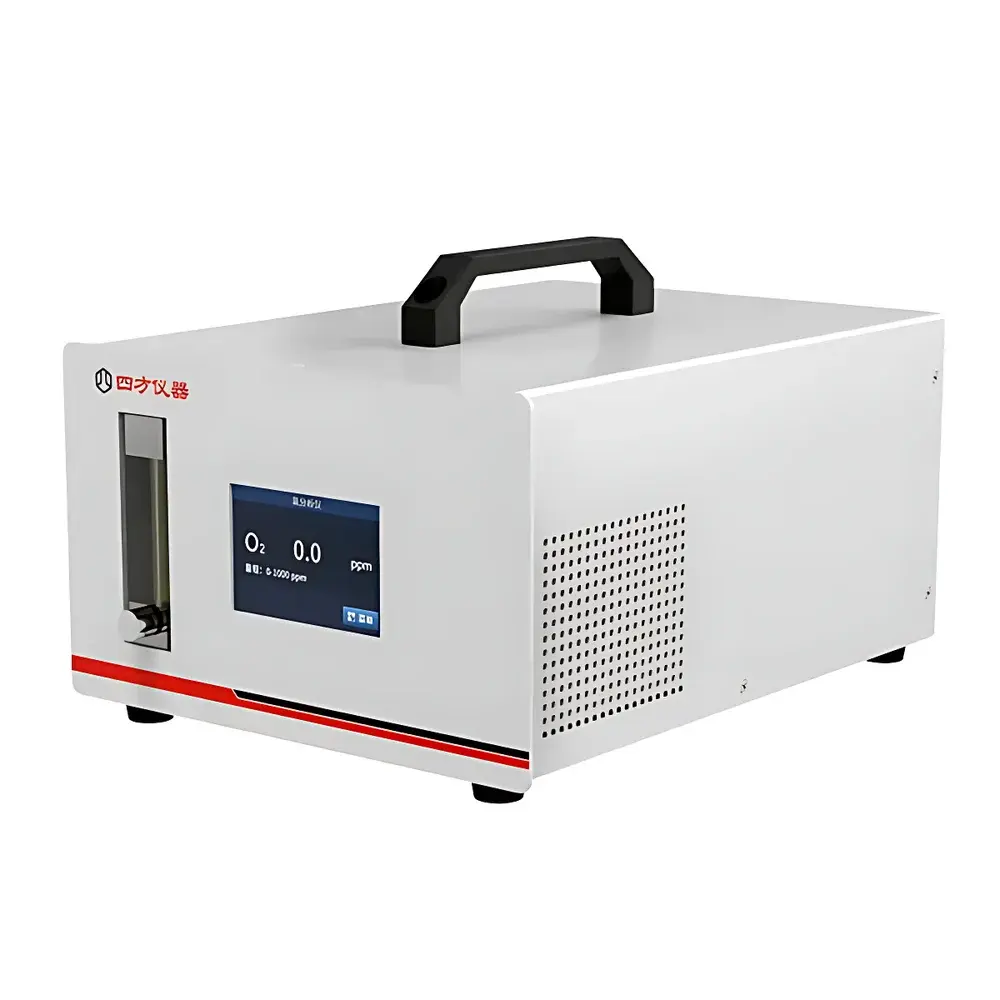
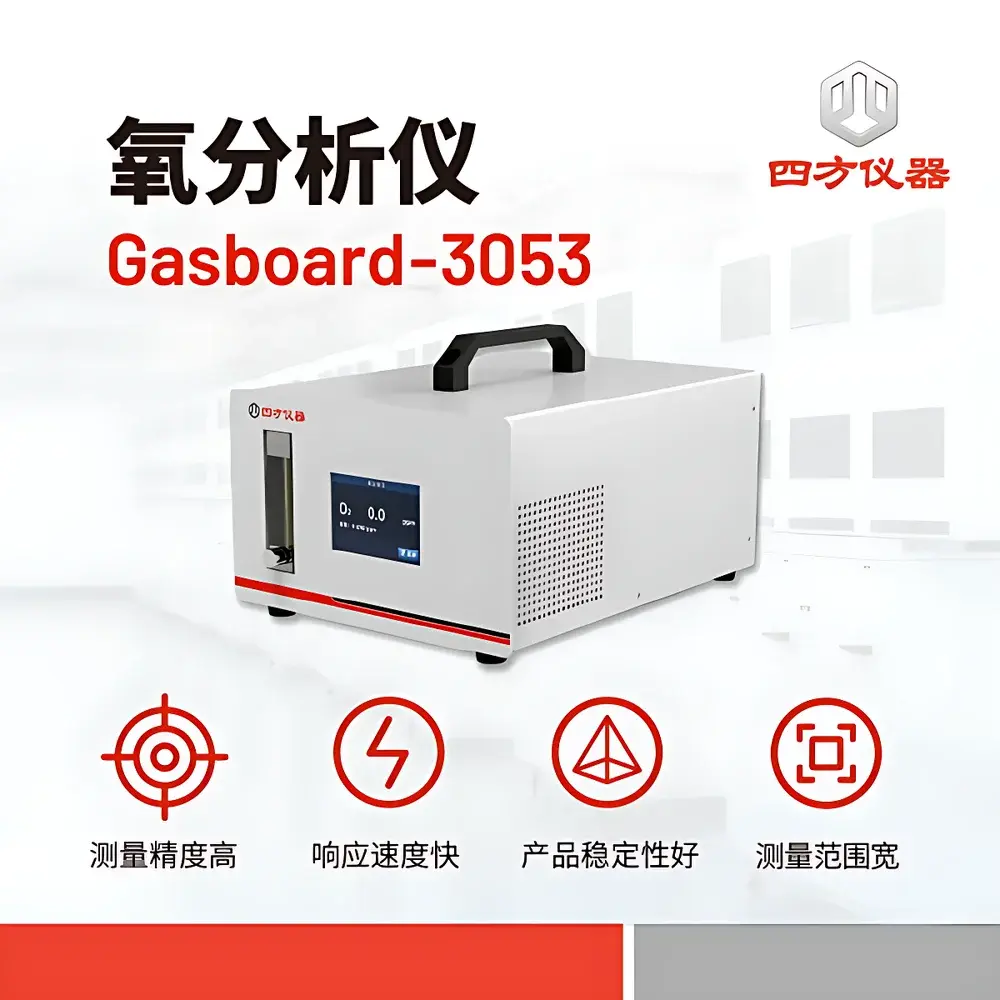
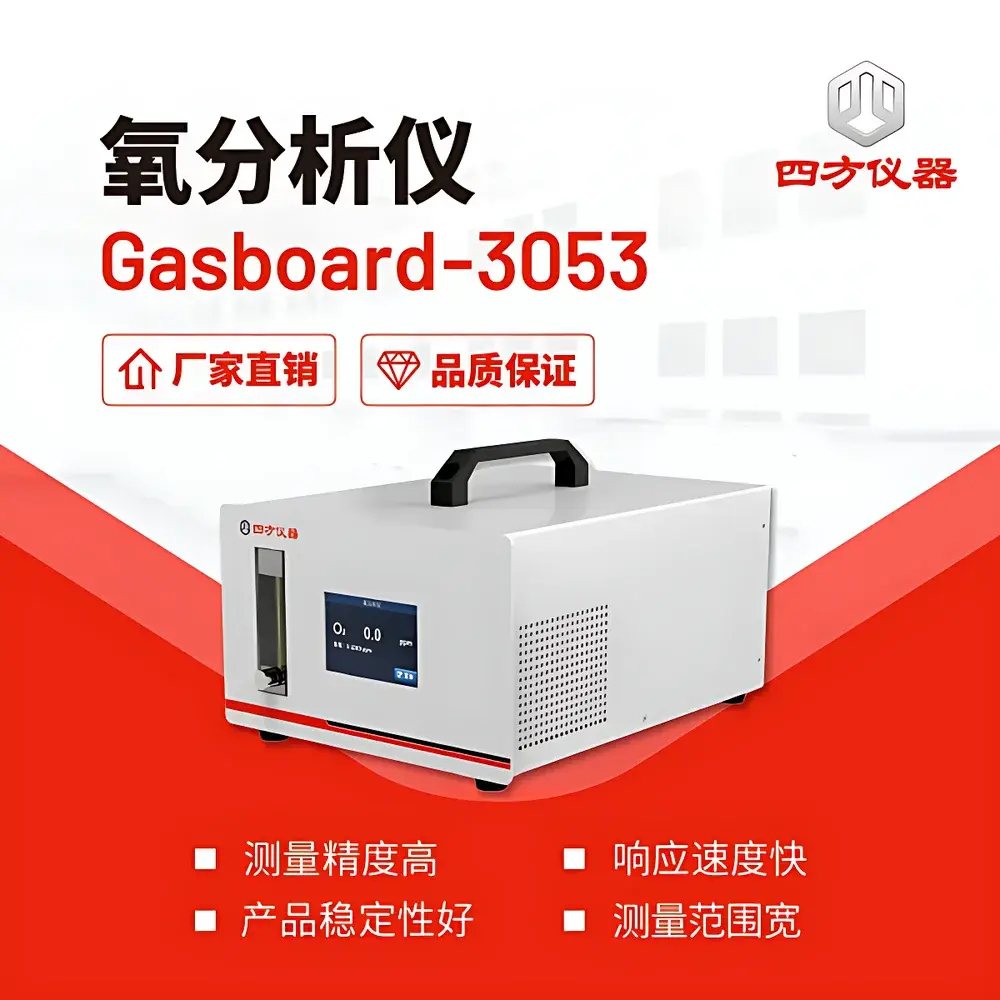
CUBIC INSTRUMENTS Gasboard-3053 Zirconia-Based Oxygen Analyzer for Semiconductor Manufacturing, Air Separation & Inert Gas Welding
| Brand | CUBIC INSTRUMENTS |
|---|---|
| Origin | Hubei, China |
| Manufacturer Type | Authorized Distributor |
| Country of Origin | China |
| Model | Gasboard-3053 |
| Measurement Range | 0–10 / 0–100 / 0–1000 ppm & 0–25% O₂ (auto-ranging) |
| LOD | 0.5 ppm |
| Resolution | 0.1 ppm |
| Accuracy | ≤±2% F.S. or ±0.5 ppm (whichever is greater) |
| T90 Response Time | ≤10 s |
| Warm-up Time | ≤20 min |
| Zero Drift | ±0.5% F.S. |
| Span Drift | ±0.5% F.S. |
| Repeatability | ±0.5% F.S. |
| Sampling Flow | 0.5–1 L/min |
| Communication | RS-232, RS-485 |
| Gas Interface | 1/4″ VCR-F (inlet & outlet) |
| Dimensions (L×W×D) | 210×134×300 mm |
| Operating Temp. | 0–50 °C |
| Humidity | 0–95% RH (non-condensing) |
Overview
The CUBIC INSTRUMENTS Gasboard-3053 is a high-performance, zirconia-based electrochemical oxygen analyzer engineered for continuous, real-time measurement of oxygen concentration across an exceptionally wide dynamic range—from trace-level detection at 0.5 ppm up to 25% volume fraction. Its core sensing element utilizes a stabilized yttria-doped zirconium oxide (YSZ) solid electrolyte operating on the principle of oxygen partial pressure-driven ion conduction, enabling Nernst-equation-based quantification with inherent thermodynamic stability and long-term baseline integrity. Designed specifically for mission-critical environments in semiconductor fabrication, air separation units (ASUs), inert gas supply systems, and high-purity welding processes, the Gasboard-3053 delivers metrologically traceable performance compliant with process control requirements under ISO 8573-1 (compressed air purity), ASTM D6299 (precision and bias in analytical instrumentation), and industry-aligned validation protocols for GMP-relevant gas monitoring. The analyzer’s compact, fully integrated architecture eliminates external pump dependencies and reduces calibration frequency—key advantages in cleanroom-integrated tooling and distributed plant monitoring networks.
Key Features
- Zirconia sensor platform with dual-range auto-switching capability (ppm and % O₂), eliminating manual range selection errors and ensuring optimal signal-to-noise ratio across full operational span.
- Integrated sampling system including a precision mass-flow-controlled internal pump and multi-stage particulate filtration (0.1 µm rated), minimizing maintenance intervals and protecting sensor integrity in dusty or condensate-prone gas streams.
- True plug-and-play deployment: factory-calibrated with documented calibration certificate; powered via standard 24 VDC input; configured via intuitive front-panel interface or remote serial command set (ASCII protocol over RS-232/RS-485).
- Robust mechanical design conforming to IP54 ingress protection; aluminum alloy housing with ESD-safe finish suitable for Class 100–1000 cleanroom proximity zones.
- On-board diagnostics including sensor health monitoring, flow verification, temperature compensation logging, and fault-code reporting—supporting predictive maintenance planning per ISO 13374 standards.
Sample Compatibility & Compliance
The Gasboard-3053 is validated for use with non-corrosive, dry-to-moderately humid gas matrices including nitrogen, argon, helium, hydrogen, and synthetic air. It is incompatible with reducing gases containing >10 ppm H₂S, Cl₂, or halogenated hydrocarbons, which may poison the zirconia electrode surface. For semiconductor applications, it meets the gas purity monitoring requirements specified in SEMI F57 (specifications for bulk gases) and supports audit readiness for FDA 21 CFR Part 11-compliant data handling when paired with validated SCADA or MES integration. All firmware and calibration records are timestamped and support GLP/GMP audit trails. Electrical safety complies with IEC 61010-1; electromagnetic compatibility conforms to IEC 61326-1 (industrial environment class).
Software & Data Management
While the Gasboard-3053 operates autonomously via its embedded controller, it supports bidirectional ASCII communication for integration into centralized process monitoring platforms. Standard Modbus RTU mapping is available upon request for PLC interoperability. Raw analog output (4–20 mA, isolated) and digital serial outputs enable redundant signal routing. Data logging is performed internally at user-defined intervals (1 s to 60 min), with storage capacity for ≥30 days of minute-level measurements. Export functionality supports CSV format via USB host port for offline trend analysis. Firmware updates are performed via secure signed binary upload, maintaining version control and rollback capability per ICH Q9 risk management principles.
Applications
- Semiconductor front-end manufacturing: real-time O₂ monitoring in purge lines feeding lithography steppers, etch chambers, and CVD/PVD tools—ensuring sub-1 ppm residual oxygen to prevent native oxide regrowth on silicon wafers.
- Air separation plants: continuous verification of product nitrogen or argon purity downstream of cryogenic distillation columns and membrane skids.
- Inert gas welding & brazing: closed-loop feedback control of shielding gas composition in automated TIG/MIG systems, especially for titanium and reactive alloy fabrication.
- Vacuum glovebox and dry room ambient monitoring: long-term stability tracking of <1 ppm O₂ levels during battery electrode coating, OLED encapsulation, and moisture-sensitive material handling.
- High-purity gas cylinder certification: verification of certified grade (e.g., Grade 5.0 or 6.0) prior to delivery to end-user facilities.
FAQ
What is the recommended calibration frequency for the Gasboard-3053 in semiconductor-grade nitrogen monitoring?
For GMP-aligned operations, quarterly zero/span calibration using NIST-traceable certified gases (e.g., 1 ppm O₂ in N₂ and zero-grade N₂) is recommended. Daily zero checks using certified zero gas are advised where process criticality exceeds ISO 8573-1 Class 1 requirements.
Can the Gasboard-3053 be installed directly in-line with a vacuum glovebox exhaust line?
Yes—provided the sample stream is depressurized to atmospheric or slightly positive pressure and filtered to remove oil mist or polymer outgassing byproducts. A dedicated pressure-regulating bypass is required if inlet pressure exceeds 150 kPa abs.
Does the instrument support analog output scaling to match legacy DCS input ranges?
Yes—the 4–20 mA output is fully configurable for any linear span within the instrument’s measurement range (e.g., 0–10 ppm = 4–20 mA) via serial command or front-panel menu.
Is the zirconia sensor replaceable in the field without specialized tools?
Yes—the sensor module is designed as a snap-in cartridge with pre-aligned thermal and electrical interfaces; replacement can be completed in under 5 minutes without soldering or alignment fixtures.
How does the built-in flow control compensate for variable upstream pressure?
An integrated laminar flow element and proportional solenoid valve maintain constant 0.8 L/min sampling flow across inlet pressures from 80–200 kPa, ensuring consistent diffusion kinetics and measurement repeatability per ISO 10724-1.