
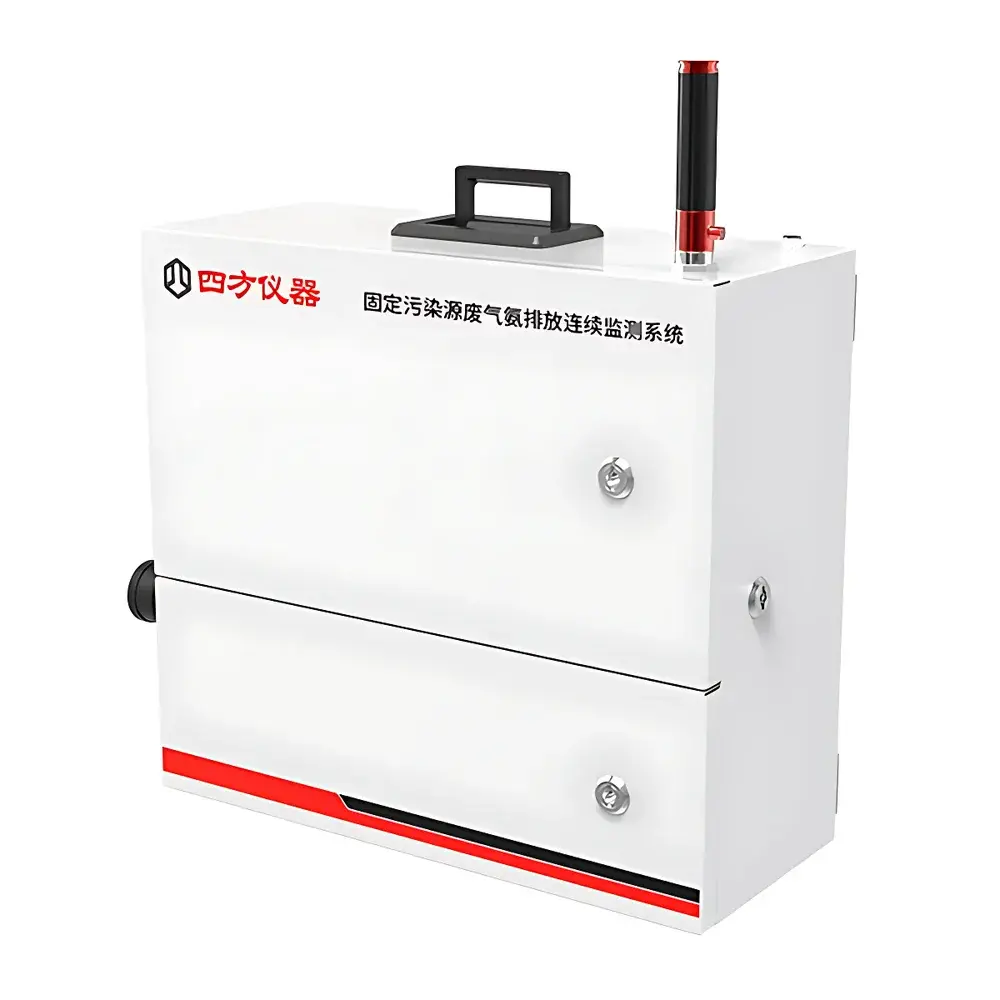
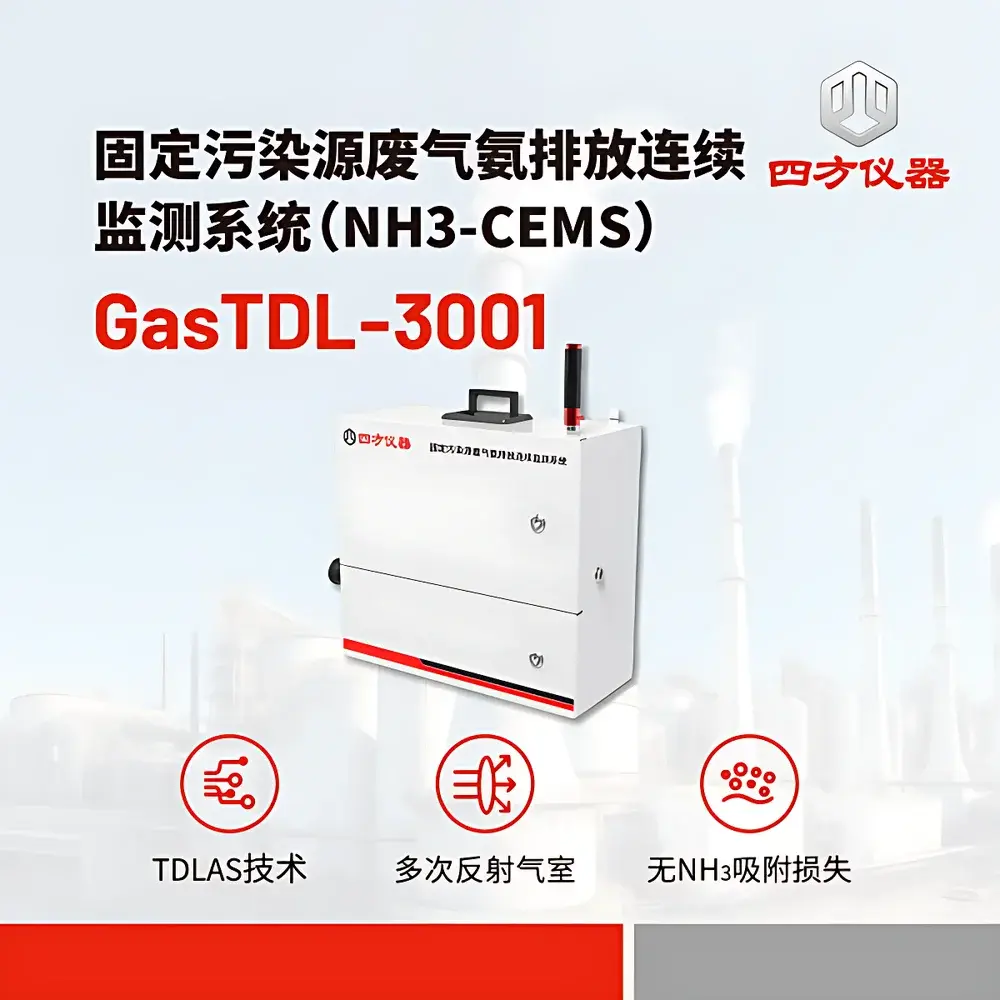
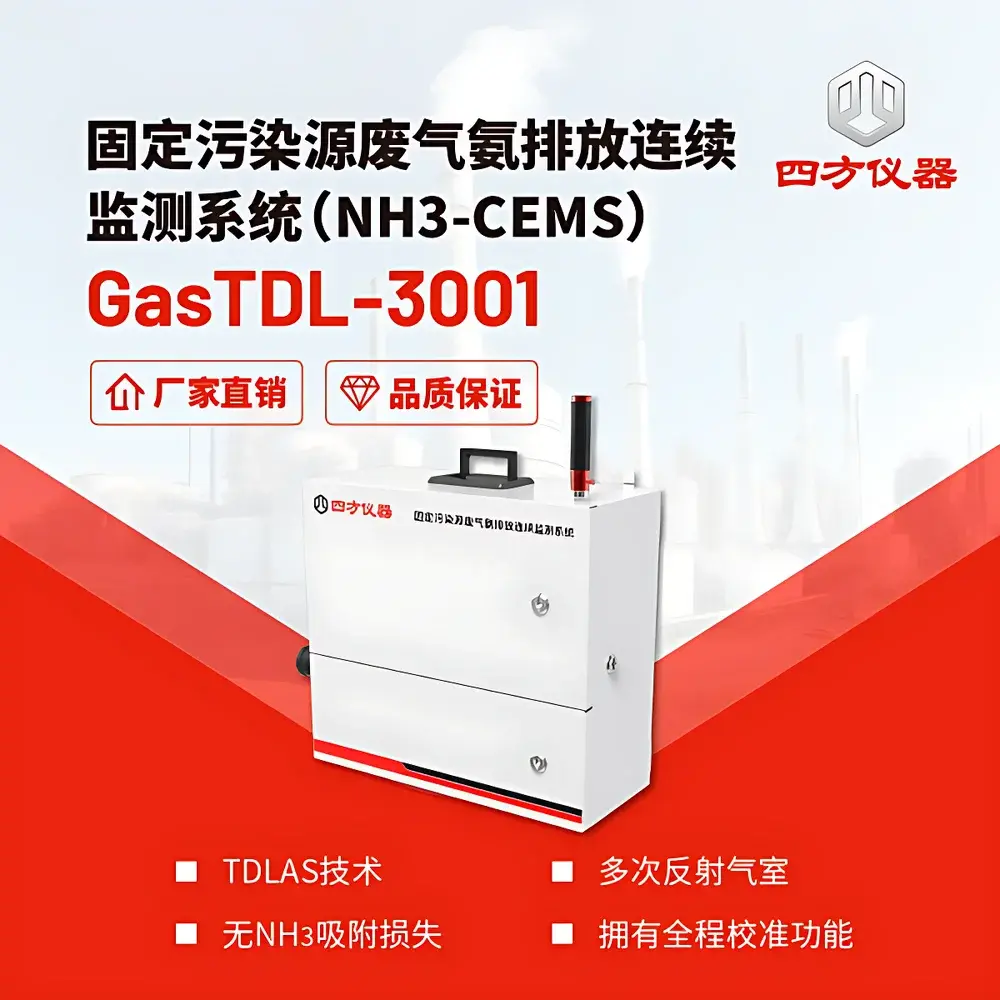
CUBIC INSTRUMENTS GasTDL-3001 Ammonia Slip Online Monitoring System for Coal-Fired Power Plant SCR DeNOₓ Systems
| Brand | CUBIC INSTRUMENTS |
|---|---|
| Origin | Hubei, China |
| Model | GasTDL-3001 |
| Detection Principle | Tunable Diode Laser Absorption Spectroscopy (TDLAS) |
| Sampling Method | In-situ |
| Measurement Range | 0–10–100 ppm (selectable) |
| Accuracy | ±1% of Full Scale (F.S.) |
| Response Time (T90) | ≤30 s |
| Repeatability | ±1% F.S. |
| Operating Ambient Temperature | −30 to +60 °C |
| Resolution | 0.01 ppm |
| Detection Limit | ±1% F.S. |
| IP Rating | IP65 or higher |
| Power Supply | 220 VAC, 50 Hz, 800 W |
| Purge Air | 0.4–0.8 MPa compressed air |
| Communication | 1× RS-232, 1× RS-485 |
| Analog Outputs | 4× 4–20 mA |
| Digital Outputs | 8× relay |
Overview
The CUBIC INSTRUMENTS GasTDL-3001 Ammonia Slip Online Monitoring System is an industrial-grade, in-situ gas analyzer engineered for continuous, real-time quantification of ammonia (NH₃) concentration downstream of selective catalytic reduction (SCR) systems in coal-fired power plants. It employs Tunable Diode Laser Absorption Spectroscopy (TDLAS), a physics-based optical technique that exploits the unique near-infrared absorption fingerprint of NH₃ molecules at specific wavelengths (e.g., ~1512 nm or ~2200 nm). Unlike extractive NDIR or electrochemical sensors, TDLAS enables direct, interference-free measurement through the process gas stream—eliminating sampling delays, condensation artifacts, and cross-sensitivity to CO₂, H₂O, SO₂, or NOₓ commonly encountered in flue gas matrices. The system is configured for in-situ installation across the duct wall, with optical path alignment maintained via robust kinematic mounts and temperature-stabilized laser modules. Its design complies with the fundamental metrological requirements of continuous emission monitoring systems (CEMS) as referenced in EN 15267-3, ISO 14956, and US EPA Performance Specification 18 (PS-18) for NH₃ slip measurement.
Key Features
- In-situ optical configuration eliminates sample transport lines, reducing maintenance burden and eliminating NH₃ adsorption losses on wetted surfaces.
- High-temperature heated optical probe and beam path (≥180 °C) prevent ammonium bisulfate (ABS) deposition and NH₃ condensation—critical for stable operation in low-temperature SCR exit zones.
- Multi-pass absorption cell integrated into the probe head enhances effective path length, achieving sub-ppm detection limits (0.01 ppm resolution) within the 0–10–100 ppm selectable range.
- Full-system calibration capability—including zero, span, and linearity verification—using certified NH₃ standard gases traceable to NIST or equivalent national standards.
- Robust mechanical architecture rated IP65 or higher, qualified for outdoor mounting on steel ductwork under ambient conditions ranging from −30 °C to +60 °C.
- Real-time compensation for pressure and temperature fluctuations via integrated PT sensors, ensuring stoichiometric accuracy per Beer–Lambert law derivation.
Sample Compatibility & Compliance
The GasTDL-3001 is validated for use in high-dust, high-moisture, and thermally dynamic flue gas environments typical of post-SCR ducts (typically 250–400 °C upstream, cooled to 120–180 °C at measurement point). Its non-contact optical measurement principle renders it immune to particulate fouling, corrosion, or sensor poisoning. All wetted materials—including quartz windows, Inconel probe body, and PTFE-sealed fittings—meet ASTM G155 and ISO 9223 compatibility guidelines for aggressive sulfur-rich atmospheres. The system supports compliance with Chinese HJ 75-2017 and HJ 76-2017 CEMS technical specifications, and its data structure and audit trail capabilities align with GLP/GMP-aligned data integrity expectations, including timestamped calibration logs and event-driven alarm records.
Software & Data Management
Embedded firmware provides local data acquisition at 1 Hz sampling rate, with onboard storage for ≥30 days of 1-minute averaged records. Communication interfaces include RS-232 (for service diagnostics) and RS-485 (Modbus RTU protocol) for integration into DCS/SCADA platforms. Four isolated 4–20 mA analog outputs support connection to plant-wide control systems, while eight programmable relay outputs enable automated responses—for example, triggering SCR reagent injection adjustment or maintenance alerts upon deviation thresholds. Optional software package offers remote configuration, spectral diagnostics, drift trending analysis, and export in CSV/Excel format compliant with ISO/IEC 17025 documentation requirements.
Applications
- Continuous NH₃ slip monitoring at SCR reactor outlet ducts in coal-, biomass-, and waste-to-energy-fired boilers.
- Optimization of ammonia injection grid distribution to minimize unreacted NH₃ while maintaining NOₓ removal efficiency >90%.
- Supporting regulatory reporting under national emissions trading schemes (e.g., China’s National Carbon Market) and environmental impact assessments (EIAs).
- Preventive maintenance guidance by correlating NH₃ slip trends with catalyst aging, soot blower performance, and boiler load profiles.
- Validation of CFD modeling assumptions related to NH₃ mixing uniformity and residence time distribution in ductwork.
FAQ
Does the GasTDL-3001 require periodic replacement of consumables such as filters or sensors?
No—this is a solid-state optical system with no consumable optical components, electrochemical cells, or replaceable membranes. Only routine cleaning of optical windows (typically every 6–12 months depending on dust loading) is recommended.
Can the system operate reliably in high-humidity flue gas (>15% v/v H₂O)?
Yes—the TDLAS measurement algorithm applies water vapor spectral subtraction in real time using co-located H₂O reference lines, ensuring NH₃ quantification remains unaffected by moisture content.
Is third-party certification available for regulatory acceptance?
CUBIC INSTRUMENTS provides factory-issued test reports aligned with HJ 76-2017 and can support site-specific validation per EN 14181 QAL1/QAL2 protocols upon request.
How is zero drift corrected during extended unattended operation?
The system supports automated zero calibration cycles using clean purge air (filtered and dried), triggered on schedule or manually via Modbus command—without interrupting measurement continuity.
What cybersecurity provisions are included for network-connected deployments?
Firmware includes configurable password protection, disabled default credentials, and read-only access mode for data retrieval—meeting baseline IEC 62443-3-3 Level 1 requirements for industrial instrumentation.







