
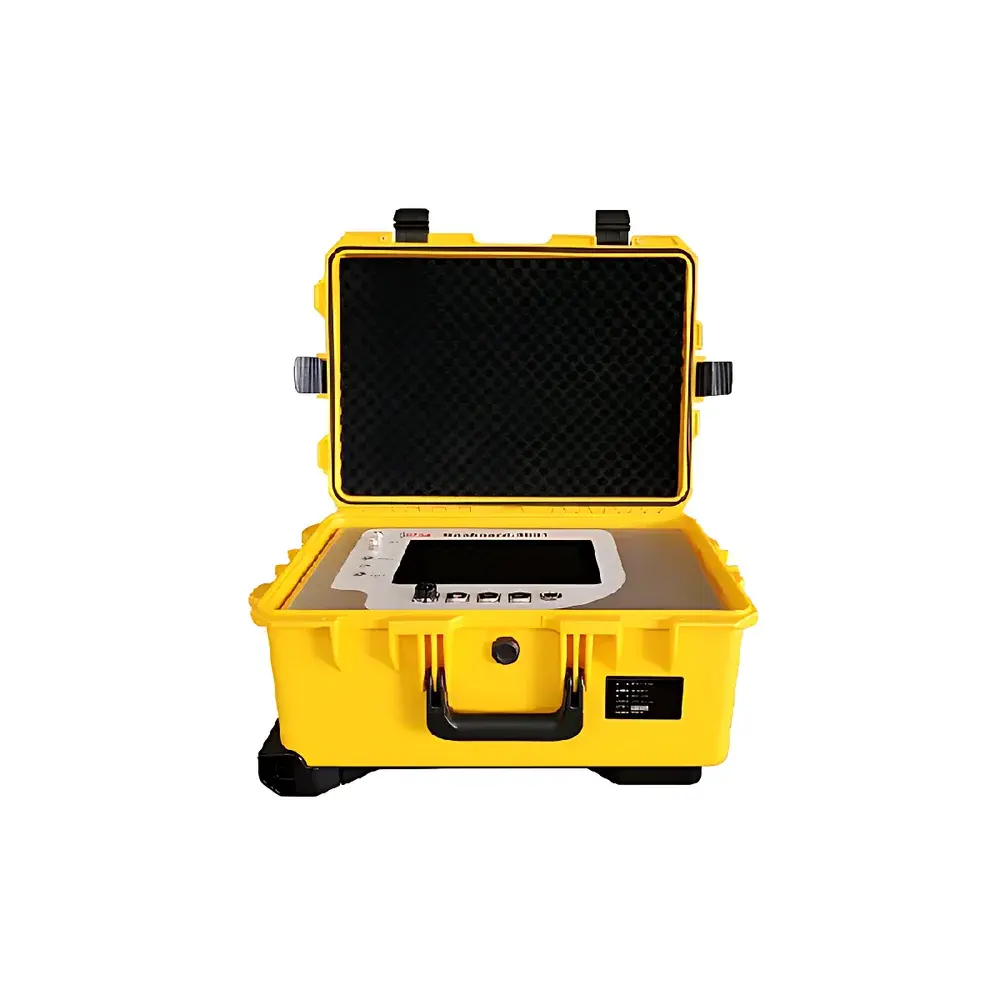
CUBIC INSTRUMENTS High-Precision Vehicle-Mounted Methane Emission Detection System
| Brand | CUBIC INSTRUMENTS |
|---|---|
| Origin | Hubei, China |
| Instrument Type | Portable |
| Measured Species | CH₄, C₂H₆ |
| Optical Path Configuration | Sealed Absorption Cell |
| Detection Limit (CH₄) | <100 ppb |
| Detection Limit (C₂H₆) | <15 ppb |
| Data Acquisition Rate | 10–20 Hz |
| Included Accessories | GNSS Positioning System (BeiDou-compatible), Ultrasonic Anemometer |
| Compliance Context | Designed for field-deployable ambient air monitoring per EPA Method 21 principles and ISO 13864:2022 guidance on mobile gas leak detection |
Overview
The CUBIC INSTRUMENTS High-Precision Vehicle-Mounted Methane Emission Detection System is an integrated mobile monitoring platform engineered for real-time, road-based quantification of atmospheric methane (CH₄) and ethane (C₂H₆) concentrations. It operates on the principle of tunable diode laser absorption spectroscopy (TDLAS) within a sealed optical cell configuration—ensuring stable baseline performance, minimal environmental interference, and high spectral selectivity for hydrocarbon species. Unlike open-path or extractive systems susceptible to particulate contamination or pressure/temperature drift, this sealed-cell architecture delivers consistent measurement integrity under dynamic vehicular conditions—including variable vibration, ambient temperature gradients (−20 °C to +50 °C operational range), and transient airflow. The system is deployed on standard passenger or light-duty utility vehicles, enabling systematic surveying of urban distribution networks, landfill perimeters, biogas facility boundaries, and natural gas transmission corridors. Its primary function is not only leak localization but also concentration-based emission rate estimation when coupled with wind vector data and vehicle kinematics.
Key Features
- High-sensitivity dual-species detection: Simultaneous quantification of CH₄ and C₂H₆ at sub-100 ppb (CH₄) and sub-15 ppb (C₂H₆) detection limits, supporting source discrimination (e.g., fossil vs. biogenic methane via C₂H₆/CH₄ ratio analysis)
- Real-time georeferenced data acquisition: Integrated BeiDou GNSS module provides sub-3 m horizontal positioning accuracy (CEP), synchronized with 10–20 Hz spectral sampling for spatially resolved plume mapping
- Onboard meteorological compensation: Co-located ultrasonic anemometer measures 3D wind speed (0.01–60 m/s) and direction (±1° resolution), enabling flux calculation using the integrated Gaussian dispersion model embedded in firmware
- Zero-drift optical design: Thermally stabilized sealed absorption cell eliminates need for frequent field calibration; factory calibration traceable to NIST-certified gas standards
- Robust data interface architecture: Dual Ethernet (RJ45), RS-485, CAN bus, and optional 4G/LTE modem support interoperability with fleet telematics and central SCADA systems
- Domestically developed software stack: Linux-based onboard controller with encrypted local storage and TLS 1.2-secured remote data upload—designed to meet data sovereignty requirements for national environmental monitoring programs
Sample Compatibility & Compliance
The system is validated for continuous ambient air sampling without pre-concentration or chemical scrubbing. It complies with core methodological expectations outlined in EPA OTM-33A (Mobile Monitoring of Fugitive Emissions) and aligns with ISO 13864:2022 for mobile gas detection instrumentation. While not certified as a Class I, Division 1 hazardous area device, its ingress protection rating (IP65) ensures reliable operation in rain, dust, and roadside particulate environments. All firmware and data handling protocols adhere to GLP-aligned audit trail requirements: timestamps are hardware-synchronized, raw spectra are stored with metadata (GPS fix quality, IMU orientation, cell temperature), and no post-acquisition data editing is permitted in the native file format (.cubbin). Exported CSV/NetCDF files retain full provenance tags for regulatory submission.
Software & Data Management
The system ships with CUBIC’s proprietary FieldSync Suite—a desktop and web-accessible platform supporting real-time telemetry dashboards, automated plume detection algorithms (based on adaptive thresholding and spatial clustering), and batch-mode emission rate calculation using the integrated wind-assisted mass balance method. Raw spectral logs are archived in HDF5 format with embedded calibration coefficients and instrument health diagnostics. Software supports export to EPA’s GHGRP-compatible XML schema and EU MRV reporting templates. Audit logging meets 21 CFR Part 11 readiness: user authentication, electronic signatures for report generation, and immutable session records. Remote firmware updates are digitally signed and verified prior to installation.
Applications
- Urban natural gas distribution network integrity assessment
- Landfill and wastewater treatment plant fugitive emission quantification
- Biogas upgrading facility methane slip monitoring
- Oil & gas midstream compressor station perimeter screening
- Regulatory compliance surveys under China’s “Methane Action Plan” and EU Methane Strategy reporting obligations
- Academic research on atmospheric hydrocarbon speciation and transport modeling
FAQ
Is the system suitable for stationary monitoring applications?
Yes—it can be configured for tripod-mounted or fixed-site deployment with external power and weather shielding; however, its calibration and drift performance are optimized for mobile use cases.
Does it require periodic span gas verification during field operation?
No. The sealed TDLAS cell exhibits <0.5% signal drift over 72 hours at constant temperature; annual factory recalibration is recommended per ISO/IEC 17025 guidelines.
Can C₂H₆ data be used to distinguish thermogenic from microbial methane sources?
Yes. The system’s dual-species capability enables real-time C₂H₆/CH₄ ratio computation, a widely accepted tracer for distinguishing fossil fuel emissions (typically >0.01) from biogenic sources (often <0.001).
What level of technical support is provided for international users?
CUBIC offers English-language documentation, remote diagnostics via secure SSH, and application engineering consultation aligned with ISO 14064-3 and IPCC Tier 2 methodology frameworks.







