
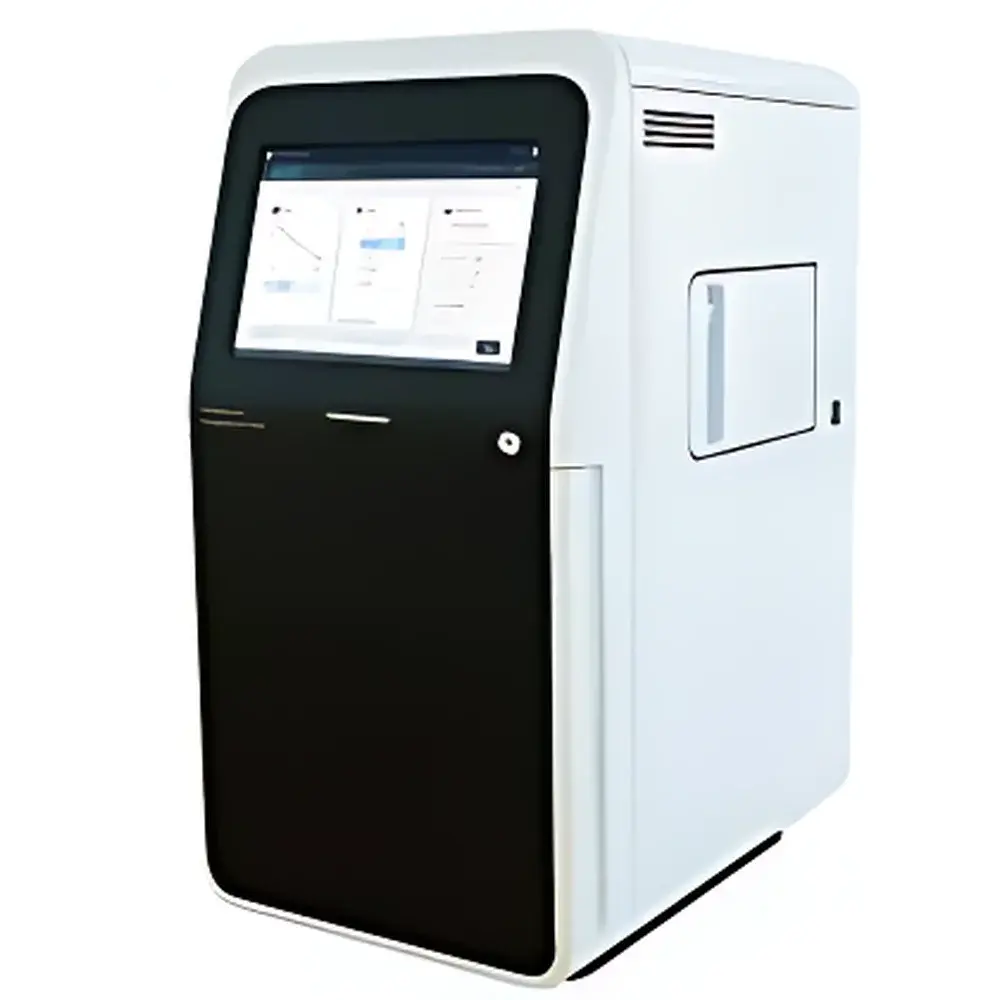
Cytiva Amersham ImageQuant 800 Chemiluminescence Imager
| Brand | Cytiva |
|---|---|
| Origin | USA |
| Model | AI800 |
| Imaging Sensor | 8.3 MP cooled CCD |
| Lens | F0.74 fixed-focus科研级镜头 |
| SNOW™ Mode | Real-time signal-to-noise optimization algorithm |
| Light Sources | 7-channel LED fluorescence excitation (365–740 nm) |
| Sample Compatibility | Gels, blots, multiwell plates, Petri dishes, membranes |
| Software | ImageQuant TL with remote access capability |
| Compliance | Designed for GLP/GMP-aligned workflows, audit-trail enabled via ImageQuant TL v10.3+ |
Overview
The Cytiva Amersham ImageQuant 800 Chemiluminescence Imager is a high-performance, cooled charge-coupled device (CCD)-based detection platform engineered for quantitative molecular imaging in life science laboratories. It operates on the principle of photon capture from chemiluminescent, fluorescent, and white-light-emitting samples—enabling precise densitometric analysis of proteins, nucleic acids, and cellular biomarkers. Unlike intensified or EMCCD systems, the AI800 employs a thermoelectrically cooled, back-illuminated CCD sensor (8.3 megapixels) optimized for low-light sensitivity and linear dynamic range (>4.8 OD), making it suitable for both routine Western blot validation and high-stringency publication-grade data acquisition. Its optical architecture integrates a proprietary F0.74 fixed-focus lens with enhanced broadband transmittance glass, delivering superior light throughput across UV–visible–NIR wavelengths without mechanical focusing drift—critical for reproducible inter-run comparisons.
Key Features
- SNOW™ (Signal-to-Noise Optimization Watch) real-time acquisition mode: captures sequential low-dose exposures, dynamically selects optimal frames, and suppresses background noise without saturation—eliminating guesswork in exposure time selection.
- F0.74 ultra-fast fixed-focus lens: minimizes optical aberration and maximizes photon collection efficiency; eliminates focus calibration drift during multi-day experiments or temperature fluctuations.
- 7-channel programmable LED illumination system: covers 365 nm to 740 nm with discrete peak wavelengths; supports standard fluorophores (e.g., Cy2, Cy3, Cy5, IRDye 680/800, Alexa Fluor series) and enables custom spectral configuration via user-inserted side-access filter trays.
- Modular sample stage with NP (Near-Parfocal) lens integration: accommodates gels (up to 25 × 25 cm), nitrocellulose/PVDF membranes, 6–384-well plates, Petri dishes (up to 100 mm), and thick-section tissue slides—without manual repositioning or adapter swaps.
- Cooled CCD sensor operating at –25 °C: reduces dark current by >90% vs. ambient sensors, enabling long-exposure chemiluminescence detection with sub-femtogram sensitivity for horseradish peroxidase (HRP) and alkaline phosphatase (AP) substrates.
Sample Compatibility & Compliance
The AI800 supports standardized sample formats defined under ISO 15195 (clinical laboratory testing), ASTM E2573 (gel documentation), and USP (fluorescence quantification). Its uniform illumination field and pixel-level flat-field correction ensure compliance with FDA 21 CFR Part 11 requirements when used with ImageQuant TL v10.3 or later—supporting electronic signatures, role-based access control, and full audit trail logging for raw image metadata, acquisition parameters, and post-processing steps. All hardware components are CE-marked and RoHS-compliant; the system is validated for use in ISO 17025-accredited QC labs and GLP-regulated preclinical studies.
Software & Data Management
ImageQuant TL software provides instrument control, automated exposure optimization, background subtraction, band/spot quantification, and publication-ready figure export (TIFF, PNG, PDF). Remote access functionality allows secure web-based monitoring and queue management via HTTPS-authenticated connections—enabling core facility staff to schedule runs across time zones. Raw image files (.IMGQ) retain embedded EXIF metadata (exposure time, binning, lens ID, temperature) and support batch reprocessing with version-controlled algorithms. Integration with LabArchives ELN and Thermo Fisher Cloud enables direct upload of quantified results with traceable provenance.
Applications
- Western blot quantification with HRP/AP chemiluminescence: achieves linear response over 4 orders of magnitude for total protein normalization and phosphorylation ratio analysis.
- Fluorescent multiplex immunodetection: simultaneous dual-color imaging using near-infrared dyes with minimal crosstalk due to spectral deconvolution algorithms.
- Nucleic acid gel documentation: ethidium bromide, SYBR Safe, and GelRed-stained DNA/RNA gels with auto-thresholding and lane profiling.
- Cell-based assays: quantification of luciferase reporter activity in 96-well plates, colony formation assays, and live-cell viability staining (Calcein AM/PI).
- High-content screening support: time-lapse macro-imaging of organoid cultures and spheroids in 6–24-well plates under controlled ambient conditions.
FAQ
Does the AI800 support time-resolved luminescence or bioluminescence imaging?
Yes—the system’s extended exposure range (0.1 ms to 60 min) and low-noise CCD architecture enable kinetic acquisition of firefly luciferase and NanoLuc signals in microplate format.
Can I upgrade the LED module after purchase?
Yes—Cytiva offers field-installable LED cartridge kits covering additional wavelengths (e.g., 405 nm deep-UV for DAPI, 505 nm for GFP); no recalibration required.
Is the SNOW™ algorithm compliant with ALPAC or ISO/IEC 17025 validation protocols?
SNOW™ is implemented as a deterministic frame-selection algorithm; its output is fully traceable and repeatable under identical acquisition settings—validated per ISO/IEC 17025:2017 Clause 7.7.1 for measurement uncertainty estimation.
What is the maximum supported file size for TIFF export?
Uncompressed 16-bit TIFFs up to 8300 × 6224 pixels (51.7 MB) are natively supported; lossless LZW compression reduces file size by ~45% without affecting quantification integrity.
Does ImageQuant TL support automated molecular weight marker alignment?
Yes—version 10.3+ includes AI-assisted lane detection and reference marker warping based on known ladder sequences (e.g., Precision Plus Protein Standards), with optional manual anchor-point correction.
Related Products




