
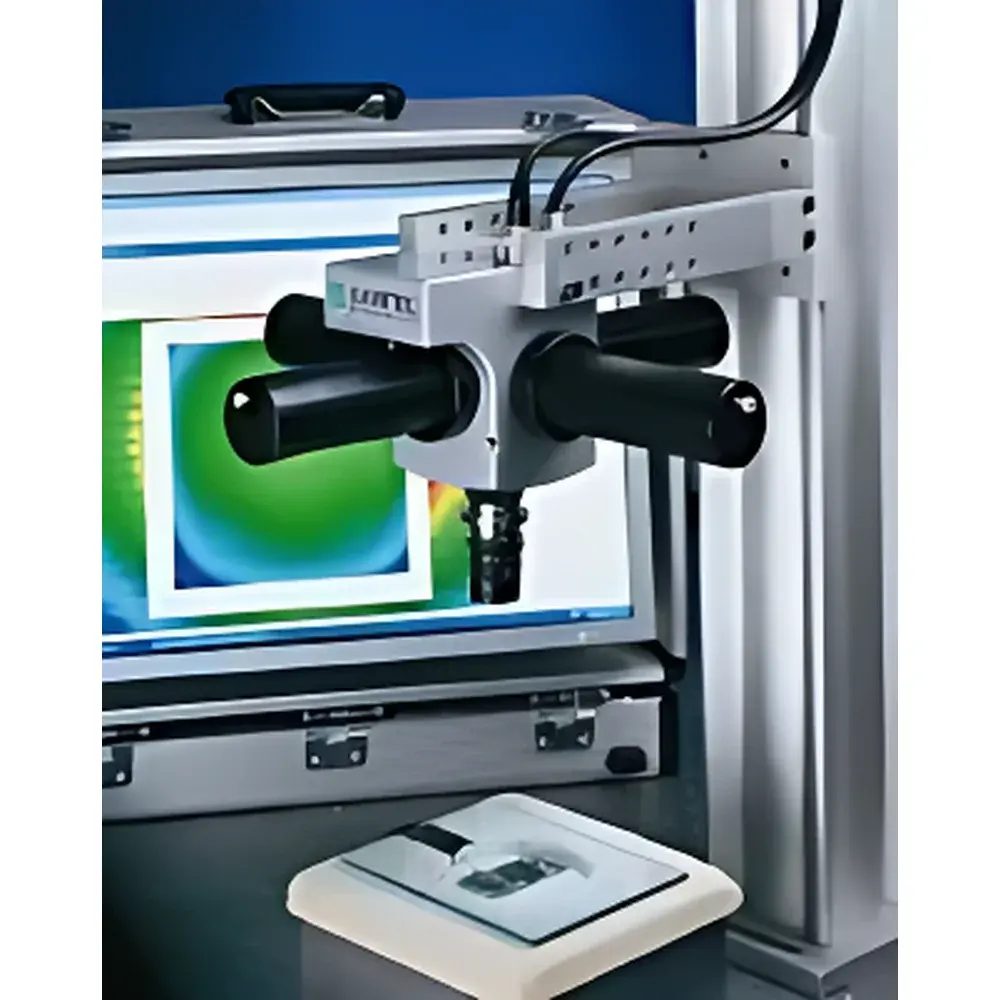
Dantec Q-300 TCT ESPI Electronic Speckle Pattern Interferometry System for Thermal Expansion Analysis
| Brand | Dantec |
|---|---|
| Origin | Germany |
| Model | Q-300 TCT |
| Measurement Dimensions | 1D/2D/3D |
| Measurable Area | 0.7 mm × 1 mm to 40 mm × 50 mm |
| Displacement Resolution | 0.01–0.1 µm (adjustable) |
| Strain Range | 0.005%–100% |
| Heating Capability | Up to 300 °C, 200 W power, ramp rate 30 °C/min |
Overview
The Dantec Q-300 TCT ESPI system is a high-sensitivity, non-contact optical metrology platform engineered for full-field, real-time quantification of thermally induced dimensional changes in solid materials. Based on Electronic Speckle Pattern Interferometry (ESPI), the instrument exploits coherent laser illumination to generate time-resolved speckle interference patterns from the surface of a test specimen. Small phase shifts—induced by thermal expansion, mechanical loading, or vibration—are encoded as fringe displacements within the recorded speckle field. These fringes are digitally processed to reconstruct quantitative displacement vectors (u, v, w) and derived strain components (εxx, εyy, γxy) across the entire illuminated area. Unlike point-wise techniques such as LVDTs or strain gauges, ESPI delivers spatially continuous data without surface preparation or sensor attachment—critical for fragile, high-temperature, or geometrically complex samples. The Q-300 TCT integrates a precision temperature-controlled stage with active heating up to 300 °C, enabling controlled thermal cycling while maintaining sub-micron interferometric stability.
Key Features
- True three-dimensional displacement mapping via dual-beam or multi-angle ESPI configurations, supporting both in-plane and out-of-plane deformation analysis.
- Adjustable displacement sensitivity: selectable resolution from 0.01 µm to 0.1 µm per fringe order, optimized for low-strain creep studies or large-deformation thermal buckling.
- Thermally isolated optical path design with active vibration damping, ensuring phase stability during extended thermal ramping (up to 30 °C/min).
- Modular heating stage with PID-controlled 200 W resistive element, calibrated temperature feedback, and thermal shielding compatible with vacuum or inert gas environments.
- High-frame-rate CMOS imaging (≥120 fps at full resolution) synchronized with laser pulse timing and thermal controller triggers for transient event capture.
- Integrated reference arm stabilization using piezoelectric transducers for dynamic phase-shifting compensation during thermal drift.
Sample Compatibility & Compliance
The Q-300 TCT accommodates specimens ranging from microscale MEMS devices (≥0.7 mm × 1 mm) to macro-scale structural coupons (up to 40 mm × 50 mm), provided surface roughness exceeds λ/10 (λ = 532 nm) for sufficient speckle contrast. It supports opaque, semi-transparent, and coated materials—including metals, ceramics, composites, and polymer films—without requiring reflective coatings or fiducial markers. All hardware and firmware comply with IEC 61000-6-3 (EMC emission standards) and IEC 61000-6-2 (immunity). Data acquisition protocols support audit-trail generation and user-access controls aligned with GLP and ISO/IEC 17025 requirements. Optional validation packages include NIST-traceable calibration artifacts for displacement and thermal uniformity verification.
Software & Data Management
Acquisition and analysis are performed using Dantec Dynamics’ ESPI Studio v5.x—a modular application built on Qt and Python-based computational kernels. The software provides real-time fringe visualization, automatic phase unwrapping (using quality-guided and minimum-norm algorithms), and export of displacement/strain fields in HDF5, TIFF stack, or CSV formats. Batch processing supports time-series correlation across thermal cycles, with statistical reporting (mean, std dev, max/min) per pixel or user-defined ROIs. For regulatory environments, optional 21 CFR Part 11 compliance modules enable electronic signatures, role-based permissions, and immutable audit logs of all parameter changes and measurement sessions.
Applications
- Quantitative CTE (coefficient of thermal expansion) mapping across heterogeneous materials (e.g., solder joints, thin-film substrates, bi-material laminates).
- Thermal fatigue assessment of aerospace alloys under cyclic heating-cooling profiles.
- In-situ validation of thermo-mechanical finite element models (FEM) for packaging reliability simulation.
- Non-destructive detection of subsurface delamination or void growth in composites during thermal stress testing.
- Microstructural strain partitioning studies in shape-memory alloys and ferroelectric ceramics.
- Calibration support for high-temperature dilatometers and push-rod thermomechanical analyzers (TMA).
FAQ
What laser wavelength does the Q-300 TCT use, and is it eye-safe?
The system employs a continuous-wave 532 nm DPSS laser (Class 3B; nominal output ≤50 mW), compliant with EN 60825-1:2014. Integrated interlocks, beam shutters, and key-controlled access ensure operational safety per institutional laser safety officer (LSO) protocols.
Can the system measure through transparent encapsulants or windows?
Yes—provided optical path differences between object and reference arms remain within coherence length (~20 mm for 532 nm), measurements can be performed through fused silica viewports or protective quartz windows (AR-coated recommended).
Is real-time strain calculation supported during heating?
Yes—frame-synchronized acquisition enables live computation of εx, εy, and γxy at up to 60 Hz, with post-processing interpolation for higher temporal resolution.
Does the system require environmental vibration isolation?
While not mandatory, optimal performance (especially below 0.05 µm displacement resolution) is achieved on passive air-damped optical tables or active inertial cancellation platforms meeting ISO 23827 Class A specifications.
How is thermal uniformity across the measurement field verified?
A calibrated infrared camera (optional accessory) or embedded thermocouple array (integrated into the stage) provides spatial temperature mapping; ESPI-derived thermal expansion gradients serve as secondary validation of field homogeneity.
Related Products



