
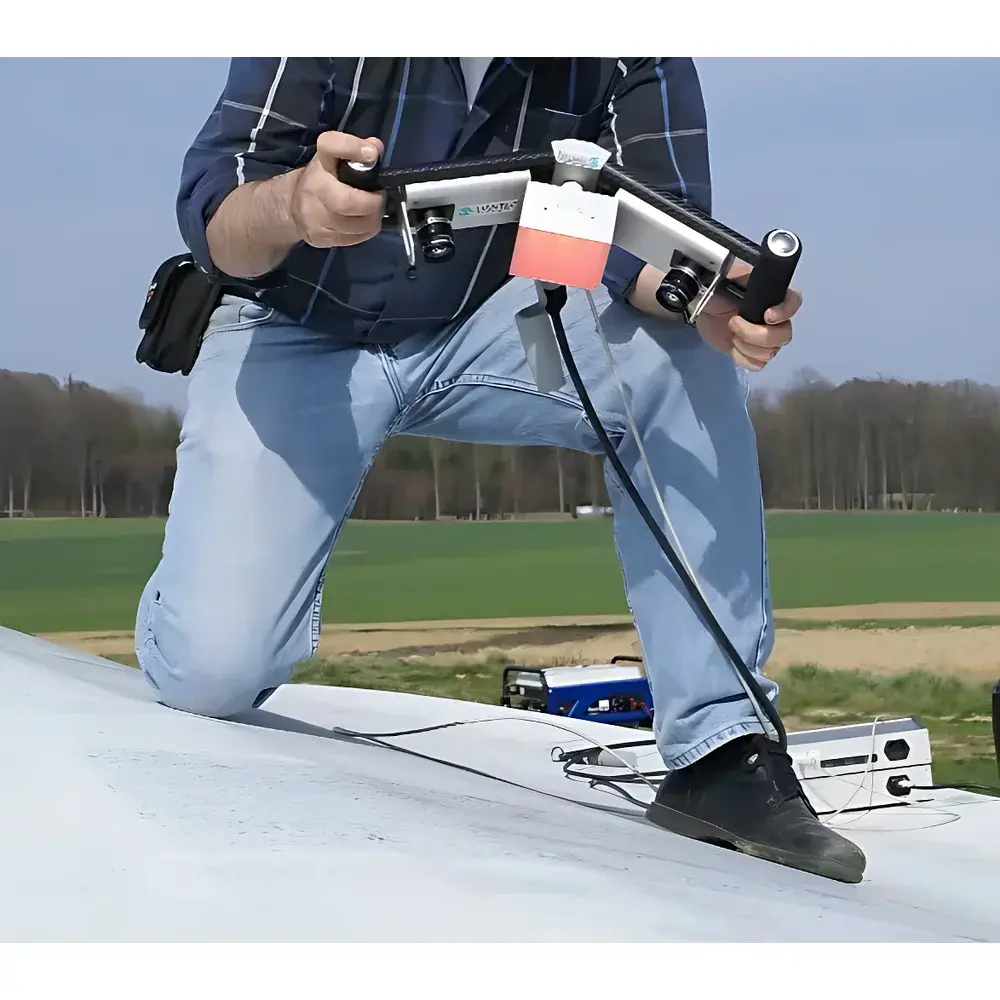
Dantec Dynamics Q-480 Handheld Digital Image Correlation System
| Brand | Dantec Dynamics |
|---|---|
| Origin | Germany |
| Model | Q-480 |
| Distribution Status | Authorized Distributor |
| Origin Category | Imported |
| Pricing | Upon Request |
Overview
The Dantec Dynamics Q-480 Handheld Digital Image Correlation (DIC) System is an engineered solution for full-field, non-contact deformation and strain measurement in industrial structural testing environments. Unlike conventional DIC systems requiring precise optical calibration, rigid mounting, and controlled laboratory conditions, the Q-480 implements a proprietary hardware-assisted repositioning protocol that eliminates the need for traditional stereo camera calibration or target-based alignment. It operates on the core principle of pixel-level intensity pattern matching between two or more high-resolution digital images—captured before and after mechanical loading—to compute displacement vectors and derive surface strain tensors (εxx, εyy, γxy) via local subset correlation algorithms. Designed specifically for large-scale structures—including wind turbine blades, railway carriages, composite fuselage sections, and civil infrastructure elements—the Q-480 bridges the gap between R&D-grade metrology and field-deployable engineering validation.
Key Features
- True handheld operation with integrated dual-camera module and real-time onboard processing unit—no external PC required during acquisition.
- Calibration-free workflow: eliminates time-consuming stereo calibration, lens distortion correction, and baseline verification steps.
- Hardware-accelerated repositioning: utilizes embedded inertial measurement units (IMUs), optical encoders, and fiducial-guided visual servoing to reconstruct prior imaging geometry within sub-millimeter spatial repeatability.
- Reference image stacking capability: supports acquisition of multiple reference frames across extended surfaces (>10 m² typical), enabling localized strain analysis without global coordinate system constraints.
- Ruggedized aluminum chassis rated IP54 for dust and splash resistance; designed for shop-floor, outdoor, and transport-critical environments.
- On-device visualization of displacement fields and principal strain maps with adjustable smoothing kernels and outlier rejection thresholds.
Sample Compatibility & Compliance
The Q-480 is compatible with matte-sprayed, painted, or naturally textured surfaces exhibiting sufficient stochastic intensity variation (minimum speckle size ≈ 2–5 pixels at working distance). It does not require retroreflective targets or adhesive markers. The system meets CE marking requirements under EU Machinery Directive 2006/42/EC and EMC Directive 2014/30/EU. Its measurement traceability aligns with ISO/IEC 17025 principles when operated within validated procedures, and data integrity workflows support audit readiness for GLP-compliant structural qualification per ASTM E837 (strain gage calibration) and ISO 10365 (digital image correlation validation guidelines). While not FDA-regulated, its documentation structure and raw data export format (HDF5 + JSON metadata) facilitate integration into 21 CFR Part 11–compliant QA systems where required.
Software & Data Management
Acquisition and preliminary analysis are performed using the embedded Q-480 Control Suite, which runs on a Linux-based real-time OS. All raw image sequences, IMU logs, and correlation result sets are stored locally on removable SSD media in vendor-neutral formats. Post-processing is supported via Dantec’s Istra4D software (v5.2+), enabling advanced filtering, multi-view stitching, temporal sequence analysis, and export to common CAE platforms (Abaqus .inp, ANSYS APDL, NASTRAN bulk data). Audit trails record operator ID, timestamp, environmental conditions (optional external sensor input), and processing parameters—ensuring full reproducibility and compliance with internal QA protocols.
Applications
- Full-field strain mapping of composite laminates during static and fatigue testing per ASTM D3039 and ISO 527-5.
- In-service deformation monitoring of welded joints and bolted connections in rail and maritime structures.
- Validation of finite element models for crashworthiness simulations in automotive body-in-white development.
- Thermal expansion characterization of aerospace alloys under controlled heating cycles.
- Non-destructive assessment of delamination onset and growth in sandwich panels using incremental loading DIC sequences.
FAQ
Does the Q-480 require calibration before each measurement session?
No. The system uses a hardware-locked geometric memory architecture that retains prior imaging configurations. Reacquisition relies on IMU-assisted pose recovery—not recalibration.
Can the Q-480 measure out-of-plane displacement?
Yes—when used in stereo configuration (dual-camera head), it delivers full 3D displacement fields with typical axial resolution of ±15 µm at 2 m working distance.
Is raw image data accessible for third-party analysis?
Yes. Uncompressed TIFF sequences and corresponding metadata JSON files are directly readable without proprietary codecs.
What is the maximum measurable strain range?
The effective strain range depends on subset size and speckle quality; typical operational limits span from 0.01% to >5% engineering strain with standard settings.
How is traceability maintained for ISO 17025 accreditation?
Through documented uncertainty budgets (based on pixel resolution, lens distortion modeling, and IMU drift characterization), version-controlled firmware/software, and serialized calibration certificates for optical modules issued by Dantec Dynamics GmbH.



