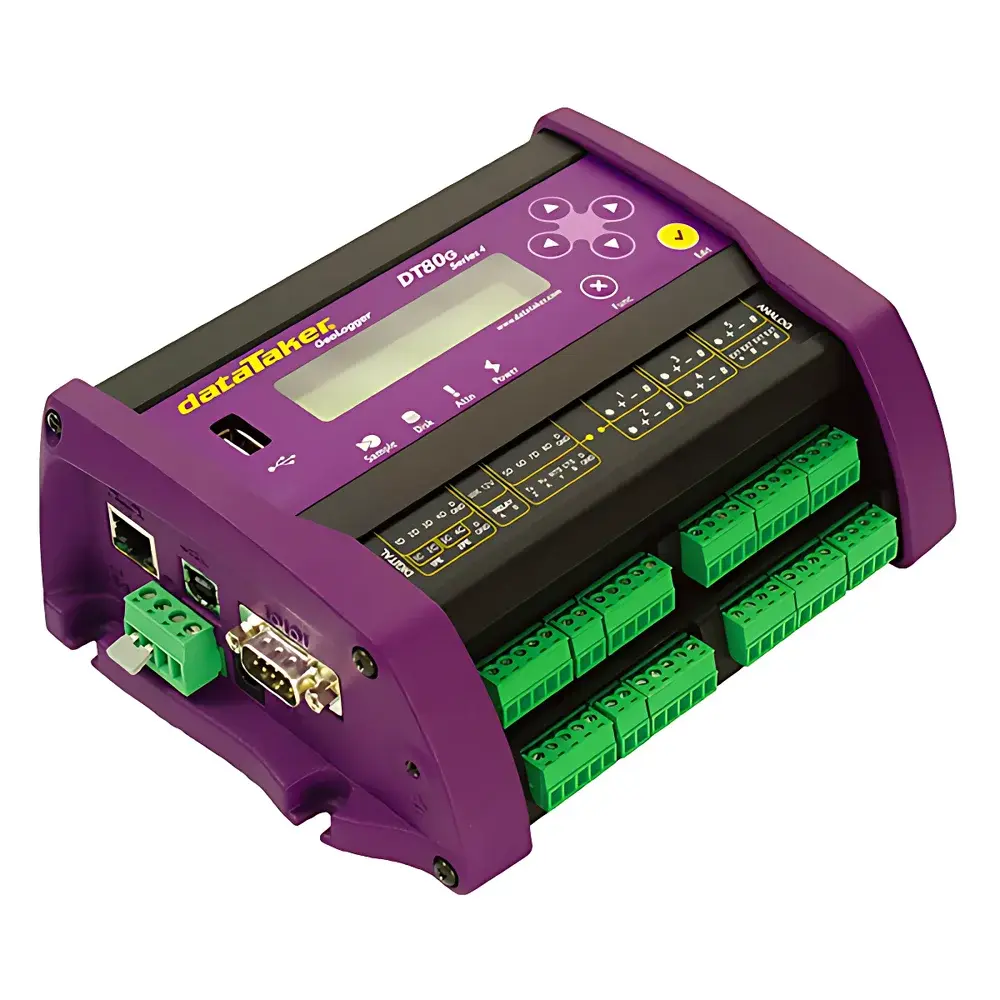
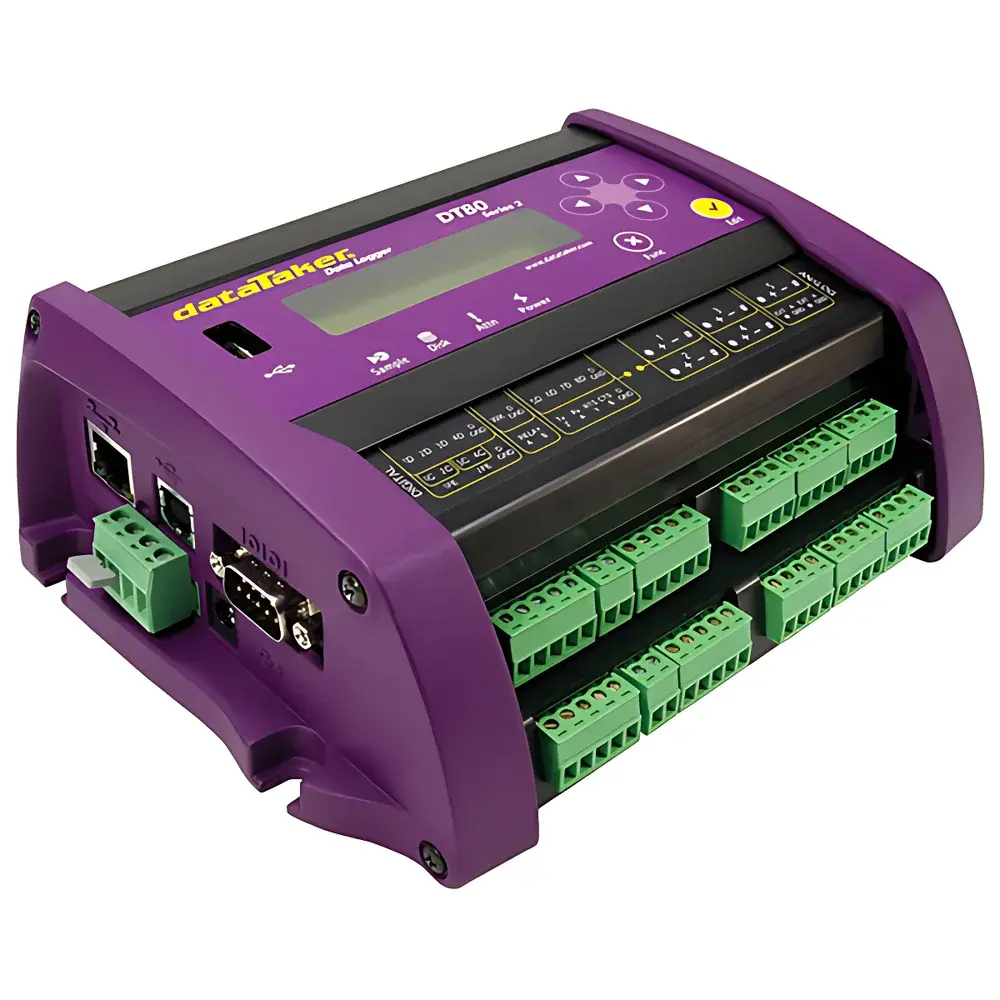
DataTaker DT80G Vibrating Wire Data Acquisition Unit
| Brand | DataTaker |
|---|---|
| Origin | Imported |
| Model | DT80G |
| Analog Inputs | 15 single-ended / 10 differential / 5 three- or four-wire |
| Resolution | 8-bit |
| Sampling Rate | up to 40 Hz |
| Vibrating Wire Channel | integrated, 500–5 kHz range, coil resistance 50–200 Ω, excitation pulse: 36 V @ 200 µs |
| Digital I/O & Counter | 32-bit, up to 100 kHz |
| Communication | RJ45 (Ethernet), USB, RS232/RS485/RS422 |
| Protocols | MODBUS RTU/TCP, SDI-12, ASCII, HTTP, FTP, SMTP |
| Power | 10–30 VDC |
| Operating Temperature | −40 to +70 °C |
| Enclosure Rating | IP54 |
| Dimensions | 180 × 137 × 65 mm |
| Weight | 1.5 kg |
| Internal Storage | 128 MB CompactFlash (upgradable to 4 GB), optional 8 GB USB drive |
| Real-Time Clock Accuracy | ±1 min/year (0–40 °C), ±4 min/year (−40–70 °C) |
| Internal Battery | 6 V @ 1.2 Ah |
Overview
The DataTaker DT80G is a rugged, industrial-grade vibrating wire data acquisition unit engineered for long-term, unattended monitoring in geotechnical, civil infrastructure, and environmental applications. Unlike general-purpose loggers, the DT80G integrates a dedicated, high-stability vibrating wire (VW) measurement module—capable of precise frequency and temperature compensation—enabling direct, high-resolution readout of VW sensors such as piezometers, inclinometers, load cells, crack meters, and strain gauges. Its measurement principle relies on resonant frequency detection using controlled excitation pulses (36 V, 200 µs), followed by digital signal processing to extract frequency (500–5,000 Hz), amplitude, and decay characteristics—critical for sensor health diagnostics and drift correction. Designed for deployment in remote or harsh environments—from dam abutments and tunnel portals to mine slope arrays—the DT80G operates reliably across −40 to +70 °C with IP54-rated aluminum housing, galvanically isolated analog inputs, and robust power management including internal backup battery support.
Key Features
- Dedicated vibrating wire interface with automatic temperature compensation and built-in diagnostics for sensor resonance quality and cable integrity
- Hybrid channel architecture: 15 single-ended, 10 differential, or 5 three-/four-wire analog inputs—fully programmable for voltage, current (4–20 mA), RTD, thermocouple, bridge, and strain gauge measurements
- Simultaneous high-speed digital I/O: 32-bit counter input (≤100 kHz), programmable digital outputs, and latching relay control (30 VDC / 1 A)
- Multi-protocol communication stack: native support for MODBUS RTU/TCP, SDI-12, ASCII, HTTP, FTP, and SMTP—enabling seamless integration with SCADA systems, cloud platforms, and legacy telemetry networks
- Onboard real-time clock with ±1 minute/year accuracy (0–40 °C) and extended-range calibration (±4 min/year at extremes), synchronized via NTP over Ethernet or manual UTC offset configuration
- Expandable architecture: compatible with up to five CEM20 channel expansion modules—scaling total capacity to 300 single-ended, 200 differential, or 100 three-/four-wire inputs
Sample Compatibility & Compliance
The DT80G is validated for use with industry-standard vibrating wire sensors compliant with ASTM D4767 (clay consolidation), ASTM D7012 (rock strength), and ISO 18674-2 (geotechnical monitoring). It supports common sensor types including GEOKON, Slope Indicator, and Geosense VW piezometers; Geokon tiltmeters; and Campbell Scientific VW strain gages. All analog inputs feature 1500 V isolation and programmable excitation (5 V / 12 V, ≤150 mA), ensuring compatibility with 2-, 3-, and 4-wire configurations without external signal conditioning. The unit meets IEC 61000-4 electromagnetic immunity standards (ESD, surge, fast transients) and carries CE marking per Directive 2014/30/EU (EMC) and 2014/35/EU (LVD). For regulated environments, dEX software supports audit-trail logging and user-access controls aligned with GLP and FDA 21 CFR Part 11 requirements when configured with password protection and change history export.
Software & Data Management
Configuration, visualization, and post-processing are managed through DataTaker’s dEX software—a Windows-based application certified for Windows 10/11 and compatible with virtualized environments. dEX provides intuitive channel setup wizards, real-time waveform display for vibrating wire signals, statistical trending (min/max/avg/std dev), and customizable alarm logic with email/SMS notification triggers. Raw data is stored in ASCII CSV or binary .DTA format—with embedded metadata (timestamp, channel ID, engineering units, status flags)—ensuring traceability and interoperability with MATLAB, Python (pandas), and commercial analytics tools. Scheduled data exports can be automated via FTP push or SMTP email delivery (including encrypted attachments), while local retrieval is supported via USB mass storage mode or direct Ethernet file transfer. Firmware updates are performed securely over HTTPS with SHA-256 signature verification.
Applications
- Geotechnical Monitoring: Continuous measurement of pore water pressure, lateral earth pressure, and structural deformation in embankment dams, retaining walls, and landslide early-warning systems
- Civil Infrastructure: Long-term strain and settlement monitoring of bridges, tunnels, and high-rise foundations during construction and service life
- Mining & Tunneling: Real-time convergence tracking in soft-ground tunneling, blast-induced vibration assessment, and stope stability surveillance
- Environmental Science: Integrated hydrological monitoring combining VW piezometers with temperature, conductivity, and turbidity sensors in groundwater observation wells
- Concrete Curing: In-situ strength development tracking via embedded VW strain gauges and thermal profiles—supporting ASTM C1074 maturity method compliance
FAQ
Does the DT80G require external signal conditioning for vibrating wire sensors?
No. The integrated VW module provides precision excitation, frequency measurement, and temperature compensation without external amplifiers or filters.
Can the DT80G operate autonomously for extended periods without mains power?
Yes. With its 6 V @ 1.2 Ah internal battery and low-power sleep modes (≤10 mA typical), it supports multi-month operation on solar-charged systems when paired with appropriate charge controllers.
Is dEX software validated for use in regulated industries?
dEX supports configurable audit trails, electronic signatures, and role-based access—enabling validation against 21 CFR Part 11 and EU Annex 11 when deployed with documented SOPs and periodic review protocols.
How is sensor calibration data managed and retained?
Calibration coefficients (e.g., K, F, T0) are stored per-channel in non-volatile memory and embedded in all exported data files—ensuring full metrological traceability from raw frequency to engineering units.
What is the maximum recommended cable length between the DT80G and a vibrating wire sensor?
For optimal signal integrity, lengths up to 1,000 m are supported using twisted-pair shielded cable (AWG 22–18); performance validation is advised for site-specific installations exceeding 500 m.