
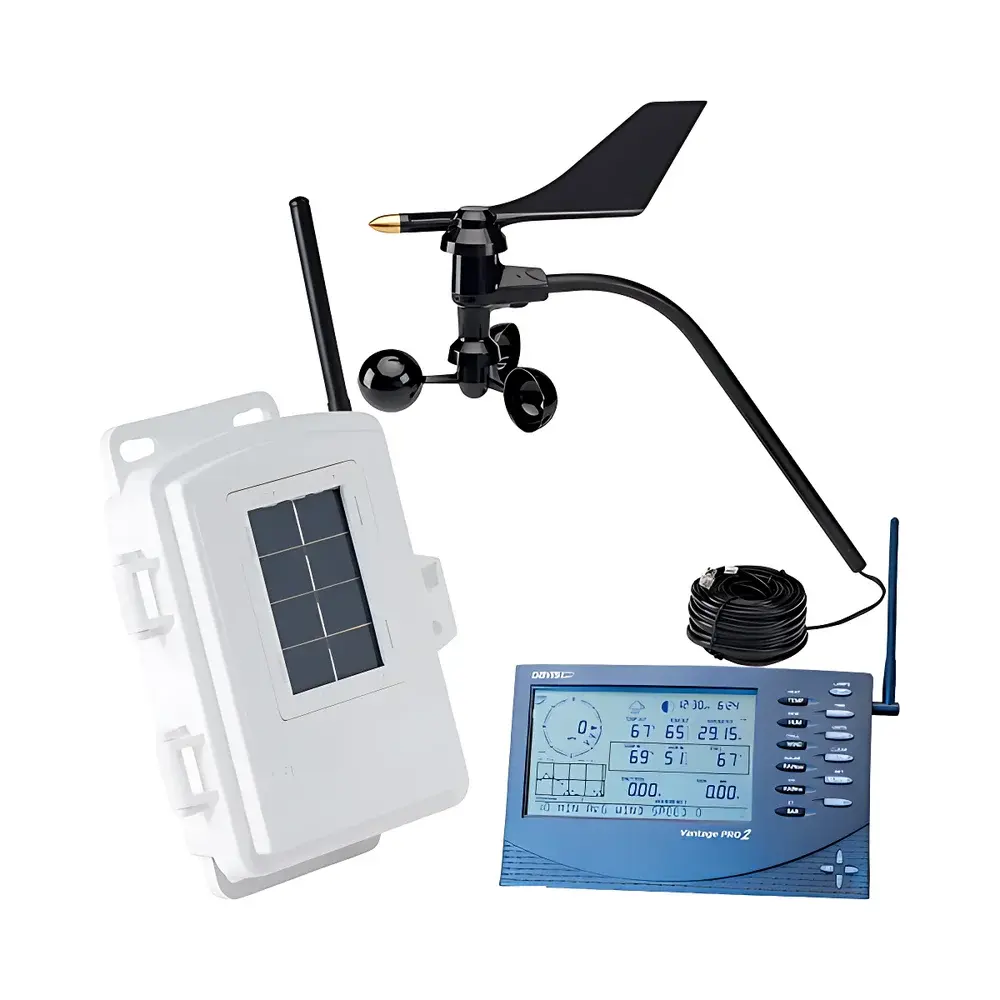
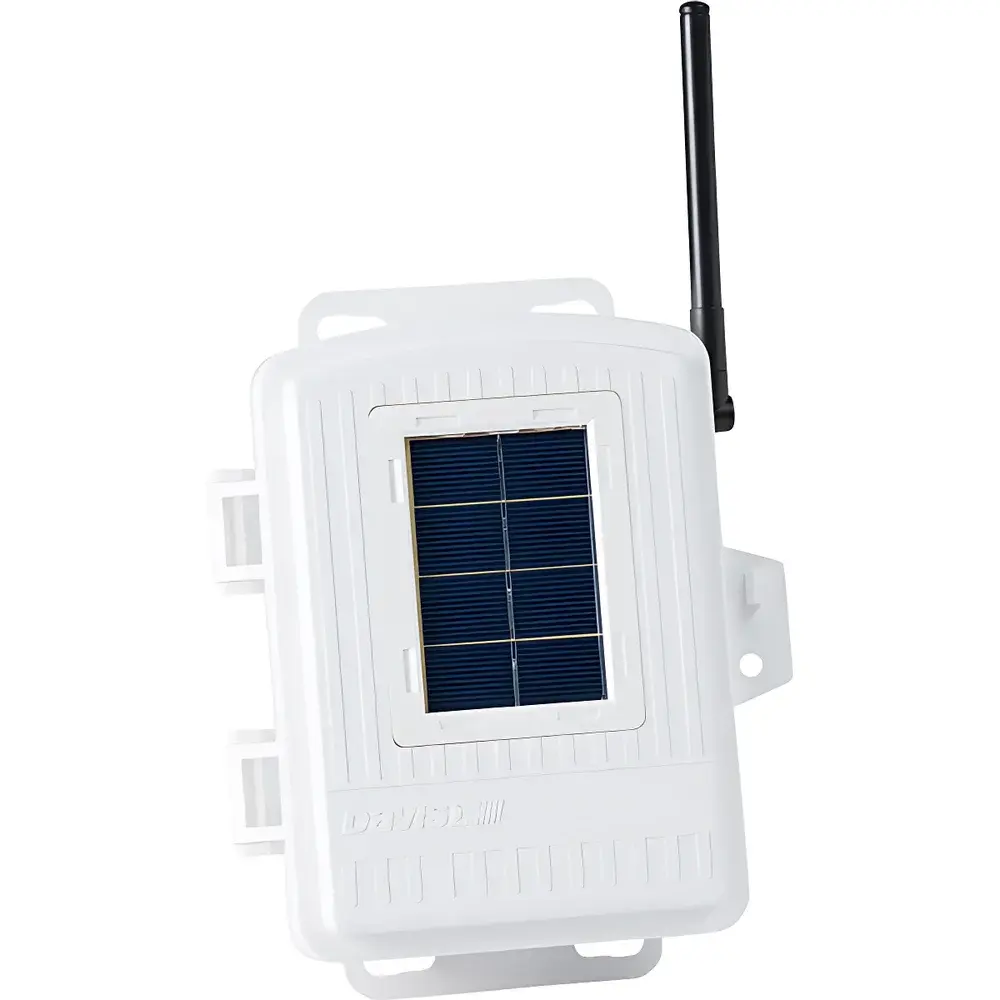
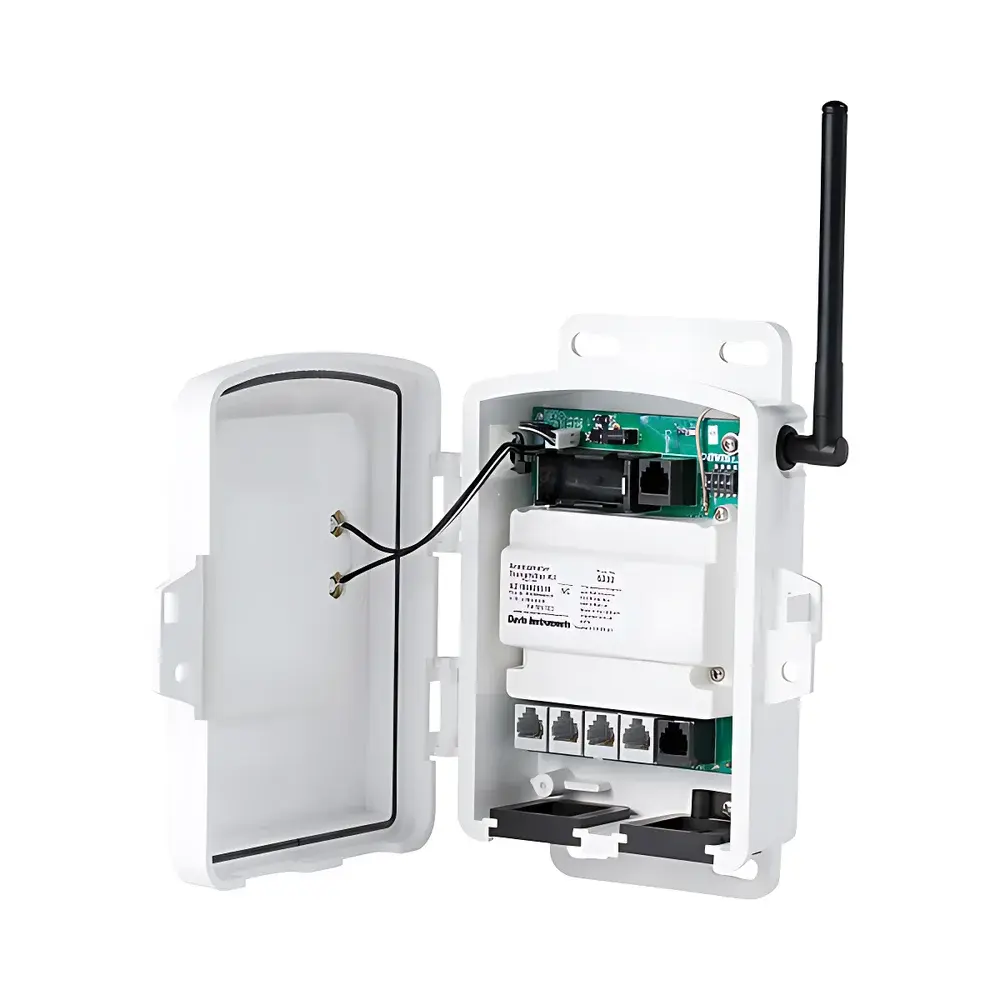
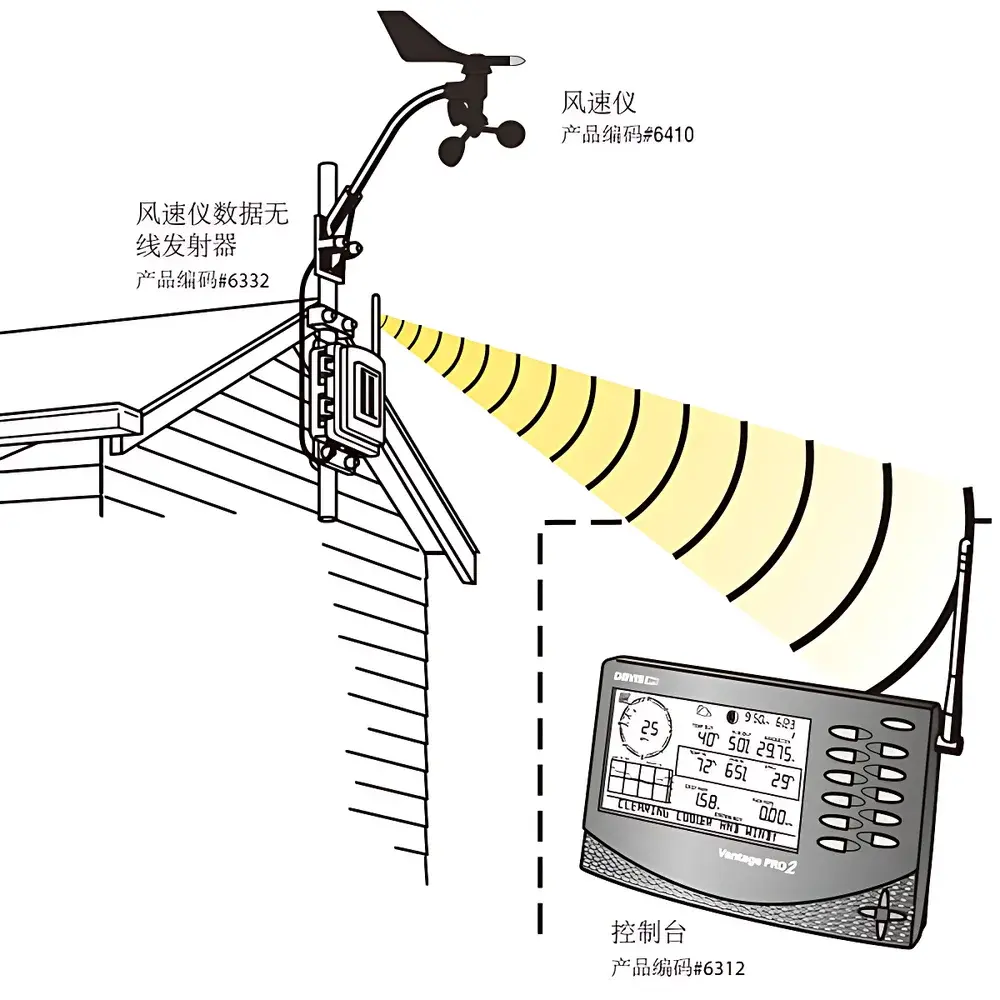
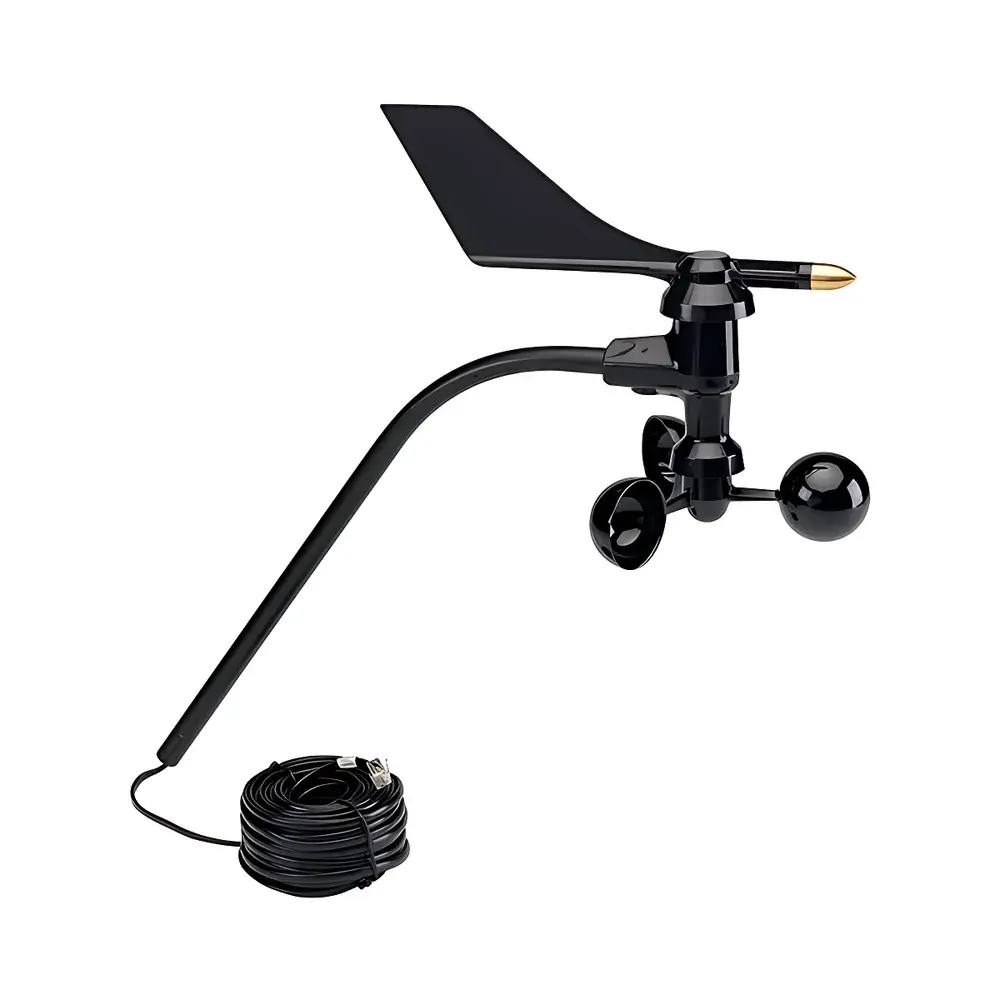
Davis 6332 Wireless Anemometer System
| Brand | Davis Instruments |
|---|---|
| Origin | USA |
| Model | 6332 |
| Instrument Type | Cup Anemometer with Integrated Wind Vane |
| Resolution | 0.1 m/s |
| Measurement Range | 0.5–89 m/s |
| Accuracy | ±5% of reading (±1 m/s, whichever is greater) |
| Operating Temperature | −40 °C to +65 °C |
| Operating Humidity | 0–100% RH |
| Wireless Transmission Range | Up to 300 m (line-of-sight), 75–150 m through obstacles |
| Power Source | Solar panel (0.5 W) + rechargeable CR-123A 3 V lithium battery |
| Battery Runtime | 8 months (no solar input), ≥2 years (typical solar exposure) |
| Data Storage Capacity | 2560 records |
| Logging Intervals | 1, 5, 10, 15, 30, 60, or 120 minutes |
| Communication Interface | RS-232 or USB |
| Baud Rate | 1200–19200 bps, half-duplex |
| Sensor Cable Length | 12 m (standard), up to 73 m optional |
| Wind Direction Range | 1–360° |
| Wind Direction Accuracy | ±3° |
| Wind Direction Resolution | 1° (digital), 22.5° (16-point compass) |
| ISS Housing Material | UV-stabilized ABS and polycarbonate |
| ISS Dimensions | 159 × 58 × 200 mm |
| ISS Weight | 0.48 kg |
| Mounting Mast Diameter | 33 mm (1.3″ OD) |
| Tripod Height | 1.77 m (total), 0.92 m mast height |
| Tripod Material | Galvanized steel |
| Control Console Operating Temp | 0–+60 °C |
| Console Display | Backlit LCD (151 × 86 mm active area) |
| Console Weight | 0.85 kg (with batteries) |
| Wireless Channel Support | Up to 8 remote stations per console |
Overview
The Davis 6332 Wireless Anemometer System is a field-deployable, solar-powered environmental monitoring solution engineered for long-term, unattended wind speed and direction measurement in meteorological, agricultural, industrial safety, and renewable energy applications. Built upon Davis Instruments’ proven Integrated Sensor Suite (ISS) architecture, the system employs a precision cup anemometer with magnetic reed switch sensing and a potentiometric wind vane—both housed in UV-resistant ABS and polycarbonate enclosures rated for extreme ambient conditions (−40 °C to +65 °C). Unlike handheld or short-duration instruments, the 6332 is designed as a fixed-site wireless node compliant with continuous operational requirements under IEC 61000-4 electromagnetic immunity standards and aligned with data integrity expectations of ISO/IEC 17025-accredited environmental labs. Its core measurement principle relies on rotational frequency conversion (cup rotation → pulse train) and resistive angular position encoding (vane orientation → analog voltage), digitized and wirelessly transmitted via a 915 MHz ISM-band radio module with AES-encrypted packet framing to ensure signal fidelity over distances up to 300 meters in open terrain.
Key Features
- Solar-rechargeable power architecture: 0.5 W monocrystalline panel paired with a CR-123A 3 V lithium battery enables autonomous operation for ≥8 months without sunlight and >2 years under typical insolation—eliminating dependency on grid power or frequent battery replacement.
- Robust wireless telemetry: Proprietary 915 MHz RF protocol supports bi-directional communication, automatic link verification, and adaptive transmission retries; line-of-sight range up to 300 m, penetration through standard building materials at 75–150 m.
- Modular sensor integration: The base ISS (Model 6410) supports seamless expansion with optional co-located sensors—including pyranometers (solar radiation), UV-B radiometers, thermistors (air temperature), capacitive humidity sensors, and tipping-bucket rain gauges—without requiring additional transmitters or wiring.
- High-resolution temporal logging: Configurable sampling intervals from 1 to 120 minutes; onboard non-volatile memory stores 2560 timestamped records with UTC synchronization support via WeatherLink software.
- Field-serviceable mechanical design: All outdoor components feature IP65-rated enclosures, stainless-steel fasteners, and UV-stabilized polymers; mounting hardware includes galvanized steel tripod (1.77 m total height) compatible with industry-standard 33 mm mast diameters.
Sample Compatibility & Compliance
The 6332 system is validated for use across diverse environmental matrices including open-field agro-meteorology, coastal wind profiling, rooftop HVAC performance verification, and occupational health & safety monitoring (e.g., OSHA 1910.1200 compliance for wind-dependent hazard assessment). It meets NIST-traceable calibration protocols for cup anemometers per ASTM D5096 and adheres to static calibration tolerances defined in IEC 61400-12-1 Annex E for wind resource assessment instrumentation. While not certified for Class I Div 1 hazardous locations, its ingress protection (IP65) and operating temperature envelope satisfy EN 60529 and MIL-STD-810G environmental stress screening requirements for outdoor deployment. Data output formats comply with CF Standard Format (Climate Forecast Metadata Conventions) when exported via WeatherLink, facilitating interoperability with NOAA NCDC, EPA AQS, and EU Copernicus Atmosphere Monitoring Service (CAMS) ingestion pipelines.
Software & Data Management
Data acquisition and archival are managed through Davis’ WeatherLink v6.x desktop application (Windows-only), which provides full audit-trail functionality—including user login timestamps, parameter change logs, and export history—with optional configuration for FDA 21 CFR Part 11-compliant electronic signatures when deployed in GLP/GMP-regulated environments. Raw sensor data is stored in binary .WLK files with embedded CRC-32 checksums; ASCII CSV export supports time-aligned multi-parameter alignment (wind speed, direction, temperature, humidity, solar irradiance) at user-defined intervals. Communication occurs via RS-232 (DB9) or USB virtual COM port at configurable baud rates (1200–19200 bps, half-duplex), enabling integration with SCADA systems using Modbus RTU wrappers or custom Python/Node-RED middleware. Firmware updates are delivered via signed .BIN packages verified by SHA-256 hash prior to installation.
Applications
- Long-term wind resource assessment for small-scale wind turbine siting and performance validation.
- Real-time ventilation monitoring in livestock barns, greenhouses, and industrial cleanrooms where airflow uniformity impacts thermal comfort and pathogen dispersion.
- Regulatory air quality monitoring networks requiring synchronized wind vector inputs for pollutant dispersion modeling (e.g., AERMOD, CALPUFF).
- Wildfire behavior prediction systems integrating wind dynamics with fuel moisture and temperature trends.
- Educational meteorology installations supporting STEM curriculum alignment with NGSS MS-ESS2-5 and HS-ESS2-2 standards.
FAQ
What is the recommended calibration interval for the 6332 ISS?
Davis recommends annual field verification against a NIST-traceable reference anemometer per ASTM D5096 Section 7.3; full recalibration is advised every two years or after physical impact or prolonged exposure to salt-laden or particulate-rich airstreams.
Can the 6332 transmit data directly to cloud platforms such as AWS IoT or Azure IoT Hub?
Not natively—the system requires local WeatherLink software running on a Windows host to act as a gateway; however, third-party middleware (e.g., Node-RED with serial-to-MQTT bridge) can be deployed on Raspberry Pi or industrial PCs to forward parsed CSV data via TLS-secured MQTT or HTTPS POST.
Is the 6332 suitable for marine offshore deployment?
While the ISS housing is UV- and corrosion-resistant, it is not rated for continuous saltwater immersion or wave splash zones; for offshore applications, Davis recommends supplemental conformal coating of PCBs and use of marine-grade stainless-steel mounting hardware beyond the standard galvanized tripod.
Does the system support time-synchronized measurements across multiple ISS units?
Yes—when configured under a single WeatherLink instance, up to eight wireless ISS nodes (including 6410, 6420, 6460 variants) are automatically time-aligned using the console’s internal RTC, with sub-second timestamp resolution preserved in exported datasets.
How is data integrity ensured during wireless transmission?
Each transmitted packet includes payload CRC-16, sequence numbering, and automatic retransmission on ACK timeout; the console performs end-to-end checksum validation before committing records to internal flash memory, rejecting corrupted frames without silent failure.







