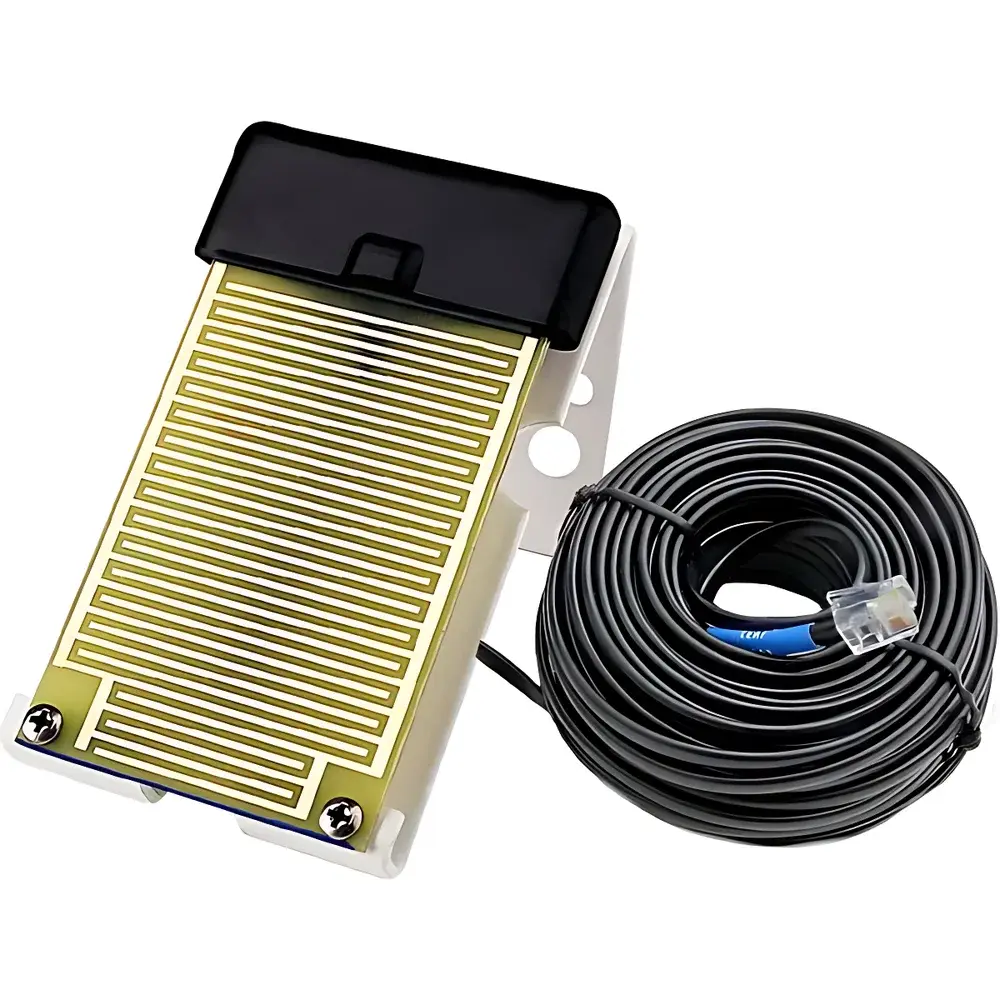
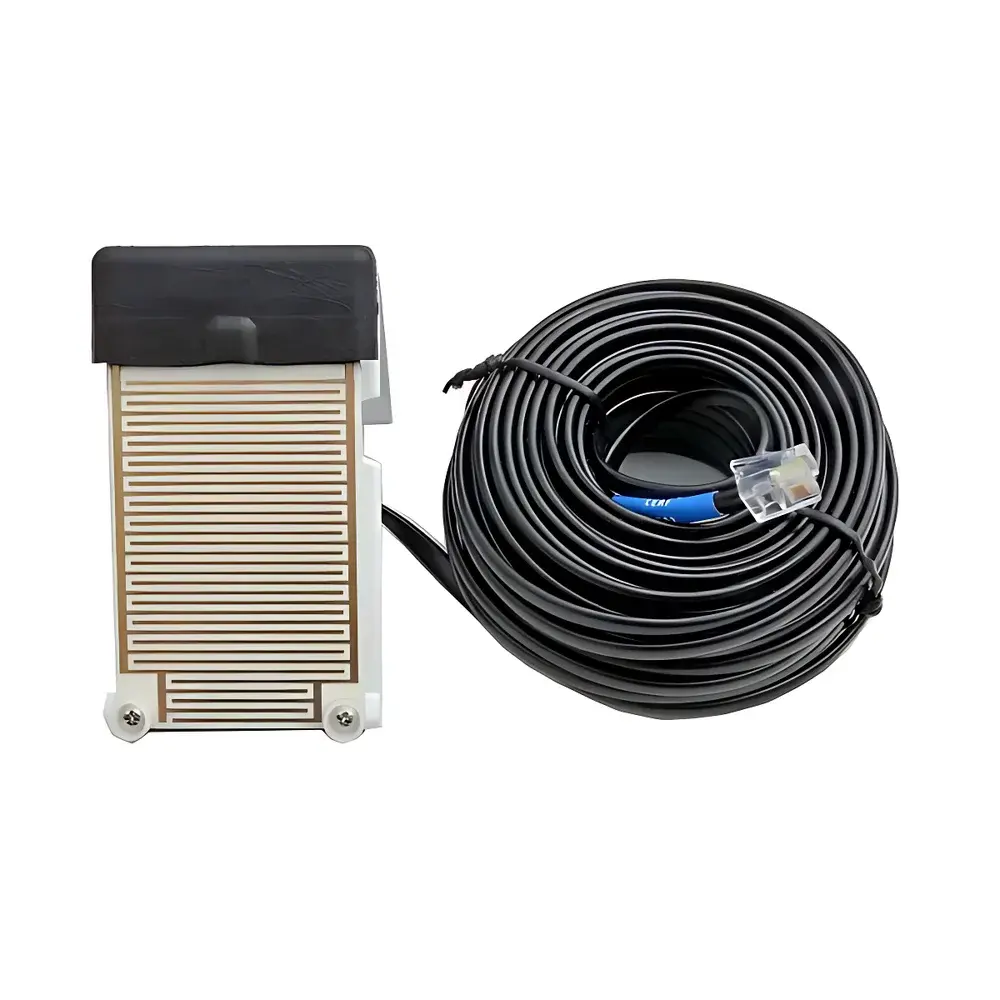
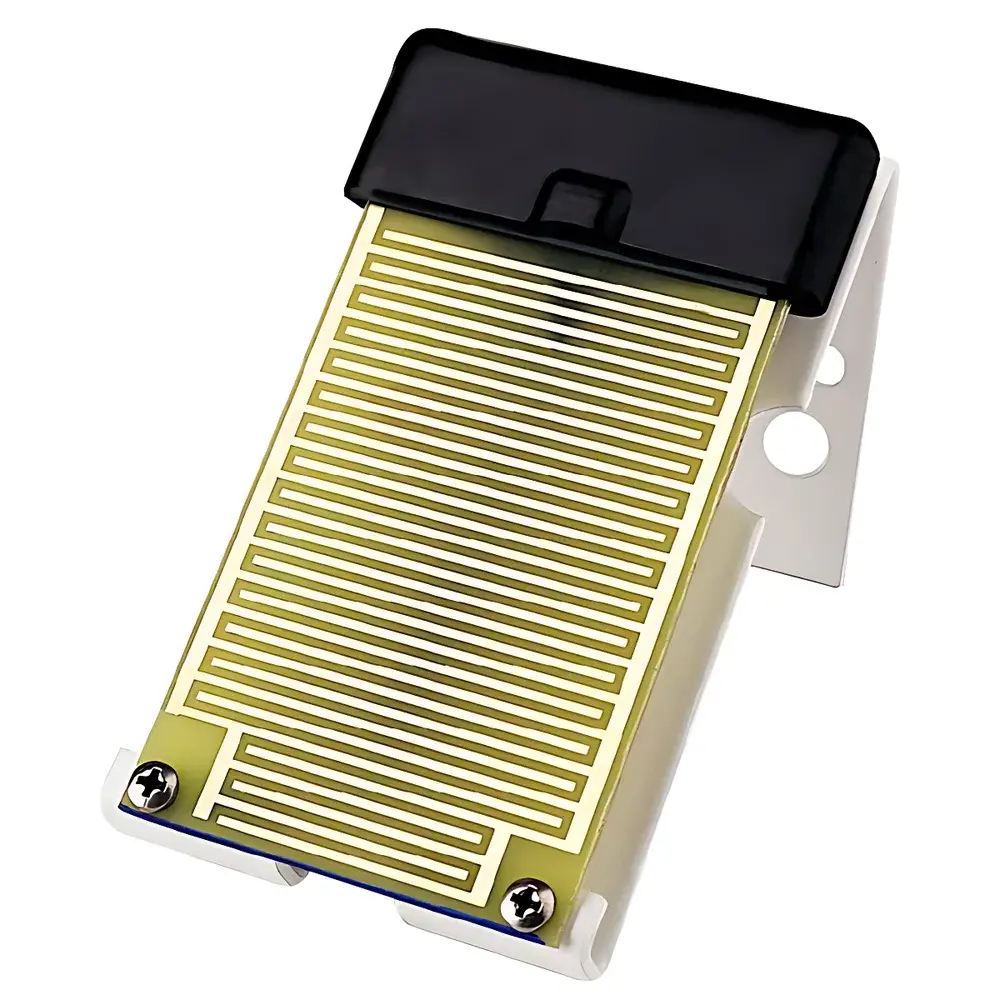
Davis 6420 Leaf Wetness Sensor
| Brand | Davis Instruments |
|---|---|
| Origin | USA |
| Model | 6420 |
| Sensor Type | Artificial Leaf Resistive Sensor |
| Excitation Voltage | 3 V (nominal, bipolar) |
| Time Constant | 2 s |
| Cable Length | 12 m |
| Cable Specification | 4-conductor, 26 AWG |
| Connector | Standard RJ-11 |
| Substrate Material | Fiberglass + Ceramic Board |
| Conductive Grid Material | Copper, Nickel, Gold |
| Mounting Bracket | Anodized Aluminum |
| Dimensions (L×W×H) | 102 mm × 58 mm × 58 mm |
| Weight | 0.4 kg |
| Output Range | 0–15 (dimensionless wetness index) |
| Accuracy | ±0.5 units |
| Resolution | 1 unit |
| Data Update Interval | 62.5–75 s |
| Compliance | Designed for outdoor agricultural and ecological monitoring per ASTM E2797-21 (Standard Practice for Measuring Leaf Wetness Duration) |
Overview
The Davis 6420 Leaf Wetness Sensor is an engineered resistive sensor designed to quantify the duration and relative intensity of surface moisture on plant foliage under field conditions. It operates on the principle of electrical conductivity change across an artificial leaf surface—comprising a precisely patterned conductive grid (copper/nickel/gold) deposited on a stable fiberglass-ceramic substrate. When dew, fog, rain splash, or high-humidity condensation accumulates on the sensor surface, electrolytic conduction increases proportionally, generating a dimensionless wetness index from 0 (completely dry) to 15 (fully saturated). This analog output is calibrated to emulate natural leaf boundary-layer hygroscopic behavior—not as a direct water thickness measurement, but as a biologically relevant proxy for pathogen-favorable microclimatic conditions. The sensor is explicitly intended for integration into automated environmental monitoring networks, particularly those supporting precision agriculture, plant pathology research, and integrated pest management (IPM) decision support systems.
Key Features
- Artificial leaf architecture with reproducible surface geometry and hydrophilic response kinetics, validated against natural leaf wetness dynamics in peer-reviewed phytoclimatological studies.
- Bipolar 3 V excitation circuitry minimizes polarization drift and extends long-term baseline stability—critical for multi-season deployments in unattended stations.
- RJ-11 connector and 12 m shielded 4-conductor cable (26 AWG) enable plug-and-play compatibility with Davis Vantage Pro2, EnviroMonitor, and third-party data loggers supporting analog voltage or resistance input channels.
- Anodized aluminum mounting bracket ensures corrosion resistance in humid, saline, or pesticide-exposed environments; low-profile housing (102 × 58 × 58 mm) minimizes wind-induced turbulence and shading artifacts.
- Thermal mass and substrate composition yield a 2-second time constant—fast enough to resolve transient dew events yet slow enough to filter high-frequency noise without oversmoothing biologically meaningful wetness transitions.
Sample Compatibility & Compliance
The 6420 is not deployed on biological tissue but serves as a standardized surrogate for foliar moisture status across diverse crop species (e.g., grapevine, tomato, wheat, soybean) and forest understory vegetation. Its output correlates strongly with fungal infection risk windows defined by empirical models such as the Mills Table for apple scab or the Smith-Rankin model for powdery mildew. The sensor complies with ASTM E2797-21 guidelines for leaf wetness sensor performance evaluation—including requirements for repeatability (< ±0.3 units over 30-day field exposure), hysteresis control (< 0.4 units), and temperature coefficient compensation (±0.02 units/°C between −20°C and +50°C). It is suitable for USDA APHIS-certified orchard monitoring programs and supports GLP-aligned data collection when paired with audit-trail-capable loggers.
Software & Data Management
Raw 6420 output (0–15 index) is ingested via analog-to-digital conversion at the host logger—no proprietary firmware or driver is required. Compatible platforms include Davis WeatherLink Live, Campbell Scientific LoggerNet, Onset HOBOware Pro, and open-source solutions (e.g., R-based agroclim packages). Time-stamped wetness duration metrics (e.g., cumulative minutes > threshold = 5) can be exported in CSV or NetCDF format for statistical analysis, machine learning–based disease forecasting, or integration into farm management information systems (FMIS). When used with Davis 6345 Wireless Leaf & Soil Moisture Stations, dual 6420 sensors provide spatial redundancy and cross-validation capability—supporting ISO 5725-2 precision criteria for field sensor arrays.
Applications
- Precision irrigation scheduling triggered by leaf wetness decay curves—reducing unnecessary overhead watering and minimizing runoff.
- Validation of atmospheric deposition models in air quality and phytotoxicity studies.
- Long-term phenological monitoring in ecological research sites (e.g., NEON, LTER networks) where leaf wetness duration is a key climate-sensitive trait.
- Regulatory compliance reporting for Good Agricultural Practice (GAP) and GlobalG.A.P. certification, where documented wetness history informs pesticide application timing logs.
- Calibration reference for optical or capacitive leaf wetness sensors undergoing comparative field trials.
FAQ
How does the 6420 differ from capacitive leaf wetness sensors?
The 6420 uses resistive measurement across a fixed-grid artificial leaf, offering superior linearity in the mid-to-high wetness range (5–12) and lower sensitivity to dust accumulation. Capacitive sensors measure dielectric permittivity changes and may require frequent recalibration in dusty or saline environments.
Can the 6420 be submerged or cleaned with solvents?
No. The sensor is rated for outdoor exposure only—not immersion. Cleaning must be performed with distilled water and soft lint-free cloth; alcohol or acetone will degrade the conductive grid adhesion.
Is calibration traceable to NIST standards?
While the 6420 itself is factory-calibrated using gravimetric dew simulation chambers, formal NIST traceability applies only at the data logger’s ADC level. Users requiring metrological validation should perform in-situ comparison against reference dew point hygrometers per ISO/IEC 17025 protocols.
What is the expected service life in continuous field operation?
Under typical agricultural conditions (UV exposure, thermal cycling, occasional pesticide contact), mean time between failures exceeds 5 years based on Davis field reliability data (n = 1,247 units, 2018–2023).
Does the sensor require periodic zero-point adjustment?
No. The bipolar excitation and ceramic substrate minimize baseline drift; however, annual visual inspection for grid corrosion or physical damage is recommended as part of routine station maintenance.