
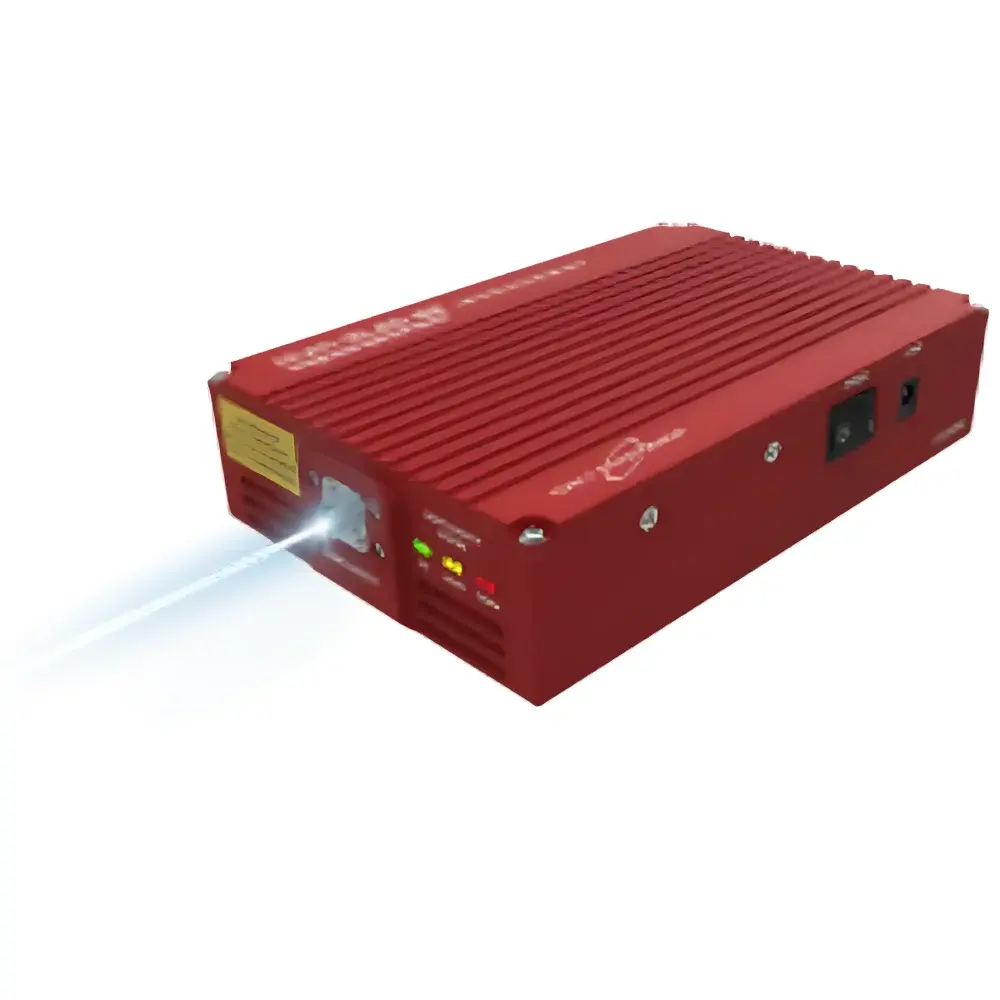
DAYY Photonics ISB2 Integrated Spectral Bench (Full-Enclosed Multi-SLED Broadband Light Source Platform)
| Brand | DAYY Photonics |
|---|---|
| Origin | Canada |
| Model | ISB2 |
| SLED Count | 2–6 configurable channels |
| Wavelength Range | 770–1680 nm |
| Spectral Bandwidth (FWHM) | 40–460 nm |
| Output Power | up to 40 mW (fiber-coupled), up to 130 mW (free-space) |
| Polarization Extinction Ratio | High (>20 dB) |
| Fiber Options | PM, SM, or low-PER single-mode |
| Integrated TEC & Monitoring Photodiodes | Yes |
| Optical Isolation | Dual-stage polarization-maintaining fiber isolator (35 dB) |
| Control Interfaces | USB, RS-232, Ethernet |
| Software Interface | GUI + programmable API |
Overview
The DAYY Photonics ISB2 Integrated Spectral Bench is a fully enclosed, turnkey broadband light source platform engineered for high-stability, spectrally seamless illumination in near-infrared (NIR) applications. Unlike conventional lamp-based or tunable laser sources, the ISB2 leverages DAYY’s proprietary spectral stitching technology—coherently combining emission from multiple superluminescent diodes (SLEDs) into a single spatially coherent output beam with low temporal coherence and broad spectral coverage. Each SLED operates within a hermetically sealed 32-pin butterfly package and is individually monitored via integrated photodiodes, while sharing a common thermoelectric cooler (TEC) for precise thermal stabilization. The system delivers calibrated, drift-compensated optical power across its entire spectral envelope—critical for metrology-grade applications such as optical coherence tomography (OCT), interferometric sensing, and component characterization where spectral flatness, power stability (<±0.05 dB over 8 hours), and polarization fidelity are non-negotiable.
Key Features
- Modular multi-SLED architecture supporting 2–6 independently addressable channels, each with dedicated monitoring photodiode for real-time power feedback and closed-loop intensity control.
- Factory-optimized spectral stitching ensures smooth, gap-free coverage from 770 nm to 1680 nm—enabling wideband OCT systems, dispersion-compensated interferometers, and multi-wavelength calibration setups.
- Integrated dual-stage polarization-maintaining fiber isolator (35 dB minimum isolation) suppresses back-reflections that degrade source coherence and destabilize sensitive interferometric measurements.
- Thermal management via precision-controlled TEC maintains junction temperature stability within ±0.1 °C, minimizing wavelength drift (<0.02 nm/°C) and power fluctuation across ambient conditions.
- Flexible output options: AR-coated sapphire window for free-space delivery (up to 130 mW), or factory-optimized coupling into polarization-maintaining (PM), single-mode (SM), or low-polarization-extinction-ratio fibers (10–40 mW).
- Multi-protocol digital interface (USB 2.0, RS-232, 10/100BASE-T Ethernet) enables remote operation, synchronization with external triggers, and integration into automated test benches compliant with IEEE 1588 PTP timing standards.
Sample Compatibility & Compliance
The ISB2 is designed for compatibility with standard NIR optical components including fiber collimators, wavelength division multiplexers (WDMs), circulators, and interferometric couplers. Its low-coherence, high-brightness output meets key requirements for ISO 13695 (optical radiation safety), IEC 60825-1 (laser product classification), and FDA 21 CFR Part 11 when used with validated software controls. All configurations support GLP/GMP-aligned audit trails via timestamped log export and user-accessible firmware revision tracking. The platform conforms to RoHS 3 and REACH directives, and its mechanical housing complies with IP52 ingress protection for laboratory environments. For OCT system validation, the ISB2 supports traceable spectral radiance calibration per NIST-traceable reference standards (e.g., NIST SRM 2031), enabling compliance with ASTM F2796 (OCT system performance testing).
Software & Data Management
The ISB2 ships with DAYY ControlSuite—a cross-platform (Windows/macOS/Linux) GUI offering real-time spectral preview, channel-by-channel power mapping, TEC setpoint scheduling, and alarm-triggered shutdown protocols. A comprehensive RESTful API and Python/C++ SDK enable full automation of power ramping, spectral switching sequences, and synchronized acquisition with oscilloscopes, DAQ systems, or OCT engines. All communication layers implement TLS 1.2 encryption and role-based access control (RBAC) to meet FDA 21 CFR Part 11 electronic record requirements. Operational logs—including temperature history, photodiode readings, and command timestamps—are stored locally on internal flash memory and exportable in CSV/JSON formats with SHA-256 integrity hashing. Firmware updates are delivered via signed binary packages with secure boot verification.
Applications
- Optical Coherence Tomography (OCT): Enables axial resolution down to 5 µm (in air) through ultra-broadband illumination; supports swept-source OCT calibration, dispersion compensation, and reference arm stabilization.
- Fiber Optic Component Testing: Characterizes insertion loss, polarization-dependent loss (PDL), and return loss of isolators, filters, and FBGs across C+L+U bands without mechanical scanning.
- Interferometric Metrology: Provides stable, low-coherence illumination for white-light interferometry, surface profilometry, and thin-film thickness measurement in semiconductor and MEMS fabrication.
- Biomedical Imaging & Sensing: Powers diffuse optical tomography (DOT), functional near-infrared spectroscopy (fNIRS), and photoacoustic imaging systems requiring spectrally tailored, high-power NIR illumination.
- Telecom R&D: Supports characterization of next-generation silicon photonics devices, quantum dot amplifiers, and nonlinear waveguide components operating beyond conventional C-band limits.
FAQ
What spectral coverage options are available for custom configurations?
Standard configurations span 770–1680 nm using combinations of 2–6 SLEDs; custom spectral profiles—including narrowband gaps, enhanced power density at specific bands (e.g., 1310/1550 nm), or extended UV-NIR coverage via hybrid SLED/LED modules—can be engineered under NDA.
Does the ISB2 support external triggering for synchronized measurements?
Yes—TTL-compatible trigger inputs accept rising-edge pulses (1–10 V, 50 Ω) to initiate channel switching, TEC setpoint changes, or power ramping with sub-microsecond jitter.
How is spectral flatness maintained across temperature and aging?
Each SLED’s photodiode monitors relative power drift; the embedded controller applies dynamic current compensation and TEC offset correction to maintain spectral shape within ±0.5 dB over 10,000 hours of operation.
Can the ISB2 be integrated into a Class 1 laser safety enclosure?
All fiber-coupled variants meet IEC 60825-1 Class 1 requirements when used with appropriate connectors and enclosures; free-space models require OEM-integrated beam containment per ANSI Z136.1.
Is firmware upgrade capability field-accessible?
Yes—firmware updates are performed via Ethernet or USB without disassembly; all updates preserve user calibration tables and retain audit-log continuity per 21 CFR Part 11 §11.10(e).




