
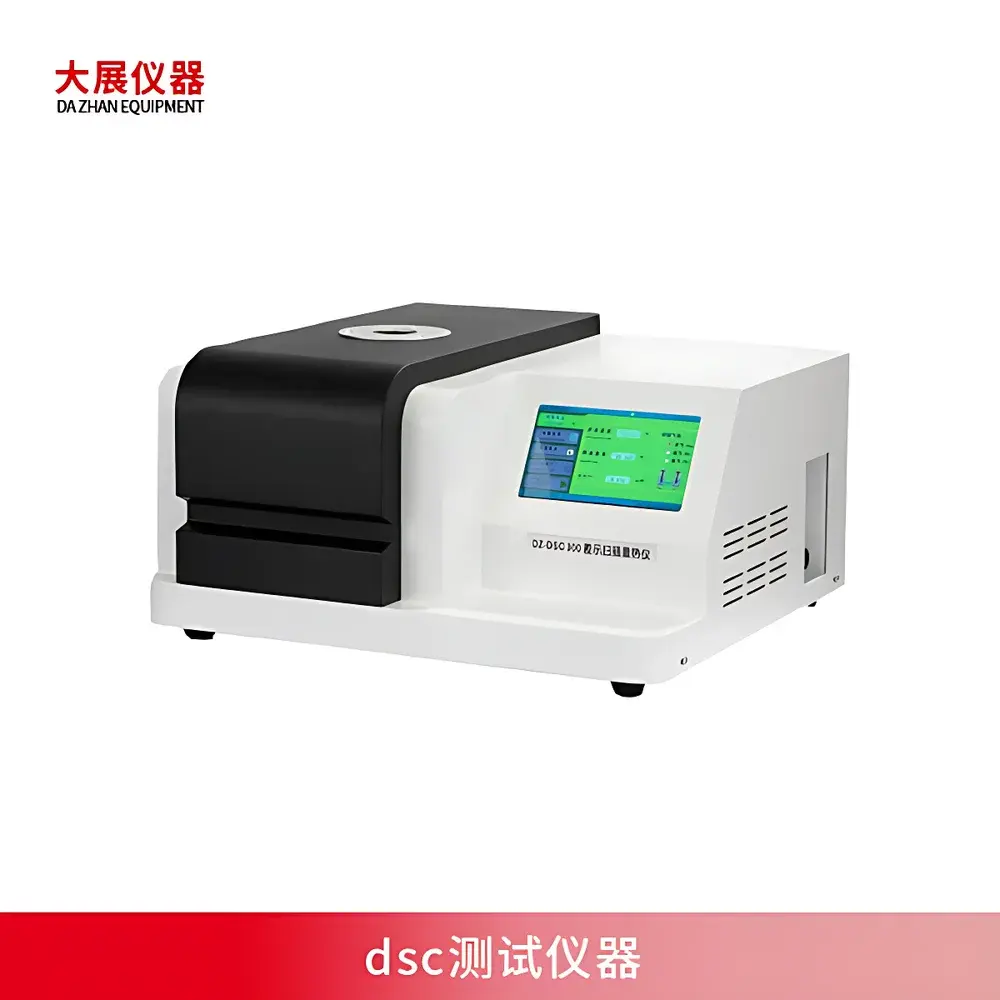
DAZHAN DZ-DSC300 Differential Scanning Calorimeter
| Brand | DAZHAN |
|---|---|
| Origin | Jiangsu, China |
| Model | DZ-DSC300 |
| Temperature Range | Ambient to 600 °C |
| Heating/Cooling Rate | 0.1–100 °C/min |
| DSC Signal Range | 0–±800 mW (expandable) |
| Temperature Stability | ±0.01 °C |
| Temperature Resolution | 0.001 °C |
| Programmable Segments | Up to 6 heating/holding/cooling steps |
| Atmosphere Control | Dual-gas auto-switching (0–200 mL/min, ≤0.5 MPa) |
| Data Interface | Standard USB |
| Display | 7-inch 24-bit color LCD touchscreen |
| Calibration Standards Included | Indium, Tin, Lead |
| Power Supply | AC 220 V / 50 Hz (customizable) |
Overview
The DAZHAN DZ-DSC300 is a high-sensitivity differential scanning calorimeter engineered for precise thermal characterization of solid and semi-crystalline materials across academic, pharmaceutical, polymer, and quality control laboratories. It operates on the heat-flux principle of DSC measurement: two identical crucibles—one containing the sample and the other an inert reference—are subjected to identical, computer-controlled temperature programs. The instrument continuously measures the differential power required to maintain both crucibles at the same temperature, yielding quantitative thermograms that reflect endothermic or exothermic transitions. With a temperature range extending from ambient to 600 °C and programmable ramp rates from 0.1 to 100 °C/min, the DZ-DSC300 supports rigorous thermal profiling including glass transition (Tg), cold crystallization, melting enthalpy (ΔHf), recrystallization, oxidative induction time (OIT), cure kinetics, and decomposition onset. Its dual-gas atmosphere management system enables controlled oxidative or inert environments—critical for stability studies compliant with ISO 11357, ASTM E794, and USP <1163>.
Key Features
- Optimized furnace architecture featuring triple-layer lid insulation and enhanced thermal mass distribution, delivering superior baseline stability (±0.01 °C drift) and improved signal-to-noise ratio.
- Thermopile-based sensor fabricated using thermal fusion bonding—replacing conventional spot-welded junctions—to ensure higher sensitivity, long-term reproducibility, and reduced thermal lag.
- Full bidirectional operation: intuitive local control via 7-inch capacitive touchscreen interface and remote configuration via PC software with real-time data streaming.
- Multi-segment temperature programming: up to six independent heating, isothermal, and cooling steps per run—enabling complex protocols such as modulated DSC (MDSC)-compatible sequences and step-isothermal relaxation experiments.
- Integrated electromagnetic shielding in analog signal acquisition circuitry minimizes environmental noise interference, ensuring reliable micro-watt-level resolution (0.001 mW).
- Automated dual-gas switching module with adjustable flow control (0–200 mL/min) and pressure regulation (≤0.5 MPa), supporting nitrogen, argon, oxygen, or synthetic air purging per ASTM D3895 and ISO 11357-2.
Sample Compatibility & Compliance
The DZ-DSC300 accommodates standard aluminum, gold-plated aluminum, and high-pressure stainless-steel crucibles (up to 100 bar), enabling analysis of volatile organics, reactive polymers, pharmaceutical actives, and food-grade emulsions. Each system ships with NIST-traceable calibration standards (indium, tin, lead) and built-in multi-point temperature correction algorithms aligned with ISO/IEC 17025 validation requirements. Instrument firmware supports audit trail logging, user access levels, and electronic signature capability—facilitating compliance with FDA 21 CFR Part 11, EU Annex 11, and GLP/GMP documentation workflows when paired with validated software modules.
Software & Data Management
Bundled DSCAnalysis Pro software provides ISO-compliant peak integration (tangent, onset, peak maximum), baseline subtraction, kinetic modeling (e.g., Ozawa-Flynn-Wall, Kissinger), and comparative overlay of multiple runs. Raw data export is supported in ASCII, CSV, and universal .QXD formats compatible with third-party platforms including TA Universal Analysis, Netzsch Proteus, and MATLAB. All measurement parameters—including gas flow logs, temperature deviation records, and calibration history—are embedded in metadata headers, ensuring full traceability during regulatory submissions or inter-laboratory round-robin studies.
Applications
- Pharmaceutical development: Polymorph screening, excipient compatibility assessment, lyophilization cycle optimization, and thermal stability evaluation per ICH Q1A(R2).
- Polymer science: Crystallinity quantification, crosslink density estimation, Tg mapping under varying humidity conditions, and degradation mechanism analysis.
- Food science: Fat crystallization behavior, starch gelatinization enthalpy, and shelf-life prediction via accelerated oxidation testing (OIT/OOT).
- Materials engineering: Phase diagram construction for metallic alloys, ceramic sintering profile validation, and nanocomposite thermal interface resistance assessment.
- Academic research: Teaching thermodynamics labs, graduate thesis projects in soft matter physics, and collaborative national key lab initiatives requiring reproducible thermal endpoints.
FAQ
What calibration standards are supplied with the DZ-DSC300?
Indium (Tm = 156.6 °C), tin (Tm = 231.9 °C), and lead (Tm = 327.5 °C) reference metals are included for temperature and enthalpy calibration per ISO 11357-1.
Is the instrument compatible with regulated environments requiring electronic records?
Yes—the optional GxP-ready software package includes role-based access control, audit trail generation, and 21 CFR Part 11-compliant electronic signatures.
Can the DZ-DSC300 perform cooling scans below ambient temperature?
No—it is designed for ambient-to-600 °C operation only; sub-ambient capability requires external cryogenic accessories not included in base configuration.
How is baseline stability maintained during extended isothermal holds?
The triple-insulation furnace design, combined with PID-controlled thermal inertia compensation and active drift correction algorithms, ensures baseline deviation remains within ±0.01 °C over 24-hour holds.
What crucible types are supported for high-pressure or corrosive samples?
Standard aluminum pans are provided; optional high-pressure stainless-steel crucibles (max. 100 bar) and hermetic gold-coated pans are available as configurable accessories.



