
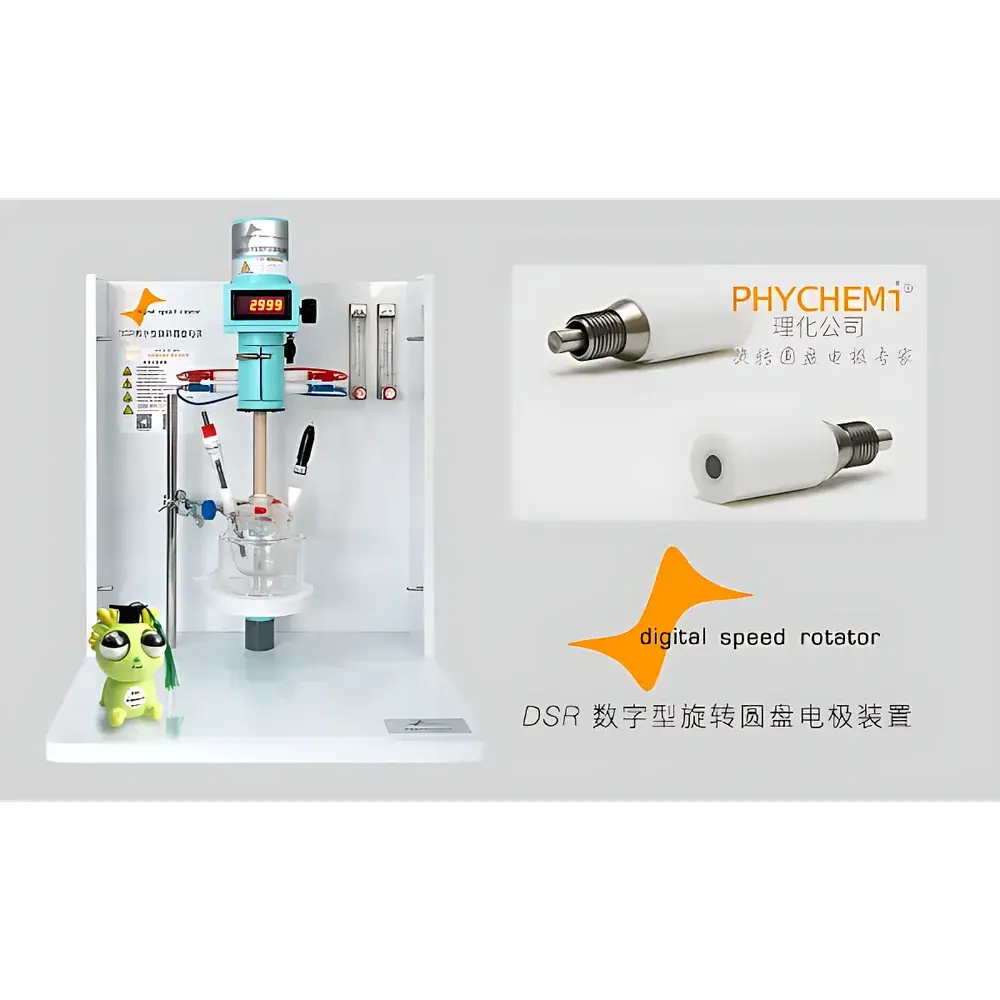
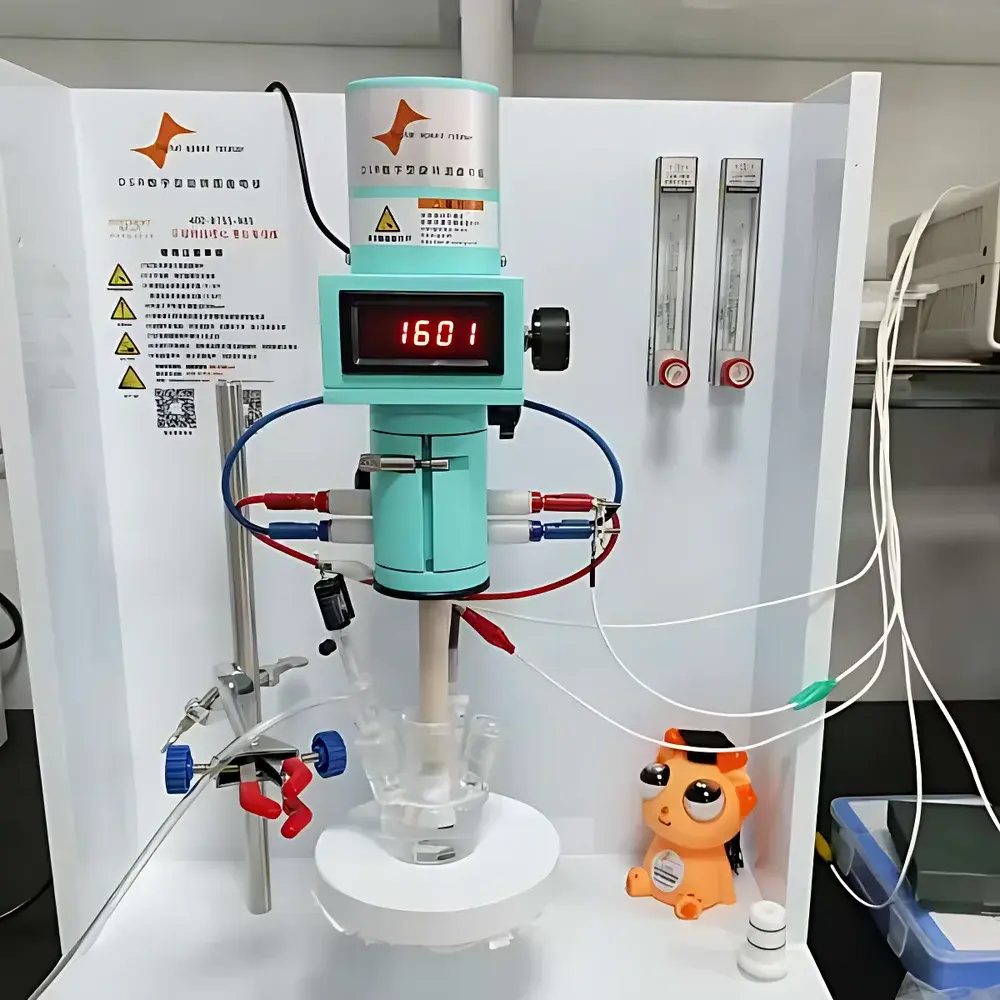
DC-Energies DSR Digital Rotating Disk Electrode (RDE) & Rotating Ring-Disk Electrode (RRDE) System
| Brand | DC-Energies |
|---|---|
| Model | DSR Digital RDE/RRDE System |
| Origin | Hubei, China |
| Motor Power | 20 W |
| Speed Range | 0–10,000 rpm |
| Shaft Length | 170 mm |
| Shaft OD | 15 mm |
| Disk Electrode Diameter | 5.0 mm |
| Disk Electrode OD | 15 mm |
| Disk-Ring Gap | ≤320 µm |
| Disk-Ring Dimensional Tolerance | ±0.01 mm |
| Disk Diameter | 5.61 mm |
| Ring Inner Diameter | 6.25 mm |
| Ring Outer Diameter | 7.92 mm |
| Collection Efficiency | 37% |
| Electrode Housing Materials | PEEK or PTFE |
| Electrical Contact | Silver-carbon brush |
| Power Supply | DC |
| External Speed Control Interface | Yes |
| Explosion-Proof Design | Yes |
| Gas Flow Control | Dual mass flow meters (inert gas + O₂) |
| Warranty | 1 year standard, lifetime technical support |
Overview
The DC-Energies DSR Digital Rotating Disk Electrode (RDE) and Rotating Ring-Disk Electrode (RRDE) System is an engineered electrochemical hydrodynamic measurement platform designed for quantitative kinetic and mechanistic studies in heterogeneous electrocatalysis. Based on the principles of controlled-convection electrochemistry, the system enables precise regulation of mass transport to the electrode surface via well-defined laminar flow—governed by the Levich and Koutecký–Levich equations. Its digital speed control architecture ensures stable, reproducible rotation across the full 0–10,000 rpm range, facilitating accurate determination of diffusion-limited currents, electron transfer numbers (n), and reaction intermediates in multi-step redox processes. The DSR system is purpose-built for integration with potentiostats and electrochemical workstations, supporting rigorous experimental protocols required in academic research, catalyst development labs, and industrial R&D centers focused on energy conversion technologies.
Key Features
- Digital closed-loop speed control with ±1 rpm stability at all setpoints—enabled by a dedicated microcontroller and low-noise DC motor drive;
- Explosion-proof mechanical housing compliant with IEC 60079-0 general requirements for electrical equipment in explosive atmospheres;
- Modular, glovebox-compatible design: detachable shaft assembly (170 mm length, 15 mm OD) allows seamless integration into inert-atmosphere electrochemical cells;
- Low-interference signal path: silver–carbon brush contact eliminates sliding resistance drift and preserves electrochemical signal fidelity up to 1 MHz bandwidth;
- Interchangeable disk and ring-disk electrodes with precision-machined PTFE or PEEK insulating bodies; disk electrode (5.0 mm active diameter, glassy carbon) features external thread interface for repeatable electrical contact and thermal stability from ambient to 80 °C;
- High-accuracy RRDE geometry: disk (5.61 mm), ring inner/outer diameters (6.25 mm / 7.92 mm), gap ≤320 µm, certified collection efficiency of 37% (N = 0.37) traceable to NIST-referenced calibration standards;
- Dual independent mass flow controllers: one for inert gas purging (e.g., Ar/N₂), one for O₂ saturation—enabling strict control of dissolved oxygen concentration during ORR/OER studies;
- U-CUP modular disk holder system permits rapid electrode exchange without recalibration, supports custom disk materials (Pt, Au, Ni, Fe–N–C, etc.), and enables product recovery for post-test analysis.
Sample Compatibility & Compliance
The DSR system accommodates standard 3-, 5-, or custom-designed electrochemical cells—including Teflon-sealed, jacketed, or high-temperature variants. Its electrode geometry conforms to ASTM D4422 (Standard Practice for Electrochemical Testing of Electrocatalysts) and ISO 13483-2 (Electrochemical sensors—Part 2: Performance testing). All electronic modules meet CE marking requirements per EMC Directive 2014/30/EU and Low Voltage Directive 2014/35/EU. For regulated environments, the system supports GLP-compliant operation when paired with 21 CFR Part 11–enabled software platforms—audit trails, user access controls, and electronic signature capabilities can be implemented at the workstation level.
Software & Data Management
While the DSR hardware operates autonomously via front-panel controls or analog/digital TTL input, it is fully compatible with industry-standard electrochemical software suites including BioLogic EC-Lab®, Pine AfterMath®, and Metrohm NOVA. External triggering (start/stop/pause) and real-time speed feedback are supported through BNC or SMB interfaces. When used with time-stamped potentiostat data, rotation-synchronized current transients allow automated Koutecký–Levich regression, Tafel slope extraction, and n-value calculation. Raw speed and torque logs may be exported in CSV format for third-party statistical analysis (e.g., MATLAB, Python SciPy).
Applications
- Oxygen reduction reaction (ORR) kinetics and selectivity analysis (H₂O₂ yield quantification via ring current integration);
- Oxygen evolution reaction (OER) mechanism studies under accelerated degradation conditions;
- Hydrogen evolution reaction (HER) activity benchmarking on non-precious metal catalysts;
- CO₂ electroreduction (CO2RR) pathway discrimination using ring detection of C₂+ intermediates;
- Electrocatalyst stability assessment via rotating ring-disk chronoamperometry (RRD-CA);
- Corrosion science: evaluation of passivation behavior, inhibitor efficiency, and localized dissolution kinetics;
- Fuel cell membrane electrode assembly (MEA) catalyst layer characterization—combined with slurry dispersion, electrode polishing, and ink coating systems (e.g., DC ID-4000, DC REP-180, DC SEC-1000).
FAQ
What is the certified collection efficiency (N) of the DSR RRDE, and how is it validated?
The system is calibrated to deliver N = 0.37 ± 0.005, verified using the [Fe(CN)₆]³⁻/⁴⁻ redox couple in 0.1 M KCl under standardized Levich conditions. Certificate of calibration is provided with each RRDE assembly.
Can the DSR operate inside an argon-filled glovebox?
Yes—the fully detachable shaft and compact control unit (190 × 120 × 65 mm) are designed for glovebox integration; no external air vents or heat sinks are required.
Is firmware upgrade supported remotely?
Firmware updates are delivered via USB flash drive; no internet connection is required on the instrument side, preserving security in isolated lab networks.
Does the system support variable-speed ramping (e.g., linear acceleration profiles)?
Yes—external analog voltage input (0–5 V) enables programmable ramp rates from 0.1 to 500 rpm/s, suitable for transient convection studies.
Are replacement electrodes and U-CUP holders available as consumables?
All electrode configurations (disk-only, RRDE, custom geometries), insulating sleeves (PEEK/PTFE), and U-CUP inserts are stocked and supplied with full dimensional certification reports.




