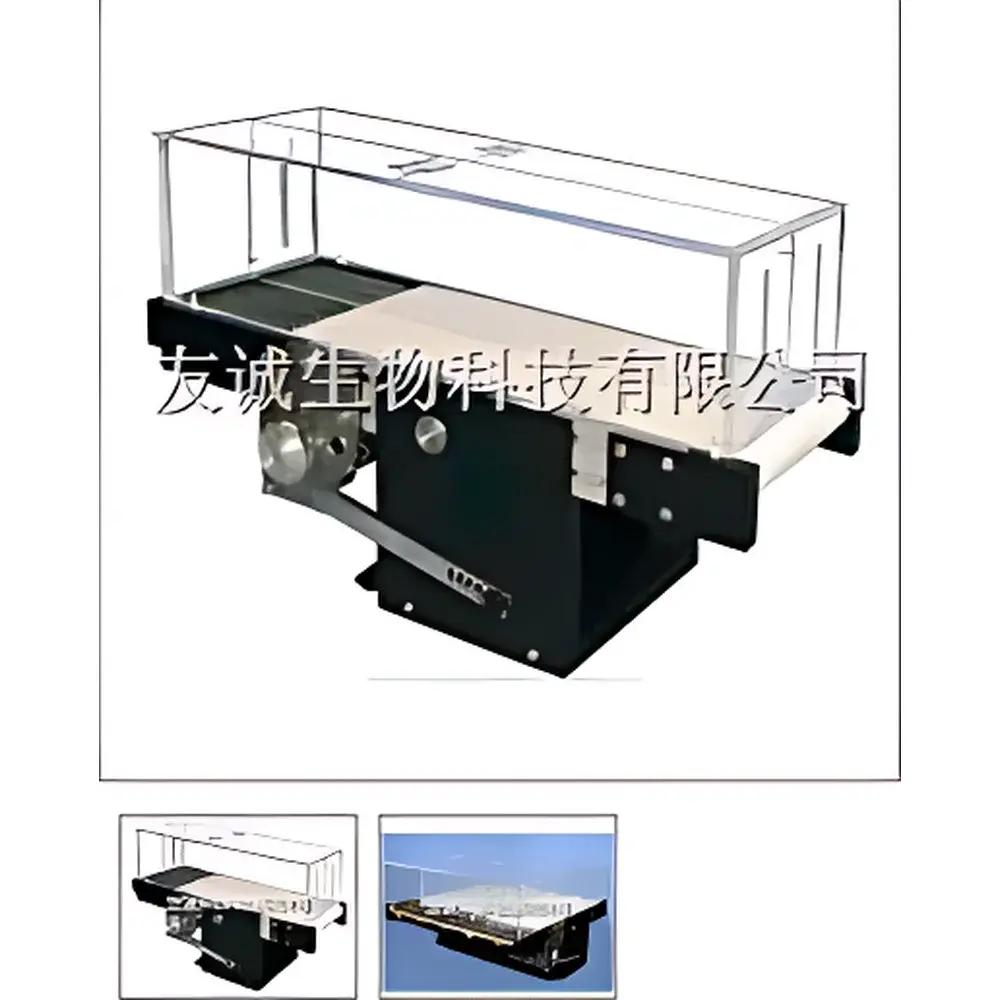
Coulbourn Instruments Model TSE-01001 Animal Treadmill System
| Brand | Coulbourn |
|---|---|
| Origin | USA |
| Manufacturer Type | Authorized Distributor |
| Origin Category | Imported |
| Model | TSE-01001 |
| Pricing | Upon Request |
| Channel Configurations | Single-, Dual-, and 5-Channel Options |
| Speed Control | Programmable Constant & Accelerating Profiles |
| Incline/Decline Adjustment | ±25° Motorized |
| Shock Absorption | Adjustable Compliance Damping |
| Detection Method | Top-Mounted Photobeam Sensors |
| Timing Resolution | 0.1 s Per Chamber |
| Noise Level | <45 dB(A) at 1 m |
| Structural Frame | Powder-Coated Steel with Polycarbonate Enclosures |
| Compliance | Designed for ASTM F2100-22 (Laboratory Equipment Safety), ISO 13485-aligned Manufacturing Practices, GLP-Ready Data Logging |
Overview
The Coulbourn Instruments TSE-01001 Animal Treadmill System is a precision-engineered, multi-channel rodent locomotion platform designed for controlled, quantifiable assessment of motor performance, endurance, fatigue resistance, and sensorimotor integration in preclinical research. Based on validated belt-driven locomotion mechanics, the system applies standardized mechanical stimuli to conscious, freely moving rats and mice under investigator-defined velocity, acceleration, incline, and duration parameters. Unlike forced swim tests—whose physiological stress confound metabolic and cardiovascular interpretation—the treadmill provides direct, load-controlled ambulation that enables reproducible quantification of gait dynamics, time-to-exhaustion, and adaptive neuromuscular responses. Its modular architecture supports both acute challenge protocols (e.g., graded exercise tolerance testing) and chronic training paradigms (e.g., 4–8 week endurance regimens), making it integral to studies in exercise physiology, neurodegeneration, metabolic disease, cardiopulmonary rehabilitation, and pharmacological efficacy evaluation.
Key Features
- Programmable dual-mode speed control: Selectable constant-velocity or linearly accelerating profiles, with user-defined ramp rates (0.1–1.0 m/min/sec) and plateau durations.
- Motorized bidirectional incline adjustment (±25°), enabling uphill resistance training and downhill eccentric loading protocols.
- Configurable channel count: Available as single-, dual-, or five-chamber systems—each chamber independently controlled and monitored.
- Integrated photobeam detection array mounted above each running lane; detects animal disengagement (e.g., failure to maintain pace) with sub-second temporal resolution.
- Adjustable shock-absorbing belt suspension system, calibrated to simulate natural substrate compliance and reduce joint impact during prolonged trials.
- Low-noise operation (<45 dB[A] at 1 meter), minimizing auditory stress artifacts during behavioral assays requiring baseline calm states.
- Robust powder-coated steel frame with optically transparent polycarbonate enclosures for unobstructed video tracking and real-time observation.
Sample Compatibility & Compliance
The TSE-01001 accommodates standard laboratory rodents including C57BL/6, Sprague-Dawley, and Wistar strains (body weight range: 18–500 g). Each chamber features adjustable lane dividers and non-slip belt surface texture optimized for murine paw grip. The system meets structural safety requirements per ASTM F2100-22 for laboratory equipment and adheres to ISO 13485-aligned quality management standards in manufacturing and calibration traceability. All timing, speed, and incline data are logged with timestamped audit trails compliant with Good Laboratory Practice (GLP) documentation standards. Optional integration with third-party video motion analysis platforms (e.g., EthoVision XT, Noldus) supports synchronized kinematic annotation.
Software & Data Management
Control and acquisition are managed via Coulbourn’s proprietary Graphic State Notation (GSN) software, which provides intuitive drag-and-drop protocol design, real-time parameter visualization, and automated event tagging (e.g., photobeam break = “exhaustion”). Raw data—including belt speed, incline angle, elapsed time per chamber, and photobeam status—are exported in CSV and MATLAB-compatible formats. The software supports FDA 21 CFR Part 11-compliant user access controls, electronic signatures, and immutable audit logs when deployed on validated Windows-based workstations. Experimental metadata (animal ID, dose group, session date/time) is embedded directly into output files to ensure traceability across longitudinal studies.
Applications
- Exercise physiology: Quantifying VO₂max surrogates, lactate threshold, and mitochondrial biogenesis markers following chronic training interventions.
- Neurological disease modeling: Assessing gait asymmetry, stride length variability, and fatigue progression in Parkinson’s, ALS, and spinal cord injury models.
- Cardiometabolic research: Evaluating cardiac output adaptation, insulin sensitivity shifts, and adipose tissue remodeling post-exercise.
- Pain and analgesia studies: Measuring weight-bearing asymmetry, voluntary running suppression, and conditioned place avoidance in inflammatory or neuropathic pain models.
- Pharmacokinetic-pharmacodynamic correlation: Linking drug half-life to functional recovery windows in muscle injury or fatigue-reversal assays.
- Toxicology screening: Detecting subclinical motor deficits induced by environmental toxins or chemotherapeutic agents.
FAQ
Can the treadmill be used for both mice and rats?
Yes—the TSE-01001 supports body weights from 18 g (young adult mice) to 500 g (large rats), with lane width and belt speed ranges optimized for species-specific locomotion kinetics.
Is incline reversal (decline mode) programmable within a single protocol?
Yes—motorized incline control allows seamless transitions between +25° uphill and –25° downhill gradients during a single run sequence.
How is exhaustion objectively defined and recorded?
Exhaustion is triggered by three consecutive photobeam breaks within a 5-second window, logged with millisecond timestamp and automatically terminating the trial.
Does the system support integration with electrophysiology or metabolic cages?
Yes—TTL-trigger outputs and analog voltage interfaces enable hardware synchronization with EMG amplifiers, indirect calorimetry systems (e.g., Promethion), and telemetry receivers.
What maintenance is required for long-term reliability?
Belt tension and photobeam alignment require quarterly verification; motor and encoder calibrations are recommended annually using Coulbourn-certified service technicians.
Related Products