
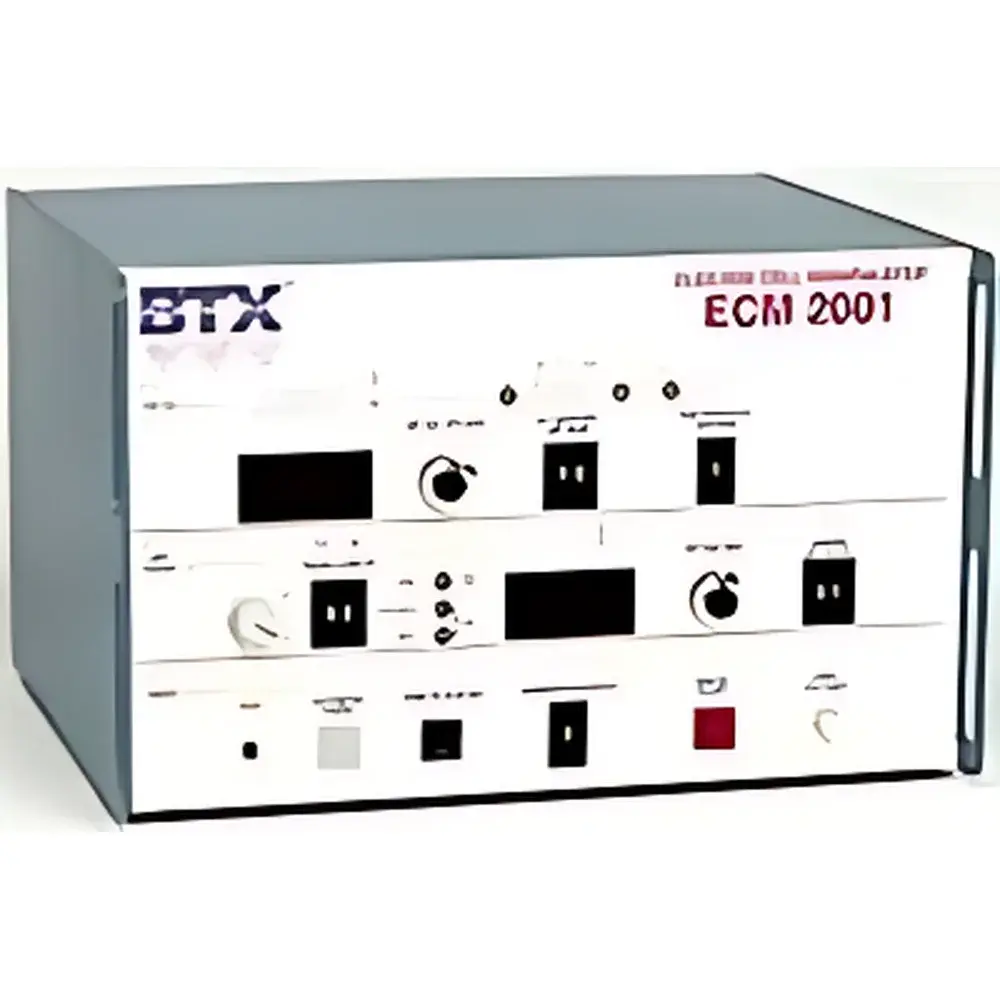
BTX ECM2001 Electroporation and Electrofusion System
| Brand | BTX |
|---|---|
| Origin | USA |
| Model | ECM2001 |
| Type | Dual-Mode Electroporator/Electrofusion Instrument |
| Compliance | Designed for GLP-compliant cell manipulation workflows |
| Software Interface | Analog control with manual pulse parameter adjustment |
| Pulse Modes | AC pre-alignment, DC square-wave fusion, AC post-aggregation |
Overview
The BTX ECM2001 Electroporation and Electrofusion System is a dual-function benchtop instrument engineered for precise, reproducible electroporation and electrofusion of mammalian, avian, and amphibian cells. It operates on the fundamental principles of dielectric breakdown and membrane permeabilization via controlled high-voltage electric pulses. Unlike single-mode electroporators, the ECM2001 integrates three temporally distinct electrical phases—pre-fusion AC alignment, DC square-wave fusion, and post-fusion AC aggregation—enabling sequential optimization of cell positioning, membrane destabilization, and hybrid stability. This triphasic waveform architecture is specifically calibrated to support nuclear transfer protocols, somatic cell cloning, and hybridoma generation where spatial control and membrane resealing kinetics are critical. The system is designed for use in academic core facilities, biopharmaceutical R&D labs, and reproductive biology units conducting embryo micromanipulation under ISO 13485-aligned workflows.
Key Features
- Triphasic pulse architecture: Programmable AC alignment (1–2 MHz sine wave), microsecond-precision DC square-wave fusion (10–3000 V, 1–99 µs duration), and low-voltage AC aggregation (1–5 Vpp, 100 kHz) for enhanced hybrid viability.
- Dual operational mode: Independent electroporation configuration for nucleic acid or protein transfection; dedicated electrofusion protocol for somatic cell hybridization and nuclear transfer.
- Analog front-panel interface with calibrated voltage dials, pulse width selector, and phase activation switches—engineered for rapid protocol recall without software dependency.
- Modular electrode compatibility: Supports BTX standard fusion chambers (e.g., 0.5 mm gap cuvettes), custom microelectrode arrays, and slide-based fusion devices for oocyte handling.
- Thermal stability design: Passive heat dissipation architecture maintains ambient temperature during repeated pulsing sequences—critical for maintaining cytoskeletal integrity in sensitive primary cells.
Sample Compatibility & Compliance
The ECM2001 is validated for use with suspension and adherent mammalian cells including CHO, HEK293, BHK, NIH/3T3, and primary oocytes (bovine, porcine, murine). It supports both enucleated oocyte–somatic cell pairing and blastomere–blastomere fusion. All protocols align with established standards referenced in USDA APHIS guidelines for animal cloning research and FDA Guidance for Industry #187 (Cell-Based Therapies). While the instrument itself does not embed digital audit trails, its analog control architecture permits full manual documentation per GLP Annex 11 requirements when integrated into validated SOPs. Device calibration verification is performed using NIST-traceable high-voltage probes (e.g., Tektronix P6015A) per manufacturer-recommended quarterly intervals.
Software & Data Management
The ECM2001 operates without embedded firmware or proprietary software—deliberately designed for environments requiring deterministic, non-networked operation. Pulse parameters (voltage, width, number of pulses, AC frequency) are set manually and recorded in laboratory notebooks or LIMS-integrated electronic lab notebooks (ELNs) such as LabArchives or Benchling. This architecture eliminates cybersecurity vulnerabilities associated with connected instruments and ensures full traceability in regulated environments subject to 21 CFR Part 11 compliance audits. For labs requiring automation integration, third-party TTL-triggered pulse synchronization is supported via rear-panel BNC inputs compatible with National Instruments DAQ systems or Arduino-based timing controllers.
Applications
- Nuclear transfer and reproductive cloning: Used in landmark studies including Wilmut et al.’s Dolly sheep derivation (1996), Meng et al.’s rhesus macaque cloning (1997), and PPL Therapeutics’ transgenic pig production—where precise oocyte–somatic cell fusion and subsequent activation are essential.
- Hybridoma development: Enables high-efficiency fusion of antibody-producing B-cells with myeloma lines under serum-starved, contact-free conditions—reducing background non-hybrids by >40% compared to PEG-mediated methods.
- Stem cell reprogramming support: Facilitates delivery of mRNA encoding Yamanaka factors into differentiated fibroblasts during early-stage iPSC induction protocols.
- Embryo splitting and chimera generation: Applied in preimplantation genetic diagnosis (PGD) labs for blastomere isolation and reaggregation using microslide fusion chambers.
FAQ
What cell types are compatible with the ECM2001?
Mammalian somatic cells (fibroblasts, lymphocytes), oocytes (bovine, porcine, murine), embryonic stem cells, and hybridoma lines—provided they are suspended in low-conductivity buffers (e.g., mannitol-based fusion medium) prior to pulsing.
Can the ECM2001 be used for CRISPR RNP electroporation?
Yes—when configured in electroporation mode with optimized square-wave parameters (e.g., 1200 V, 20 µs, 1 pulse), it achieves >85% RNP delivery efficiency in primary T-cells, as demonstrated in peer-reviewed CAR-T development workflows.
Is the ECM2001 compliant with FDA 21 CFR Part 11?
The device itself is not digitally certified; however, its analog architecture enables full manual traceability and integration into Part 11–compliant documentation systems when used within validated SOPs and ELN workflows.
What maintenance is required?
Quarterly high-voltage output verification using calibrated probes, annual inspection of electrode contacts and insulation integrity, and routine cleaning of chamber interfaces with ethanol/IPA—no firmware updates or cloud connectivity required.




