
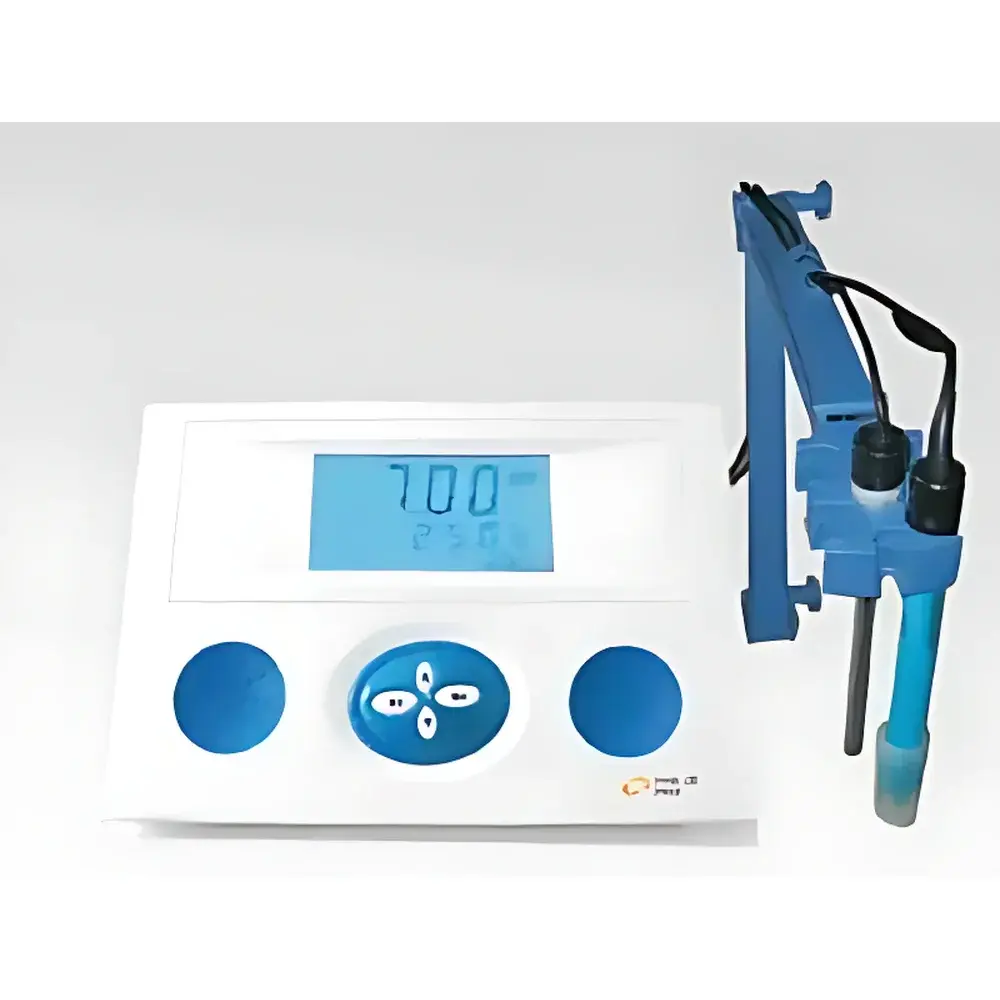
DDS-307A Digital Conductivity Meter
| Origin | Shanghai, China |
|---|---|
| Manufacturer Type | Authorized Distributor |
| Origin Category | Domestic (PRC) |
| Model | DDS-307A |
| Price | USD 230 (FOB Shanghai) |
| Accuracy Class | 1.0 |
| Conductivity Range | 0–1.999 μS/cm, 2.0–19.99 μS/cm, 20.0–199.9 μS/cm, 200–1999 μS/cm, 2.0–19.99 mS/cm, 20.0–199.9 mS/cm |
| Temperature Range | –5 to 105 °C |
| Conductivity Accuracy | ±1.0% FS |
| Temperature Accuracy | ±0.5 °C |
| Temp. Compensation | 0–100 °C, Coefficient 2.0%/°C |
| Electrode Constants Supported | 0.01, 0.1, 1.0, 10.0 cm⁻¹ |
| Display | Backlit LCD, Multi-parameter |
| Auto Functions | Auto-ranging, Auto-calibration, Auto-temperature compensation |
| Measurement Modes | Conductivity, Resistivity, TDS, Temperature |
Overview
The DDS-307A Digital Conductivity Meter is a benchtop electrochemical instrument engineered for precision measurement of electrical conductivity, resistivity, and total dissolved solids (TDS) in aqueous solutions across research laboratories, quality control environments, and industrial process monitoring applications. It operates on the principle of two-electrode AC conductometric measurement—applying a low-frequency alternating current to minimize electrode polarization and ensure stable, reproducible readings. The instrument conforms to fundamental metrological requirements defined in ISO 7888 (Water quality — Determination of electrical conductivity) and supports traceable calibration protocols aligned with GLP-compliant workflows. Its six-range auto-scaling architecture enables seamless transition between ultrapure water (e.g., 0.055 µS/cm at 25 °C) and highly conductive brines (up to 199.9 mS/cm), eliminating manual range selection errors and reducing operator dependency.
Key Features
- High-stability microprocessor-based electronics with embedded temperature-compensated algorithms (2.0%/°C coefficient, adjustable within 0–100 °C range)
- Backlit graphical LCD display showing simultaneous conductivity, resistivity, TDS, and real-time temperature values
- Full auto-function suite: automatic range switching, automatic one-point or two-point calibration (using standard KCl solutions), and real-time temperature compensation
- Universal electrode interface compatible with four standardized cell constants: 0.01 cm⁻¹ (for ultrapure water), 0.1 cm⁻¹ (for deionized water and pharmaceutical water), 1.0 cm⁻¹ (general laboratory use), and 10.0 cm⁻¹ (high-conductivity samples such as seawater or industrial effluents)
- Electronic accuracy certified to Class 1.0 per GB/T 11016–2018 (equivalent to IEC 60746-3:2019 for conductivity meters), with basic error ≤ ±1.0% of full scale for conductivity and ±0.5 °C for temperature sensing
- Rugged ABS housing with IP20-rated enclosure suitable for controlled indoor laboratory environments
Sample Compatibility & Compliance
The DDS-307A is validated for use with aqueous electrolyte solutions—including purified water (WFI, PW), buffer solutions, cooling tower water, boiler feedwater, wastewater, and food-grade process liquids. It does not support non-aqueous or highly viscous media. When paired with a certified 0.01 cm⁻¹ cell, it achieves reliable detection down to 0.02 µS/cm (typical for Type I ultrapure water per ASTM D1193). The instrument meets functional requirements for routine QC testing under ISO/IEC 17025-accredited laboratories and supports documentation practices consistent with FDA 21 CFR Part 11 when integrated with external audit-trail-capable data loggers (not included). All calibration records, measurement timestamps, and temperature logs can be manually transcribed into LIMS or ELN systems.
Software & Data Management
The DDS-307A operates as a standalone unit without proprietary software or USB connectivity. Data output is limited to visual readout and manual recording; no RS-232, Bluetooth, or analog output ports are provided. However, its stable analog front-end and repeatable auto-calibration sequence ensure high inter-instrument comparability—critical for multi-site labs performing parallel testing. Users may integrate the meter into automated workflows via external relay-triggered logging devices or camera-based OCR systems for digital record capture. Calibration certificates for matched electrode–meter pairs are available upon request and include NIST-traceable KCl reference solution verification data.
Applications
- Pharmaceutical water system validation (PW, WFI, Purified Water per USP )
- Environmental monitoring of surface water, groundwater, and wastewater effluent conductivity trends
- Chemical manufacturing process control for acid/base concentration verification
- Food & beverage production line checks for rinse water purity and cleaning-in-place (CIP) endpoint detection
- Academic teaching labs for fundamental electrochemistry experiments (Kohlrausch’s law, ion mobility studies)
- Power plant demineralizer outlet monitoring and condensate purity assurance
FAQ
What electrode constant should I select for measuring ultrapure water?
Use a 0.01 cm⁻¹ cell—this minimizes polarization error and extends lower detection limits into the sub-0.1 µS/cm range.
Does the DDS-307A comply with ASTM D1125 or ISO 7888?
Yes—the instrument’s measurement methodology, temperature compensation algorithm, and accuracy specifications align with the operational principles defined in both standards.
Can I perform multi-point calibration?
No—calibration is limited to one-point or two-point (low/high) using certified KCl standards; no polynomial or custom curve fitting is supported.
Is temperature probe included with the meter?
Yes—a built-in Pt1000 RTD sensor is integrated into the main unit; no external probe is required for standard operation.
What is the recommended recalibration frequency?
Per ISO/IEC 17025, recalibrate before each analytical batch or at least once per shift when used continuously; verify daily with a secondary standard if traceability is critical.





