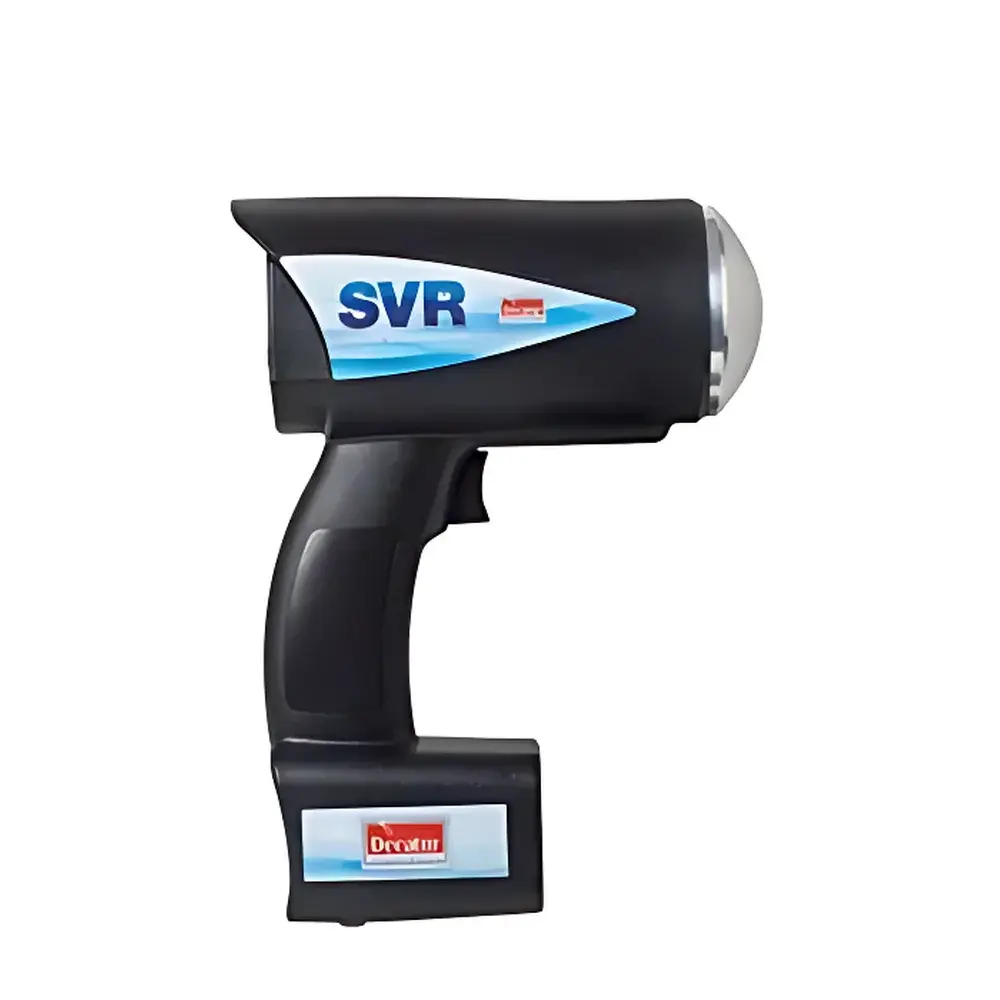
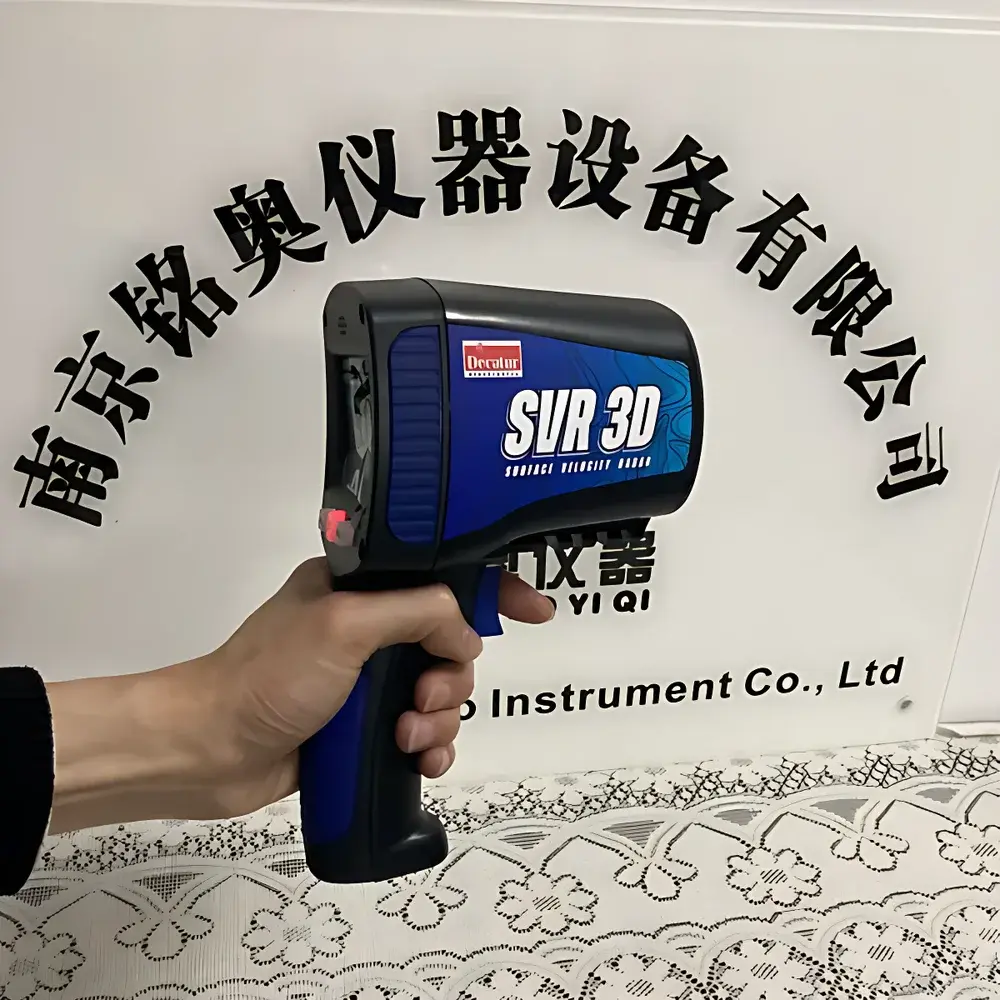
Decatur SVR 3D Microwave Surface Velocity Radar
| Brand | Decatur |
|---|---|
| Origin | USA |
| Model | SVR 3D |
| Measurement Principle | Doppler-based microwave radar |
| Velocity Range | 0.3–20.00 m/s |
| Accuracy | ±0.05 m/s |
| Resolution | 0.01 m/s |
| Maximum Range | 100 m |
| Beam Angle | 12° (horizontal) |
| Transmit Power | 7 mW |
| Operating Temperature | −30 °C to +70 °C |
| Tilt Compensation | Automatic vertical (via integrated inclinometer) |
| Housing Material | ABS/polycarbonate blend |
| IP Rating | IP55 per IEC 60529:1989 & EN 60529 |
| Power Supply | 6× AA NiMH batteries or detachable 12 VDC cable with cigarette lighter adapter |
| Display Units | m/s, ft/s |
| Signal Processing | 32-bit DSP engine |
| Humidity Resistance | 90% RH at +37 °C |
Overview
The Decatur SVR 3D Microwave Surface Velocity Radar is a field-deployable, non-contact surface velocity measurement instrument engineered for hydrological monitoring, emergency response, and real-time open-channel flow assessment. It operates on the principle of continuous-wave Doppler radar: a 24.125 GHz microwave signal is transmitted toward the water surface; motion-induced frequency shift (Doppler shift) in the reflected signal is detected and converted into surface velocity using calibrated signal processing algorithms. Unlike ultrasonic or electromagnetic sensors, the SVR 3D requires no physical immersion, eliminates sensor fouling risks, and functions reliably under turbulent, aerated, or debris-laden conditions—making it especially suitable for flash flood monitoring, dam outflow verification, and post-storm rapid deployment scenarios.
Key Features
- Non-contact operation ensures operator safety during high-flow, hazardous, or inaccessible channel conditions.
- Integrated 32-bit digital signal processor (DSP) enables real-time velocity computation with high signal-to-noise ratio, even over low-reflectivity surfaces (e.g., smooth laminar flows or sediment-laden water).
- Automatic vertical tilt compensation via built-in solid-state inclinometer maintains measurement integrity on uneven terrain or sloped embankments.
- Manual horizontal angle adjustment (0°–60° in 5° steps) allows precise targeting of flow vectors across curved channels or angled cross-sections.
- Ruggedized housing constructed from an ABS/polycarbonate polymer blend meets IP55 ingress protection standards—resistant to dust ingress and low-pressure water jets from any direction.
- Dual power architecture supports extended field use: six AA NiMH rechargeable batteries (typical runtime >12 h) or optional 12 VDC input via automotive cigarette lighter adapter.
- Ergonomic rubber keypad with dedicated Menu, Select, Power, Recall, and Mode buttons enables intuitive one-handed operation wearing gloves in adverse weather.
Sample Compatibility & Compliance
The SVR 3D is optimized for natural and engineered open-channel flows—including rivers, canals, spillways, culverts, and stormwater conveyances—where surface velocity correlates strongly with mean flow velocity (typically applied with established rating curves or index-velocity methods). It does not require calibration against submerged instrumentation but benefits from periodic validation using certified current meters or ADCPs. The device complies with international electromagnetic compatibility (EMC) requirements per FCC Part 15 Subpart B and CE marking directives (2014/30/EU). Its radar emission profile conforms to ICNIRP exposure guidelines for occupational environments. While not intrinsically rated for Zone 1 hazardous areas, its non-sparking design and low-power transmission (7 mW) support safe use in most civil infrastructure settings.
Software & Data Management
The SVR 3D operates as a standalone field instrument with no embedded data logging; however, all measurements are displayed in real time with unit-switching capability (m/s or ft/s) and timestamped manually via user annotation. For integration into broader hydrometric networks, velocity outputs may be recorded externally using field tablets or notebooks. Although the device lacks native Bluetooth or USB connectivity, its consistent output protocol and stable analog behavior enable straightforward interfacing with third-party SCADA systems via external analog-to-digital converters. Firmware updates are not field-upgradable; service-level revisions are managed through authorized Decatur technical support channels. All operational parameters—including tilt offset, unit preference, and backlight timeout—are retained in non-volatile memory across power cycles.
Applications
- Real-time flood stage and velocity monitoring during extreme weather events.
- Validation of stage-discharge relationships in USGS and NOAA-certified gauging stations.
- Rapid post-event hydraulic assessment following levee breaches or dam releases.
- Index-velocity calibration for permanent acoustic Doppler velocimeters (ADVs) or acoustic Doppler current profilers (ADCPs).
- Field verification of computational fluid dynamics (CFD) model boundary conditions in river restoration projects.
- Regulatory compliance reporting under EPA Method 1605 (surface velocity estimation for wastewater outfalls) and ASTM D5451–22 (standard practice for open-channel flow measurement using surface velocity radars).
FAQ
How does the SVR 3D handle varying water surface conditions, such as foam or ripples?
The 24.125 GHz microwave band provides strong reflectivity from capillary waves and small-scale surface disturbances, enabling robust detection even on aerated or partially foamed flows. However, sustained standing waves or deep hydraulic jumps may reduce signal coherence and require repositioning.
Is the SVR 3D suitable for measuring velocities in tidal estuaries with bidirectional flow?
Yes—the Doppler algorithm distinguishes directionality (approach vs. recession) and displays signed velocity values. Users must ensure unobstructed line-of-sight and account for salinity-driven dielectric changes only when extrapolating to volumetric flow without auxiliary depth data.
Does the device meet NIST-traceable calibration requirements?
The SVR 3D is factory-calibrated against NIST-traceable reference velocity sources using controlled flume testing. Calibration certificates are provided with each unit; field recalibration is not required under normal operating conditions but recommended annually or after mechanical shock.
Can the SVR 3D be mounted permanently on a bridge or gantry?
Yes—its compact form factor (220 × 125 × 100 mm), IP55 rating, and 12 VDC input option support semi-permanent installation. Mounting hardware and vibration-damping brackets are available through Decatur’s accessories catalog.
What is the minimum detectable velocity, and how is it affected by distance?
The lower limit of 0.3 m/s is specified at optimal range (≤30 m). At maximum range (100 m), beam spread and reduced signal return may raise the effective threshold to ~0.5 m/s; users should verify performance at site-specific distances during commissioning.