
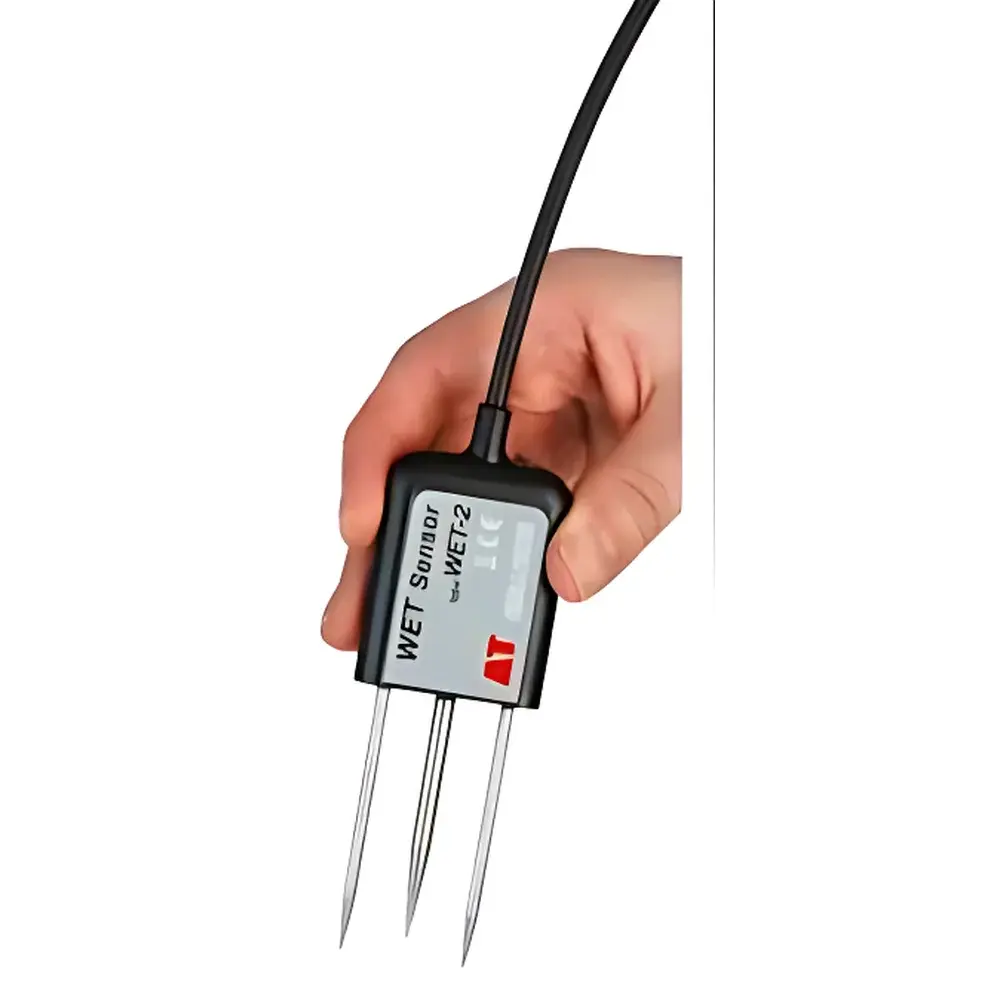
Delta-T Devices WET-2-K1 Soil Moisture, Temperature & Electrical Conductivity Sensor
| Brand | Delta-T Devices |
|---|---|
| Origin | United Kingdom |
| Model | WET-2-K1 |
| Instrument Type | Multifunctional Soil Analyzer |
| Measurement Principle | Frequency Domain Reflectometry (FDR) |
| Temperature Range | –5 to 50 °C (±1.5 °C accuracy, 0.1 °C resolution) |
| Dielectric Permittivity Range | 1–80 (±2.5 units accuracy, 1 unit resolution) |
| Bulk Electrical Conductivity (ECb) | 0–200 mS·m⁻¹ (±10 mS·m⁻¹ accuracy, 1 mS·m⁻¹ resolution) |
| Volumetric Water Content (VWC) | 0–100% (±3% accuracy, 0.1% resolution) |
| Pore Water Conductivity (ECp) | up to 1500 mS·m⁻¹ (1 mS·m⁻¹ resolution) |
| Probe Dimensions | 3 mm Ø × 68 mm L (central electrode: 5 mm × 60 mm) |
| Sampling Volume | ~500 mL |
| Operating Voltage | 6–10 V DC |
| Current Draw | ~38 mA |
| Output | TTL Serial Data |
| Operating Frequency | 20 MHz |
| Response Time | 2.5 s |
| Enclosure Rating | IP68 |
| Operating Ambient Temperature | 0–50 °C |
| Standard Cable Length | 2 m |
Overview
The Delta-T Devices WET-2-K1 is a field-deployable, three-parameter soil sensor engineered for simultaneous, in-situ measurement of volumetric water content (VWC), soil temperature, and bulk electrical conductivity (ECb) using Frequency Domain Reflectometry (FDR). Unlike single-parameter probes or time-domain transmission (TDT) systems, the WET-2-K1 integrates a coaxial three-electrode geometry that enables concurrent acquisition of dielectric permittivity (εr), thermal resistance, and conductive loss—allowing robust derivation of both ECb and, critically, pore water electrical conductivity (ECp) via empirical calibration against VWC. This capability supports quantitative interpretation of soil solution salinity independent of matrix effects, making it particularly valuable in saline agriculture, irrigation management, and biogeochemical flux studies where ion mobility and solute transport dynamics are central.
Key Features
- Triple-parameter FDR sensing architecture delivering synchronized VWC, temperature, and ECb with traceable metrological performance.
- IP68-rated stainless-steel probe housing with precision-machined 3 mm diameter electrodes (central electrode 5 mm × 60 mm), optimized for minimal soil disturbance and repeatable insertion in mineral and organic soils.
- High-frequency 20 MHz excitation ensures immunity to contact resistance artifacts and reliable operation across variable soil textures—from sandy loams to clay-rich profiles.
- Integrated temperature compensation applied in real time to both dielectric and conductivity calculations, eliminating post-hoc correction dependencies.
- Low-power design (6–10 V DC, ~38 mA) compatible with battery-powered data loggers and solar-recharged field stations for long-term unattended deployment.
- Serial TTL output enables direct integration with Campbell Scientific, Onset HOBO, or custom microcontroller-based acquisition systems without signal conditioning.
Sample Compatibility & Compliance
The WET-2-K1 is validated for use in mineral soils, peat, potting media, and hydroponic substrates. Its 500 mL effective sampling volume ensures representative characterization at the root-zone scale. The probe meets IEC 60529 IP68 ingress protection standards for continuous submersion up to 1 m depth, supporting installation in flooded fields or lysimeters. While not certified to ISO/IEC 17025 for accredited calibration, its factory calibration traceability aligns with ASTM D5437 (Standard Test Method for Determining Soil Moisture Content Using Electromagnetic Sensors) and supports GLP-compliant data collection when deployed with audit-trail-enabled logging platforms. No hazardous substances are used in construction; RoHS and REACH compliance is documented per Delta-T Devices’ EU Declaration of Conformity.
Software & Data Management
Data acquisition is supported via the HH2 handheld meter (2100-point internal memory, USB interface) or third-party loggers using ASCII serial protocol (9600 baud, N, 8, 1). Delta-T’s PC-based WETView software provides visualization, batch export (CSV, Excel), and user-defined calibration equation application—including custom εr-to-VWC and ECb-to-ECp transformations. All raw sensor outputs (dielectric count, thermistor ADC value, conductance magnitude) are accessible for algorithmic reprocessing. When integrated into networked environmental monitoring systems, timestamped records comply with FDA 21 CFR Part 11 requirements for electronic records if paired with appropriate audit trail and electronic signature modules.
Applications
- Irrigation scheduling in horticulture and viticulture, leveraging real-time ECp to avoid salt accumulation in root zones.
- Soil hydrology research requiring co-located thermal and dielectric properties to parameterize Richards’ equation models.
- Long-term ecological monitoring networks assessing climate-driven changes in soil moisture regimes and solute leaching potential.
- Green infrastructure evaluation (e.g., bioswales, rain gardens) where rapid assessment of infiltration capacity and contaminant transport is required.
- Calibration and validation of remote-sensing soil moisture products (e.g., SMAP, Sentinel-1) at field scale.
FAQ
Can the WET-2-K1 be used in frozen soils?
No. The probe is specified for operation between –5 °C and 50 °C, but dielectric measurement becomes unreliable below 0 °C due to phase transition effects on polarization response.
Does the probe require soil-specific calibration?
Factory calibration covers typical mineral soils (clay < 40%, OM < 10%). For high-organic or saline-sodic soils, users may apply site-specific εr-VWC and ECb-ECp relationships derived from gravimetric and extract analysis.
How is pore water conductivity (ECp) calculated?
ECp is estimated using the Hilhorst model, which relates bulk conductivity (ECb), dielectric permittivity (εr), and temperature-corrected solution conductivity—requiring no separate pore water extraction.
Is the HH2 meter necessary for data collection?
No. The WET-2-K1 outputs TTL serial data and can interface directly with any RS-232/RS-485 converter or microcontroller with UART capability.
What is the recommended recalibration interval?
Delta-T recommends verification against reference standards every 24 months under normal field use; more frequent checks are advised in abrasive or highly saline environments.







