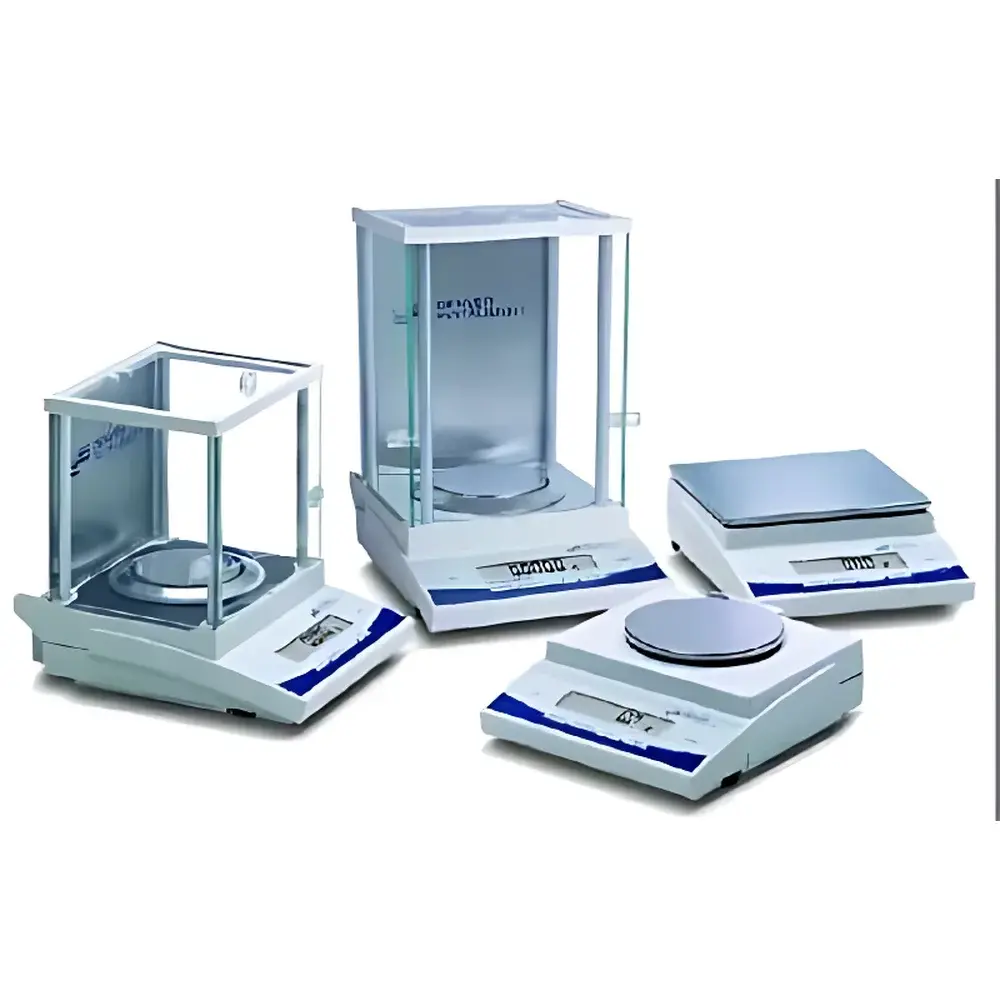
Denver TP Series Standard Electronic Balance
| Brand | Denver |
|---|---|
| Origin | USA |
| Manufacturer Type | Authorized Distributor |
| Origin Category | Imported |
| Model | TP Series Standard Electronic Balance |
| Pricing | Available Upon Request |
| Sensor Technology | Dual-stage Integrated Load Cell |
| Filtering | Quadruple Intelligent Digital Filtering |
| Calibration | Automatic External Calibration System |
| Temperature Compensation | Full-Range Active Temperature Compensation |
| Diagnostics | Real-time Automated Fault Detection |
| Anti-Static Design | Anodized Aluminum Draft Shield Backplate |
| Overload Protection | Integrated Mechanical & Electronic Safeguard |
| Applications | Piece Counting, Animal Weighing, Percentage Weighing, Net/Gross/Formula Summation, Unit Conversion |
| Display | High-Contrast LCD |
| Interface | Bidirectional RS-232 |
| Keypad | Tactile Feedback Keys |
| Battery Operation | Select Models (TP-202, TP-402, TP-602, TP-2101, TP-4101, TP-6101) |
| Balance Types | Analytical (TP-114, TP-214), Precision (TP-213, TP-313, TP-1102, TP-2102, TP-3102), and General-Purpose (TP-202–TP-6101) |
| Weighing Range | 110 g to 6100 g |
| Readability | 0.0001 g to 0.1 g |
| Pan Dimensions | Ø90 mm or 174 × 143 mm or Ø116 mm |
| Repeatability | ≤ ±0.0001 g to ±0.1 g |
| Linearity | ≤ ±0.0002 g to ±0.2 g |
Overview
The Denver TP Series Standard Electronic Balance is an engineered precision weighing platform designed for routine laboratory, quality control, and industrial applications where reliability, repeatability, and regulatory traceability are essential. Built upon a dual-stage integrated load cell architecture, the TP Series delivers stable force transduction across its operational range—minimizing drift under thermal fluctuation and mechanical disturbance. Its full-range active temperature compensation continuously adjusts internal gain and offset parameters in real time, ensuring consistent metrological performance from ambient startup through extended operation. Unlike single-point compensated systems, this architecture maintains accuracy across the entire span without requiring manual recalibration at intermediate points. The balance operates on fundamental electromagnetic force restoration principles common to modern analytical and precision balances, with digital signal processing optimized for low-noise, high-stability output. All models comply with international weighing standards including OIML R76, NIST Handbook 44, and ISO/IEC 17025 requirements for calibration validity and measurement uncertainty reporting.
Key Features
- Dual-stage integrated load cell design for enhanced mechanical stability and long-term zero retention
- Quadruple intelligent digital filtering—adaptive algorithm dynamically selects optimal filter profile based on sample dynamics and environmental vibration
- Automatic external calibration system with user-initiated or scheduled calibration routines; supports calibration weight recognition via RS-232 handshake
- Full-range active temperature compensation using embedded thermal sensors and proprietary correction coefficients
- Real-time automated fault diagnostics with self-reporting of sensor anomalies, power instability, draft shield interference, and overload events
- Anodized aluminum draft shield backplate—engineered to dissipate static charge and reduce electrostatic interference during low-mass weighing
- Mechanical + electronic overload protection: hardware limit stops engage before sensor saturation; firmware disables weighing and logs event timestamp
- Tactile feedback keypad ensures positive actuation—critical in gloved-hand environments and high-throughput workflows
- Bidirectional RS-232 interface compliant with standard ASCII protocol; compatible with LIMS, ELN, and statistical process control (SPC) software
Sample Compatibility & Compliance
The TP Series accommodates diverse sample forms—including powders, granules, liquids in tared containers, live animals (via animal weighing mode with stabilization damping), and irregular solids—across its analytical (0.0001 g readability), precision (0.001–0.01 g), and general-purpose (0.1 g) configurations. All models meet Class I and II environmental classification per ANSI/NCSL Z540.3 for laboratory use. The TP-114 and TP-214 analytical models are suitable for USP and applications involving assay uniformity and content testing. Precision models (e.g., TP-2102, TP-3102) support ASTM E899-22 for mass calibration verification and ISO 9001 clause 7.6 compliance in manufacturing QA/QC labs. The RS-232 interface enables audit-trail-capable data export aligned with FDA 21 CFR Part 11 requirements when integrated with validated data acquisition software.
Software & Data Management
Data capture is natively supported via RS-232 serial communication using standard delimiter protocols (CR/LF, tab, comma). The balance outputs timestamped records including gross/net/tare mass, application mode identifier, calibration status flag, and diagnostic code. When connected to compliant laboratory information management systems (LIMS) or electronic lab notebooks (ELN), raw data streams retain full metadata integrity—enabling GLP/GMP-aligned audit trails. Optional Denver Balance Manager software (v3.2+) provides configurable report templates, statistical summaries (mean, SD, CV%), and trend visualization across multiple instruments. All firmware updates are digitally signed and installed via secure USB-to-serial bridge, maintaining cryptographic integrity per IEC 62443-3-3 SL2 requirements.
Applications
- Pharmaceutical QC: tablet weight variation (USP ), active ingredient assay preparation, excipient dispensing
- Chemical synthesis: stoichiometric reagent dosing, catalyst loading, yield calculation
- Food & beverage: recipe formulation, nutritional labeling compliance, portion control validation
- Materials science: powder density determination, coating thickness estimation via mass loss
- Educational laboratories: foundational metrology training, uncertainty propagation exercises, calibration hierarchy demonstration
- Environmental testing: filter mass gain analysis (EPA Method 1695), sediment drying protocols
FAQ
Does the TP Series support internal calibration?
No—calibration is performed externally using certified weights; the system features automatic external calibration with programmable trigger intervals and weight recognition.
Is the RS-232 interface compatible with modern Windows/macOS systems?
Yes—when used with a certified USB-to-RS-232 adapter and standard terminal emulation (e.g., Tera Term, PuTTY), the interface maintains full command-response fidelity.
Can the balance be operated in regulated environments requiring 21 CFR Part 11 compliance?
Yes—when paired with validated third-party data acquisition software that implements electronic signatures, audit trails, and role-based access control.
What is the recommended calibration frequency for GMP-regulated use?
Per ISO/IEC 17025:2017 Clause 6.4.6, calibration interval must be risk-assessed; Denver recommends daily performance verification and formal calibration every 24–72 hours depending on usage intensity and criticality.
Are draft shields included with all models?
Yes—standard acrylic draft shields are supplied with analytical and precision models; general-purpose models (TP-202 and above) include optional shield kits for controlled environments.