
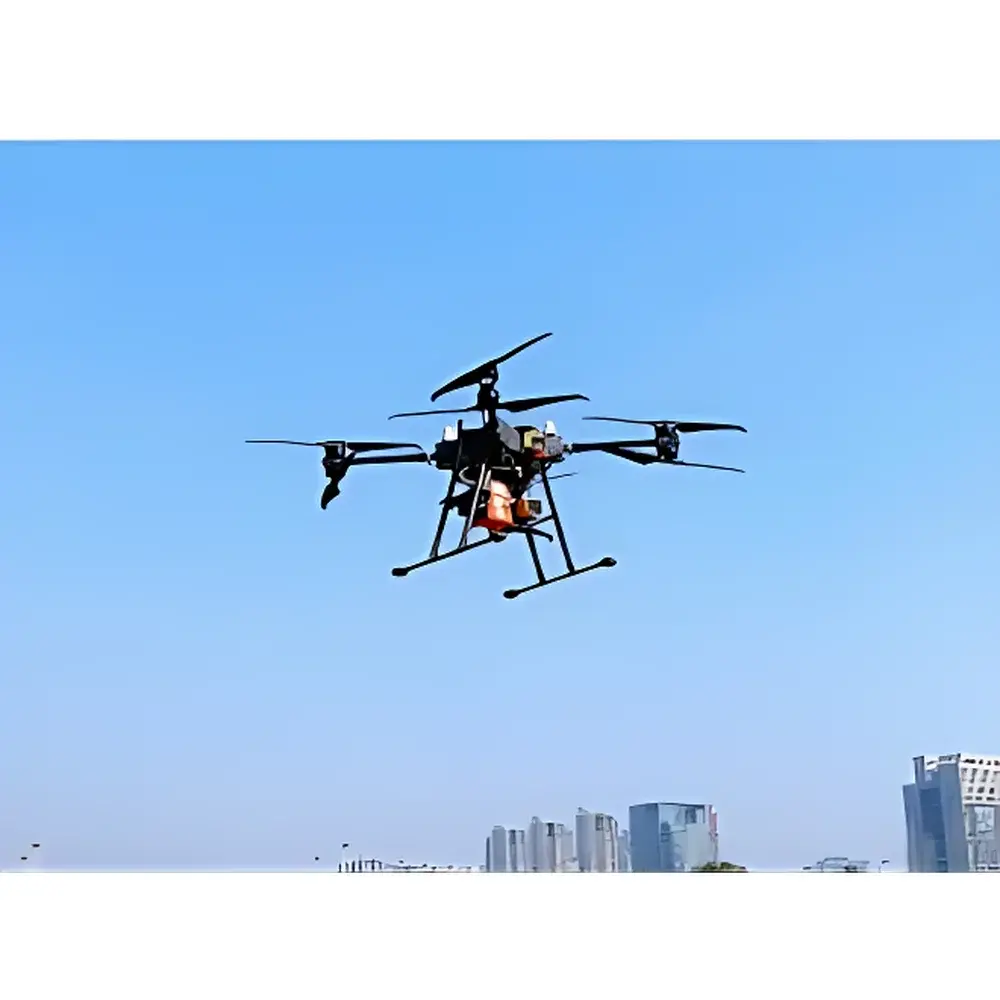
EcoTech Ecodrone® LiDAR-Based Bathymetric and Topographic Surveying UAV System
| Brand | EcoTech |
|---|---|
| Origin | Beijing, China |
| Manufacturer Type | Authorized Distributor |
| Country of Origin | China |
| Model | Ecodrone® |
| Pricing | Upon Request |
Overview
The EcoTech Ecodrone® LiDAR-Based Bathymetric and Topographic Surveying UAV System is an integrated airborne remote sensing platform engineered for high-precision, dual-domain (subaerial and subaqueous) terrain mapping. It leverages full-waveform green-wavelength (532 nm) LiDAR technology—specifically the YellowScan Navigator sensor—to simultaneously acquire bathymetric and topographic point clouds in a single flight pass. Unlike conventional airborne LiDAR systems limited to terrestrial surfaces, this system exploits the optical transmission properties of visible green light in clear water columns to penetrate the air-water interface and return both surface and submerged echoes. Its operational principle follows time-of-flight (ToF) measurement with waveform decomposition, enabling robust separation of water surface, water column attenuation, and seabed/riverbed returns. Designed for coastal zone management, fluvial geomorphology, wetland monitoring, and climate-resilient infrastructure planning, the system delivers continuous, co-registered elevation models across dynamic land-water boundaries—critical for tracking shoreline evolution, quantifying sediment transport, and assessing inundation risk under sea-level rise scenarios.
Key Features
- Coaxial octocopter UAV platform with >20 minutes endurance under typical bathymetric payload configuration
- Integrated YellowScan Navigator green LiDAR sensor operating at 532 nm wavelength, optimized for shallow-water penetration
- RTK-GNSS positioning with dual-antenna heading determination; horizontal accuracy ≤ 5 cm + 5 ppm (CEP), with enhanced magnetic immunity for operation near metallic structures or geologically active zones
- Point cloud vertical accuracy better than 3 cm at 100 m AGL (Above Ground Level), validated per ASPRS LiDAR Accuracy Standards
- Embedded global-shutter 2 MP RGB camera for photogrammetric point cloud coloring and visual interpretation support
- Full-waveform digitization enabling echo decomposition, bottom detection in turbid conditions, and water column characterization
- Field-of-view of 40° and pulse repetition rate up to 50 Hz for high-density spatial sampling over complex littoral zones
- Maximum operational bathymetric depth up to 2 Secchi Depth—empirically calibrated for varying water clarity conditions in freshwater and marine environments
Sample Compatibility & Compliance
The system is validated for deployment across diverse aquatic environments including tidal flats, estuaries, coral reef fringes, reservoirs, rivers, and artificial ponds. It complies with ISO 19115 metadata standards for geospatial data documentation and supports export formats aligned with national mapping frameworks (e.g., LAS/LAZ 1.4, GeoTIFF, ASCII XYZ). All GNSS-derived coordinates are traceable to WGS84 and compatible with regional datums via standard transformation parameters. For regulatory applications—including those subject to EU INSPIRE Directive, USGS National Map requirements, or China’s GB/T 17798–2007 specifications—the system’s raw waveform data and processed point clouds retain full auditability. The onboard RTK solution meets ICAO Annex 10 Class 3 integrity requirements for airborne survey operations.
Software & Data Management
The system ships with EcoTech’s proprietary Ecodrone® Processing Suite—a modular, desktop-based software environment supporting end-to-end workflow automation: from mission planning and real-time telemetry monitoring to waveform-based point classification, radiometric correction, and DSM/DTM/DHM generation. The suite implements noise filtering algorithms compliant with ASPRS Best Practices for Bathymetric LiDAR, includes automatic water surface detection using intensity gradient analysis, and enables manual refinement of bottom returns where required. All processing logs, parameter settings, and version-controlled outputs are archived with timestamped metadata, satisfying GLP-compliant data governance requirements. Export modules support direct integration into GIS platforms (ArcGIS Pro, QGIS), CAD environments (AutoCAD Civil 3D), and hydrodynamic modeling tools (HEC-RAS, Delft3D).
Applications
- High-resolution coastal change detection and erosion/accretion rate quantification
- Shallow-water habitat mapping for benthic community assessment and marine protected area monitoring
- Bridge pier scour analysis and dam safety inspection via repeat bathymetric surveys
- Post-storm damage assessment of beach profiles and dune systems
- Integration with hydrological models for floodplain delineation and storm surge simulation
- Supporting UN SDG 14 (Life Below Water) and 15 (Life on Land) through standardized, open-format environmental baselines
FAQ
What is the maximum achievable bathymetric depth under optimal conditions?
Under high-clarity conditions (Secchi depth ≥ 9 m), the system has demonstrated reliable bottom detection to 18 m in controlled calibration sites—though operational specification remains conservatively defined as up to 2 × Secchi depth.
Can the system operate in turbid or brackish water?
Yes—the full-waveform architecture allows post-processing deconvolution of attenuated returns, though effective depth will scale inversely with water column Kd(490) attenuation coefficient. Field validation protocols recommend concurrent Secchi disk and CDOM measurements for depth prediction modeling.
Is the system compatible with third-party processing software such as LAStools or CloudCompare?
All exported point clouds conform to LAS 1.4 specification with mandatory VLRs for waveform metadata, ensuring interoperability with industry-standard open-source and commercial toolchains.
Does the platform support automated flight path generation for linear features such as rivers or coastlines?
Yes—the mission planner includes corridor mapping mode with adaptive altitude adjustment based on real-time terrain model feedback, maintaining consistent point density along sinuous waterways.
How is data security and traceability maintained during field deployment?
Onboard storage uses encrypted SSDs with write-once-read-many (WORM) mode enabled by default; all raw sensor logs include SHA-256 checksums and are signed with embedded hardware keys meeting NIST SP 800-147B guidelines.
Related Products







