
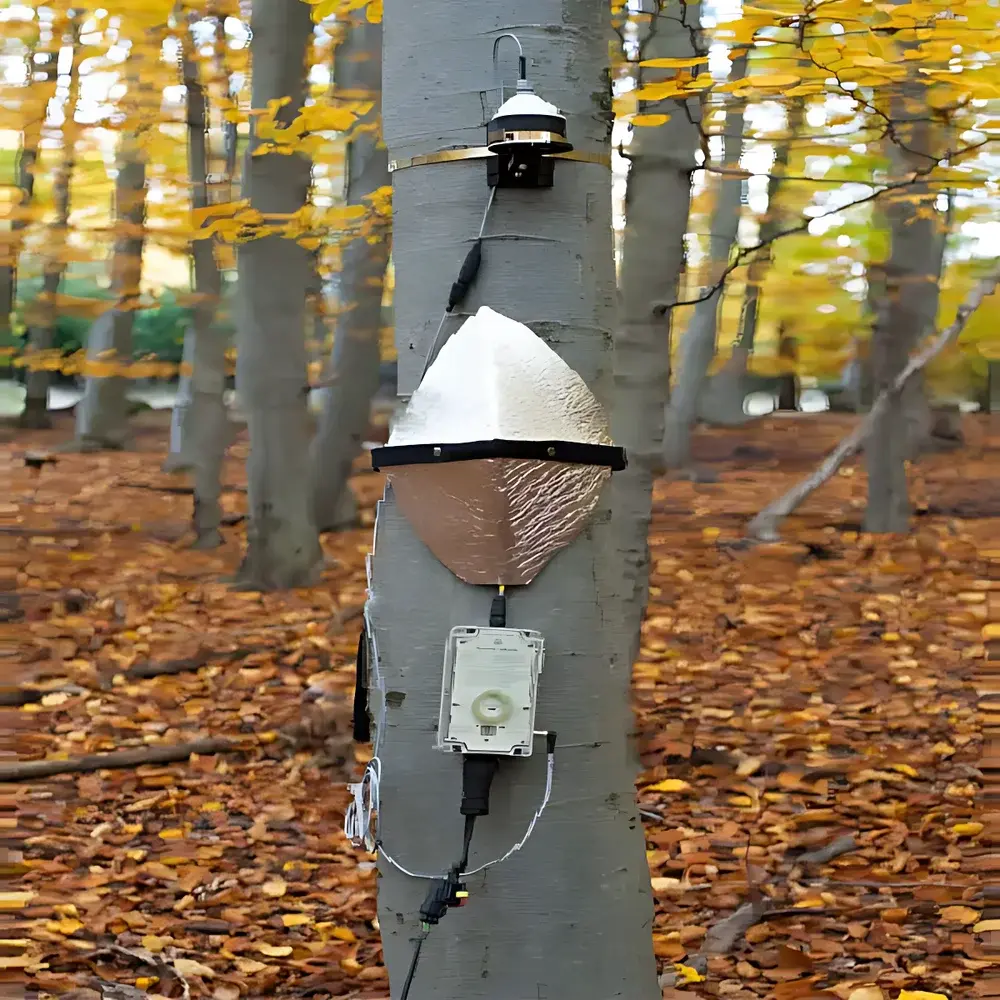
EMS81 Tree Stem Flow Monitoring System
| Origin | Czech Republic |
|---|---|
| Manufacturer Type | Authorized Distributor |
| Origin Category | Imported Instrument |
| Model | EMS81 Tree Stem Flow Monitoring System |
| Price Range | USD 13,500 – 27,000 |
Overview
The EMS81 Tree Stem Flow Monitoring System is a precision-engineered, field-deployable instrumentation platform designed for continuous, non-invasive quantification of sap flow velocity and volumetric stem flow in woody plants. Built upon the Tissue Heat Balance (THB) principle—a thermodynamic method grounded in first-law energy conservation—the system directly heats xylem tissue via controlled current passage between insulated electrodes embedded in the trunk, enabling real-time calculation of mass-based sap flux (kg·hr⁻¹) without empirical calibration. Unlike thermal dissipation or heat pulse methods, THB eliminates reliance on species-specific empirical coefficients or assumptions about wood thermal properties, delivering inherently absolute measurements traceable to SI units. The EMS81 integrates seamlessly with the MicroSet 8X control unit, which houses an embedded data logger, SDI-12 interface support, and dedicated input for the DR26 dendrometer—enabling synchronous, time-synchronized acquisition of stem flow and radial growth dynamics. Its architecture supports both autonomous single-tree deployment (battery-powered, self-contained) and scalable multi-node networks across heterogeneous forest stands, making it suitable for long-term ecohydrological studies, drought response monitoring, and carbon–water coupling research under GLP-aligned field protocols.
Key Features
- Tissue Heat Balance (THB) measurement principle: Direct xylem heating via 3+1 electrode configuration—three insulated current-carrying electrodes (60/70/80 mm lengths for 25/35/45 mm xylem depths) and one un-insulated reference electrode positioned 100 mm below the heating array
- Dynamic power modulation: Heating current (40–200 mA at 1 kHz) scales with sap flow magnitude; average power consumption 0.3–0.4 W at ΔT = 1 K, max 4 W—minimizing thermal disturbance and eliminating xylem overheating risk
- High-resolution thermal sensing: Custom 3+1 needle-type thermistors with user-selectable constant temperature differentials (1 K, 2 K, or 3 K)
- Integrated dual-parameter logging: Simultaneous acquisition of stem flow (kg·hr⁻¹) and radial stem growth (μm resolution) via DR26 dendrometer interface
- Modular expandability: Optional co-deployment with Minikin microclimate sensors (air temperature ±0.2°C, RH ±2%, PAR & global radiation ±5%), tipping-bucket rain gauges, soil moisture/temperature probes, FluorPen chlorophyll fluorescence modules, and minirhizotron imaging systems
- Robust field operation: IP67-rated MicroSet 8X unit; operating temperature range −20°C to +50°C; internal clock accuracy ±1 minute per month; 120,000-sample onboard memory (sufficient for 1-year logging at 10-min intervals)
- Flexible data retrieval: IrDA infrared and USB interfaces; no proprietary hardware required for field download
Sample Compatibility & Compliance
The EMS81 is validated for use on tree stems ≥12 cm diameter at breast height (DBH), including broadleaf and coniferous species with irregular bark morphology or heterogeneous xylem anatomy. Its THB methodology conforms to ISO 17025-aligned measurement traceability principles, as energy input (W) and temperature differential (K) are directly measured physical quantities. While no formal ASTM or ISO standard yet exists specifically for THB-based sap flow, the system’s operational parameters align with best-practice guidelines published in Tree Physiology, iForest, and Ecological Modelling for long-term plant water relations monitoring. Data integrity meets GLP requirements for environmental monitoring: all logged records include UTC timestamps, sensor metadata, and raw thermal/electrical values—supporting full audit trails. Firmware and software comply with IEC 62304 Class B for medical-grade embedded systems, ensuring deterministic real-time performance under variable solar loading and battery voltage fluctuations (12–15 V DC; auto-shutdown <10.5 V).
Software & Data Management
The included Windows-based EMS Studio software provides full lifecycle data management: remote configuration of sampling intervals, ΔT setpoints, and electrode polarity; secure IrDA/USB data download with CRC-32 validation; automated conversion of raw mW and ΔT into kg·hr⁻¹ stem flow per unit circumference; and export-ready statistical reporting—including hourly/daily means, cumulative sums, min/max envelopes, linear regression against microclimate variables, and gap-filling interpolation using neighboring node correlations. All plots retain embedded EXIF-style metadata (GPS coordinates, installation date, sensor ID, firmware version). Export formats include CSV, Excel (.xlsx), and NetCDF 4.0 for integration with R, Python (xarray), or MATLAB workflows. Audit logs record every parameter change, download event, and firmware update—fully compliant with FDA 21 CFR Part 11 requirements for electronic records when used in regulated ecological trials.
Applications
- Quantifying whole-tree transpiration responses to diurnal cycles, soil moisture depletion, and vapor pressure deficit gradients
- Assessing drought resilience in mixed-species forests and urban tree inventories
- Calibrating and validating land surface models (e.g., CLM, ORCHIDEE) with empirical sap flux constraints
- Studying hydraulic redistribution and nocturnal sap flow in deep-rooted species
- Correlating stem flow dynamics with phenological transitions (budburst, leaf senescence) tracked via FluorPen fluorescence indices
- Integrating root-zone water status (via soil moisture sensors) and canopy-level gas exchange proxies (via PAR/radiation data) into mechanistic water-use efficiency frameworks
- Long-term dendroecological monitoring where concurrent growth and water transport metrics improve interpretation of climate–growth relationships
FAQ
What is the minimum trunk diameter supported by the EMS81 system?
The system is validated for trees with stem diameter ≥12 cm at measurement height. Electrode length selection (60/70/80 mm) ensures optimal xylem penetration depth (25/35/45 mm) across varying bark thickness and wood density.
Does the THB method require species-specific calibration?
No. THB is a first-principles method: stem flow is derived from direct measurement of electrical power input (W) and axial temperature gradient (K), independent of wood density, specific heat, or thermal conductivity assumptions.
Can multiple EMS81 units be synchronized across large distances?
Yes. Units operate autonomously but can be networked via SDI-12 (on compatible MicroSet 8X variants) or coordinated via GPS-synchronized timestamps. No master–slave architecture is required—each node maintains its own high-accuracy real-time clock.
Is the DR26 dendrometer compatible with all EMS81 configurations?
Yes. The DR26 interface is native to the MicroSet 8X control unit and requires no additional adapters or firmware patches. It delivers 1 µm resolution over a 65 mm stroke range and is rated for continuous deployment on stems ≥8 cm DBH.
How is data security and traceability ensured during long-term deployments?
All measurements are stored with immutable UTC timestamps, sensor serial numbers, and raw engineering units (mW, K, µm). EMS Studio enforces digital signature logging for configuration changes and supports encrypted backup archives compliant with ISO/IEC 27001 information security standards.





