
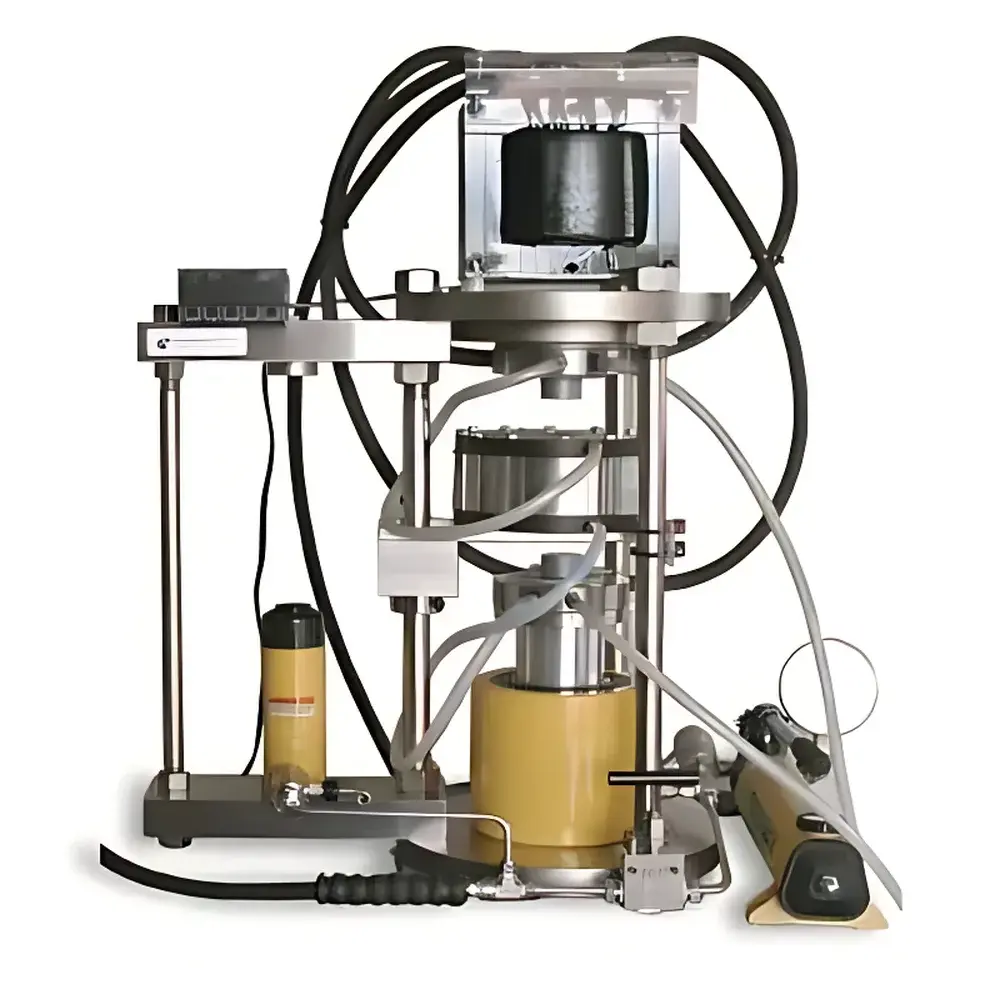
Depths of the Earth QuickPress Piston-Cylinder High-Pressure & High-Temperature Apparatus
| Brand | Depths of the Earth |
|---|---|
| Origin | USA |
| Manufacturer Type | Authorized Distributor |
| Equipment Type | Tube Furnace |
| Max Temperature | 1800 °C |
| Temperature Control Accuracy | ±2 °C |
| Voltage/Current Rating | 220–240 V, 20 A |
| Ramp Rate to Max Temp | 100 °C/min |
| Heating Method | Electrical Resistance Heating |
| Internal Chamber Dimensions | 120 × 60 × 60 cm |
| Pressure Range | 0.3–4.0 GPa |
| Pressure Control Precision | ±0.03 GPa |
| Temperature Gradient | ±15 °C |
| Quench Rate | up to 300 °C/s |
| Sample Volume Capacity | 90 mm³ (at 4.0 GPa, 10 mm die), 150 mm³ (at 2.5 GPa, 13 mm die), 500 mm³ (at 1.0 GPa, 19 mm die) |
| Continuous Operation Duration | Minutes to Months |
| Cooling System | Integrated Water-Cooled Jacket |
| Thermocouple Compatibility | Type B, J, E, T, L, N, K, W5Re–W26Re, Pt–Pt10Rh, Pt–Pt13Rh |
| Safety Features | Overtemperature, overvoltage, overcurrent, and coolant flow failure interlocks |
Overview
The Depths of the Earth QuickPress Piston-Cylinder High-Pressure & High-Temperature (HPHT) Apparatus is an engineered platform for static high-pressure synthesis and in-situ thermodynamic characterization under controlled isostatic conditions. Based on the classical Bridgman-style piston-cylinder geometry, it utilizes a hydraulically actuated tungsten carbide or sintered diamond-anvil assembly coupled with a precisely regulated resistive heating system to generate simultaneous high pressure (up to 4.0 GPa) and high temperature (up to 1800 °C) within a compact, self-contained chamber. Unlike multi-anvil presses or large-volume presses requiring complex infrastructure, the QuickPress achieves reproducible static pressures through mechanical force transmission via hardened steel pistons and calibrated pressure-transmitting media (e.g., NaCl, MgO, or borosilicate glass), enabling precise control of P–T paths critical for phase transition studies, metastable material synthesis, and geophysical mineral calibration. Its modular architecture supports rapid sample turnaround and integration with external diagnostics—including synchrotron X-ray diffraction, Raman spectroscopy, and electrical transport measurement systems—without compromising pressure integrity.
Key Features
- Static pressure generation from 0.3 to 4.0 GPa with closed-loop pressure control accuracy of ±0.03 GPa, traceable to NIST-certified calibration standards
- Temperature range of 25–1800 °C with stability maintained at ±2 °C across the full operational envelope; programmable ramp rates up to 100 °C/min to 1800 °C
- Compact footprint (120 × 60 × 60 cm internal chamber volume) with integrated water-cooled jacket and fail-safe thermal management
- Multi-die compatibility: interchangeable pressure assemblies (10 mm, 13 mm, and 19 mm inner-diameter dies) enabling scalable sample volumes (90–500 mm³) and pressure optimization per experimental objective
- Dual-mode quench capability: rapid thermal extraction up to 300 °C/s using active water-jacket modulation and auxiliary cryogenic gas injection ports
- Comprehensive safety architecture including real-time monitoring of heater voltage, current, thermocouple response, and coolant flow rate, with automatic shutdown upon deviation beyond user-defined thresholds
- Full thermocouple flexibility supporting Type B, J, E, T, L, N, K, W5Re–W26Re, and Pt–Pt(Rh) variants—enabling accurate calibration across diverse pressure-media chemistries and redox environments
Sample Compatibility & Compliance
The QuickPress accommodates a broad spectrum of sample geometries and chemistries relevant to condensed-matter physics, geochemistry, and advanced ceramics development. Standard configurations support cylindrical samples up to 5 mm in length and compatible with common pressure-transmitting media including NaCl, MgO, KBr, and borosilicate glasses. For oxygen-sensitive syntheses (e.g., high-Tc superconductors or metal hydrides), optional inert-gas purging and vacuum-sealed sample capsules are available. All pressure vessels and furnace components conform to ASME BPVC Section VIII Division 1 design codes for high-pressure containment. The system’s operational protocols align with ISO/IEC 17025 requirements for calibration traceability, and its data acquisition architecture supports audit-ready logging compliant with FDA 21 CFR Part 11 when paired with validated third-party software. Routine maintenance and pressure calibration procedures follow ASTM E2250 (Standard Practice for Calibration of High-Pressure Gauges) and EPRI TR-102292 (Guidelines for HPHT Experimental Reproducibility).
Software & Data Management
Control is managed via a dedicated industrial-grade PLC-based interface with Ethernet connectivity and remote SSH access. The embedded firmware logs timestamped records of temperature, pressure (via load cell or strain gauge feedback), heater power, coolant temperature, and thermocouple voltages at user-selectable intervals (100 ms to 10 s resolution). Export formats include CSV, HDF5, and MATLAB-compatible binary files. Optional integration with LabVIEW™ or Python-based control suites enables synchronization with external detectors (e.g., CCD-based XRD, FTIR spectrometers) and automated P–T trajectory scripting. Audit trails include operator ID, session start/stop timestamps, parameter setpoints, and all triggered safety events—fully compliant with GLP/GMP documentation workflows.
Applications
- Phase stability mapping of mantle minerals (e.g., olivine, wadsleyite, ringwoodite) under upper- and lower-mantle P–T conditions
- Synthesis of metastable nitrides, phosphides, and borocarbides with tunable electronic band structures
- High-pressure densification and grain-boundary engineering of ultra-refractory ceramics (e.g., ZrB₂, HfC)
- In-situ thermodynamic characterization of hydrogen storage materials (e.g., MgH₂, LiBH₄) under variable p(H₂)
- Calibration of pressure standards (e.g., gold, platinum, and ruby fluorescence scales) across the 1–4 GPa range
- Thermochemical modeling of fluid–mineral equilibria in subduction zone analogs, including Cl–H₂O–silicate systems
FAQ
What pressure media are recommended for operation at 4.0 GPa and 1800 °C?
NaCl and MgO are routinely used above 3 GPa; for temperatures exceeding 1600 °C, doped MgO or sintered MgO–Y₂O₃ composites provide improved thermal stability and reduced chemical reactivity.
Can the QuickPress be integrated with synchrotron beamlines?
Yes—the standard chamber design includes two orthogonal 25 mm-diameter beryllium or Kapton windows optimized for X-ray transmission; custom flanges with CF-100 or DN63 vacuum compatibility are available upon request.
Is quenching from 1800 °C feasible without sample fracture?
Rapid quenching (≤300 °C/s) is achievable using the integrated water-jacket modulation and optional He/N₂ gas injection; success depends on sample geometry, pressure medium brittleness, and thermal expansion mismatch—empirical optimization is recommended for new material systems.
Does the system support long-duration experiments (>72 hours)?
Yes—continuous operation for weeks is supported by redundant coolant flow sensors, thermal derating algorithms, and automated heater duty-cycle modulation to minimize thermal fatigue in furnace elements.
Are calibration certificates provided with each pressure die?
Each die assembly ships with a NIST-traceable pressure calibration certificate generated using ruby fluorescence shift measurements at multiple isotherms (300 K, 800 K, 1200 K), valid for two years under normal usage conditions.
Related Products



