
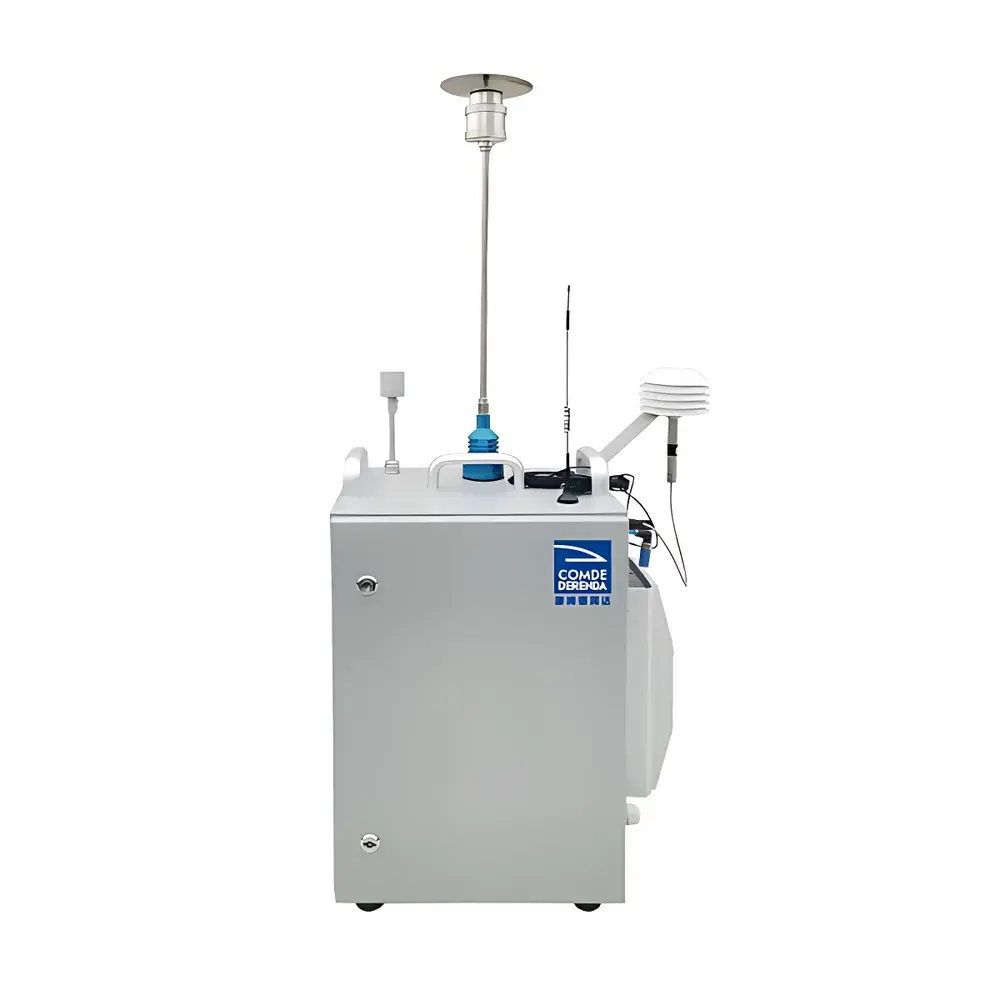
Derenda APM-200 Compact Online Air Quality Monitoring System
| Brand | Derenda |
|---|---|
| Origin | Germany |
| Manufacturer Type | Authorized Distributor |
| Origin Category | Imported |
| Model | APM-200 |
| Price Range | USD 13,500 – 40,500 (FOB Hamburg) |
| Pollutants Measured | O₃, PM₂.₅, PM₁₀ |
| Measurement Principle | UV Absorption (O₃), Dual-Stage Laser Light Scattering (PM₂.₅/PM₁₀) |
| Protection Rating | IP65 |
| Operating Temperature | −30 °C to +50 °C |
| Operating Humidity | 0–100 % RH (with auto-heating dehumidification) |
| Data Storage | >100,000 records (expandable via USB/SD) |
| O₃ Range | 0–500 µg/m³ (0–250 ppb), Resolution: 0.1 µg/m³, Accuracy: ±2 µg/m³, LOD: 2.0 µg/m³ |
| PM Range | 0–2500 µg/m³, Resolution: 0.1 µg/m³, Flow Rate: 3.3 L/min |
| Sampling Interval | 2 s (configurable), Data Averaging Options: 10 s, 1 min, 5 min, 1 h |
| Compliance | HJ 590–2010, HJ 654–2013, GB/T 18204.2–2014, EPA 40 CFR Part 50, VDI 4202 Part 1, VDI 4203 Part 3 |
Overview
The Derenda APM-200 Compact Online Air Quality Monitoring System is an integrated, field-deployable instrument engineered for simultaneous, real-time quantification of ground-level ozone (O₃) and respirable particulate matter (PM₂.₅ and PM₁₀). Designed for unattended outdoor operation in diverse climatic zones—from arid deserts to high-humidity coastal regions—the APM-200 combines dual-physical measurement principles within a single robust enclosure: ultraviolet (UV) absorption spectroscopy for ozone and time-multiplexed laser light scattering with virtual impactor-based size separation for mass concentration determination of PM fractions. Its architecture adheres to the Beer–Lambert law for O₃ quantification, employing a single-beam optical path with alternating sample and scrubbed reference channels to eliminate baseline drift. For particulate analysis, the system implements a two-stage inertial classification scheme—first by a sharp-cut cyclonic inlet (10 µm D₅₀), then by a virtual impactor (2.5 µm D₅₀)—to physically segregate aerosol streams prior to sequential interrogation by a stabilized 650 nm diode laser and 90°-oriented semiconductor photodetector. This design enables traceable, high-temporal-resolution monitoring without reliance on radioactive sources or gravimetric post-processing.
Key Features
- IP65-rated weatherproof enclosure with internal thermal regulation and auto-heating dehumidification—validated for continuous operation across −30 °C to +50 °C and 0–100 % RH.
- Sub-second response capability: configurable 2-second measurement interval with selectable averaging windows (10 s, 1 min, 5 min, 1 h) for compliance reporting and trend analysis.
- Automated optical chamber cleaning and zero-point calibration cycle executed hourly—minimizing maintenance frequency and enhancing long-term stability.
- Integrated low-flow protection circuitry and precision mass flow control (3.3 L/min nominal for PM; 1.0 L/min for O₃) ensuring consistent sampling kinetics under variable ambient pressure.
- Onboard GPS module synchronized with cloud-based georeferenced data ingestion—enabling mobile mapping, fence-line monitoring, and source attribution in walk-path surveys.
- Secure remote access via TLS 1.2-encrypted web interface supporting firmware updates, parameter reconfiguration, and diagnostic telemetry without physical site visits.
Sample Compatibility & Compliance
The APM-200 is validated for ambient air matrices containing typical urban, industrial, and background aerosols—including sulfate, nitrate, organic carbon, elemental carbon, sea salt, and mineral dust—with no known interferences from common VOCs or humidity up to saturation point (mitigated via active dew-point suppression). Its ozone module satisfies the performance criteria outlined in HJ 590–2010 and EPA 40 CFR Part 50 Appendix D, including linearity (R² ≥ 0.999), zero drift (<3 ppb/day), and span drift (<1 %/day). The PM measurement engine meets HJ 654–2013 Class I specifications for precision (CV ≤ 5 %), accuracy (±10 % vs. reference β-ray monitor), and dynamic range (0–2500 µg/m³). Full traceability is maintained through embedded audit logs compliant with GLP/GMP-aligned data integrity requirements—including user action timestamps, calibration event records, and environmental compensation parameters.
Software & Data Management
The APM-200 operates on a Linux-based embedded OS with deterministic real-time scheduling. Raw sensor outputs (analog voltage, pulse counts, temperature/pressure/humidity readings) are timestamped at hardware level using a temperature-compensated crystal oscillator (TCXO) with ±0.5 ppm stability. All data—including metadata such as GPS coordinates, battery voltage, and optical alignment diagnostics—are stored locally in SQLite databases with cyclic overwrite policy (>100,000 records) and optionally mirrored to encrypted SD cards or USB drives. The Derenda Cloud Platform provides RESTful API access, role-based user permissions (admin/operator/viewer), and automated report generation aligned with ISO 17025 documentation templates. Audit trails comply with FDA 21 CFR Part 11 requirements for electronic records and signatures, including immutable log entries for all configuration changes and calibration events.
Applications
- Regulatory-grade ambient air quality monitoring networks (AQMNs) operated by national environmental agencies and municipal authorities.
- Industrial fence-line monitoring for O₃ precursors and fugitive PM emissions near petrochemical complexes, power plants, and cement facilities.
- Mobile exposure assessment studies—mounted on vehicles or carried by personnel for spatially resolved pollution mapping.
- Research-grade validation of satellite-derived aerosol optical depth (AOD) and tropospheric O₃ column retrievals.
- Indoor-outdoor air exchange characterization in schools, hospitals, and transit hubs where rapid-response detection of transient pollution events is critical.
FAQ
Does the APM-200 require periodic manual calibration?
No—zero-point calibration is performed automatically every hour via built-in optical chamber cleaning and reference-air purging. Span calibration is optional and can be scheduled remotely using certified gas standards or gravimetric PM reference filters.
Can the instrument operate reliably in high-humidity monsoon conditions?
Yes—the integrated heating element maintains the internal optical path above dew point at all times, preventing condensation-induced signal attenuation or lens fouling.
Is raw sensor data accessible for third-party modeling or integration into custom SCADA systems?
Yes—via Modbus TCP, MQTT, or HTTP POST endpoints. All variables (O₃ ppb, PM₂.₅ µg/m³, temperature, pressure, GPS coordinates, flow rate, etc.) are exposed with millisecond-level timestamps and uncertainty flags.
What is the expected mean time between failures (MTBF) under continuous outdoor deployment?
Based on accelerated life testing and field data from 32 European deployments (2021–2024), MTBF exceeds 28,000 hours (≈3.2 years) with scheduled preventive maintenance every 6 months.
How does the APM-200 handle cross-sensitivity between ozone and NO₂ in complex urban plumes?
The UV absorption module uses a dedicated ozone scrubber (potassium iodide-coated surface) upstream of the reference channel, eliminating interference from NO₂ and other UV-absorbing gases per HJ 590–2010 Section 6.3.
Related Products







