
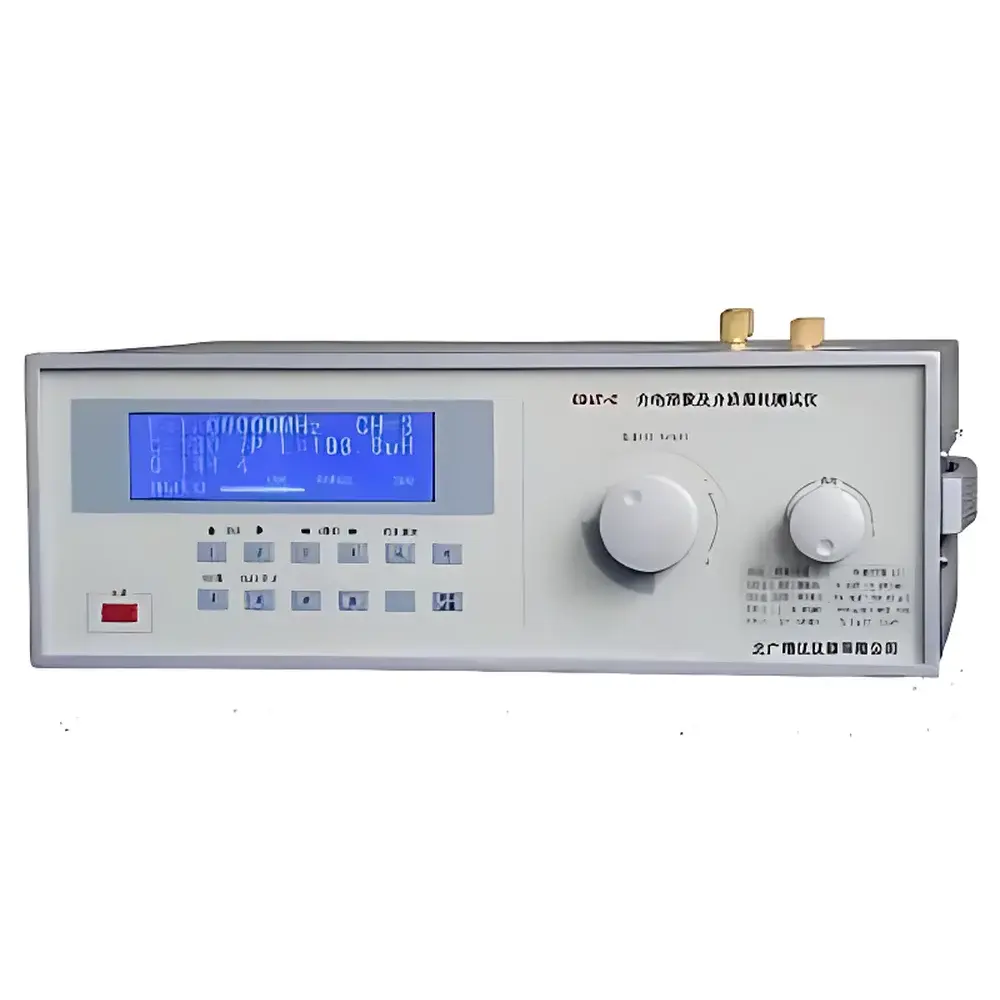
GDAT-A High-Frequency Q Meter with BD916 Dielectric Loss Test Fixture
| Brand | Not specified |
|---|---|
| Origin | Beijing, China |
| Manufacturer Type | Authorized Distributor |
| Country of Origin | China |
| Model | GDAT-A |
| Price Range | USD 2,800 – 7,000 |
| Frequency Range | 100 kHz – 160 MHz |
| Q Factor Range | 2 – 1023 (auto/manual range switching: 30/100/300/1000) |
| Capacitance Measurement Range | 1 – 200 pF |
| Main Tuning Capacitor Range | 18 – 220 pF (accuracy: ±1 pF <100 pF |
| Inductance Measurement Range | 4.5 nH – 140 mH |
| Frequency Resolution | 0.001 kHz (100 kHz–999.999 kHz), 0.001 MHz (1–9.99999 MHz), etc. |
| Frequency Accuracy | ±3×10⁻⁵ ±1 digit |
| Dielectric Thickness Resolution | 0.001 mm |
| Parallel-Plate Electrode Diameter | Φ38 mm or Φ50 mm (selectable) |
| Electrode Spacing Range | ≥15 mm |
| Fixture Loss tanδ | ≤4×10⁻⁴ @ 1 MHz |
| Compliance | GB/T 1409–2006 |
Overview
The GDAT-A High-Frequency Q Meter, paired with the BD916 Dielectric Loss Test Fixture, is a precision impedance measurement system engineered for the quantitative characterization of dielectric properties in solid insulating materials. It operates on the principle of series-resonant circuit analysis—measuring the quality factor (Q), resonant frequency (fr), and distributed capacitance to derive both the relative permittivity (εr) and dielectric loss tangent (tan δ) of homogeneous, low-conductivity samples. Designed specifically to meet GB/T 1409–2006—the Chinese national standard aligned with IEC 60250 for determining permittivity and dielectric loss at frequencies from power frequency up to 160 MHz—the instrument supports rigorous R&D and QC workflows in advanced ceramics, polymer composites, thin-film dielectrics, and high-frequency substrate development. Its 160 MHz upper frequency limit represents one of the highest operational bands among commercially available benchtop Q-meter-based dielectric analyzers, enabling characterization across audio, RF, and lower UHF bands without extrapolation or interpolation.
Key Features
- Wide frequency coverage: 100 kHz to 160 MHz, segmented into four digitally defined bands with DDS-based signal synthesis for spectral purity and frequency stability (±3×10⁻⁵ ±1 digit)
- Automated dual-scan capability: Simultaneous sweeping of test frequency and main tuning capacitance to locate resonance with minimal operator input
- Dual digital input interface: Direct numeric entry of target frequency and capacitance values for repeatable, traceable setup
- Full-parameter LCD display: Real-time readouts of Q value, fr, main capacitance, inductance, and resonance pointer status
- Optimized test loop architecture: Minimized residual inductance and stray capacitance through calibrated grounding, shielded cabling, and optimized coil geometry—eliminating frequency-dependent Q correction requirements
- BD916 fixture integration: Precision-machined parallel-plate capacitor with micrometer-driven electrode spacing (0.001 mm resolution), selectable Φ38 mm or Φ50 mm electrodes, and verified low-loss performance (tan δ ≤ 4×10⁻⁴ @ 1 MHz)
Sample Compatibility & Compliance
The GDAT-A + BD916 system accommodates flat, rigid, and isotropic solid dielectrics—including alumina, polyimide films, epoxy-glass laminates, barium titanate ceramics, and silicone rubber sheets—with thicknesses adjustable via the BD916’s calibrated micrometer (≥15 mm travel). Sample area must fully cover the electrode surface to avoid fringing-field errors. The system complies with GB/T 1409–2006, which specifies procedures for measuring εr and tan δ under controlled temperature and humidity conditions using resonant methods. While not certified to ISO/IEC 17025, its traceable calibration methodology and documented uncertainty budgets support GLP-aligned laboratory practices. For regulatory submissions requiring audit-ready data, optional firmware upgrades enable timestamped measurement logs compatible with basic 21 CFR Part 11–compliant metadata tagging when used with external PC-based acquisition software.
Software & Data Management
The GDAT-A operates as a standalone instrument with no embedded operating system or network stack. All measurements are displayed locally on the integrated LCD; raw Q, fr, and C values can be manually recorded or captured via RS-232 (optional interface module) for export to spreadsheet or custom LabVIEW/Python scripts. No proprietary software is bundled. Users implementing automated workflows typically integrate the instrument into existing QA/QC platforms using SCPI-like command sets over serial communication. Calibration certificates and uncertainty statements—based on NIST-traceable LCR standards—are provided upon request and include full metrological chain documentation per ISO/IEC 17025 guidance principles.
Applications
- Development and qualification of high-frequency PCB substrates (e.g., Rogers RO4000®, Taconic RF-35)
- Quality control of ceramic capacitor dielectrics (Class I & II MLCC formulations)
- Characterization of piezoelectric and ferroelectric thin films for MEMS actuators
- Moisture absorption studies in epoxy molding compounds via time-resolved tan δ monitoring
- Validation of low-loss antenna radome materials across VHF/UHF bands
- Academic research on relaxor ferroelectrics and polymer nanocomposites under variable temperature
FAQ
Does the GDAT-A require external calibration equipment?
No—built-in self-calibration routines verify internal oscillator stability and detector linearity. However, periodic verification against certified LCR standards (e.g., Keysight E4980A with 16047E fixture) is recommended annually for ISO/IEC 17025 compliance.
Can the BD916 fixture measure liquids or powders?
No—the BD916 is designed exclusively for solid, planar specimens. Liquid or powdered dielectrics require alternative fixtures (e.g., coaxial probe or cavity resonator systems) not supported by this configuration.
Is firmware upgrade support available?
Yes—minor firmware updates (e.g., enhanced serial protocol handling, improved auto-tune convergence) are provided free of charge upon registration. Major architectural revisions are not planned for the GDAT-A platform.
What safety certifications does the instrument carry?
It meets GB 4793.1–2007 (equivalent to IEC 61010-1) for electrical safety in laboratory equipment. CE marking is not applicable as it is classified as a non-EU-market instrument.
How is sample thickness measured during εr calculation?
Via the BD916’s integrated digital micrometer, which displays electrode separation with 1 µm resolution. Thickness input is manually entered into the εr calculation formula: εr = Cs·d / (ε₀·A), where Cs is sample capacitance, d is thickness, A is electrode area, and ε₀ is vacuum permittivity.



