
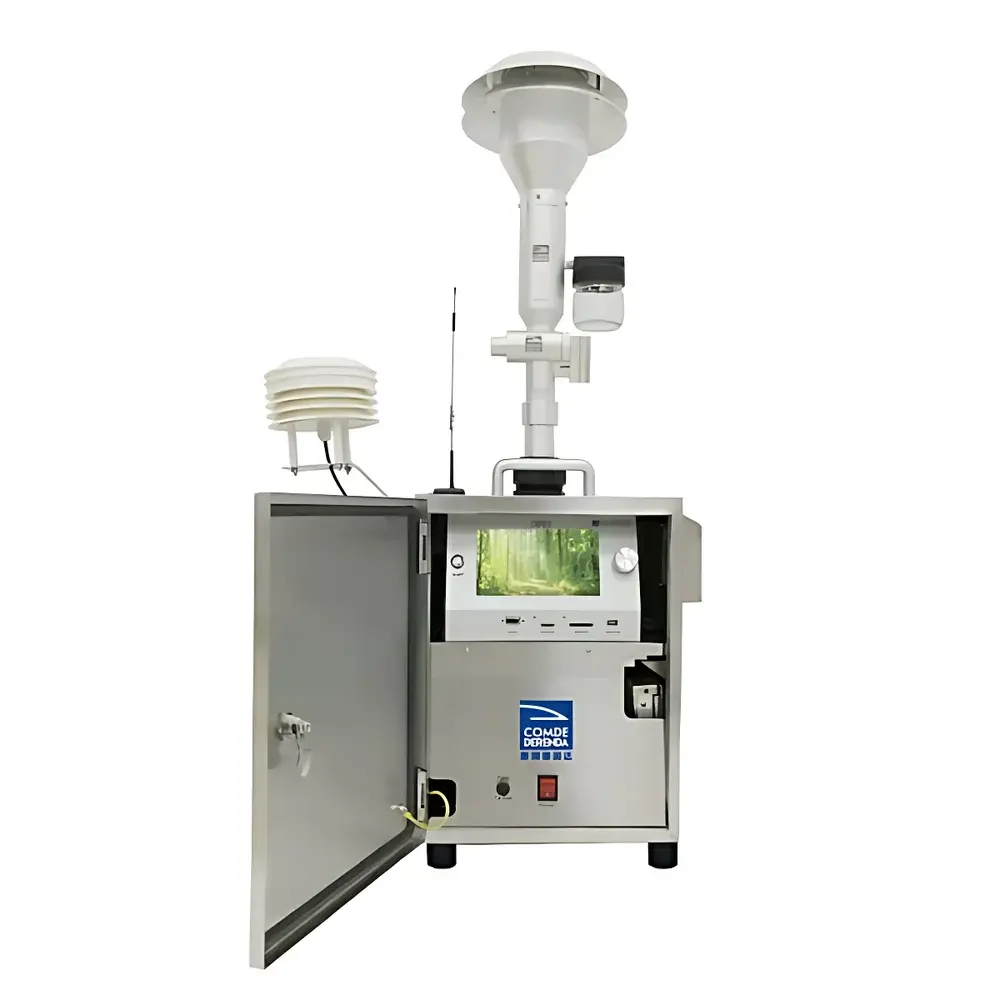
Derenda PNS16T-10 Portable Automated Filter-Changing Particulate Matter Sampler
| Brand | Derenda |
|---|---|
| Origin | Jiangsu, China |
| Manufacturer Type | Authorized Distributor |
| Country of Origin | China |
| Model | PNS16T-10 |
| Typical Configuration | Integrated Ambient Air Particulate Sampler |
| Flow Range | 1.0–2.3 m³/h (adjustable) |
| Maximum Vacuum Pressure | >800 hPa |
| Flow Stability | <2.0% deviation over 24 h |
| Maximum Flow Accuracy | ≤±2% |
| Operating Duration at Max Flow & Backpressure | 1 min–999 h |
| Rated Lifetime at Max Flow & Backpressure | >50,000 h |
| Temperature Control Range (Filter Chamber) | ≤20 °C (adjustable, via Peltier cooling) |
| Ambient Operating Temperature | −30 °C to +50 °C |
| Relative Humidity Range | 0–100% RH |
| Sampling Time Range | 1 min–999 h |
| Power Supply | 220 V ±10%, 50 Hz |
| Filter Diameter | 47 mm |
| Dimensions | 330 × 330 × 430 mm |
| Weight | 20 kg |
| Acoustic Noise Level | <62 dB(A) |
| Ingress Protection Rating | IP55 |
| Max Power Consumption | 190 W |
| Cooling Module Power | ~70 W |
Overview
The Derenda PNS16T-10 is a portable, automated filter-changing particulate matter (PM) sampler engineered for high-integrity, long-term ambient air monitoring of PM10 and PM2.5. It operates on the gravimetric principle per ISO 7708, EN 12341, and U.S. EPA Method IO-3.0 — drawing ambient air through standardized 47-mm diameter filters at precisely controlled volumetric flow rates. Its core architecture integrates a thermoelectric (Peltier) cooling module to maintain filter chamber temperature at or below 20 °C, minimizing volatilization losses of semi-volatile organic compounds (SVOCs), ammonium nitrate, and other thermally labile aerosol components. This thermal stabilization is critical for compliance with HJ 618–2011, HJ 656–2013, and HJ 93–2013 — Chinese national standards governing manual PM mass concentration measurement, sampler performance verification, and field sampling protocols.
Key Features
- Precision mechanical filter exchange mechanism: A gear-driven, motor-actuated system enables fully automated sequential loading of up to 10 pre-weighed filters without manual intervention; rated for ≥300,000 fault-free cycles.
- Dual-compartment filter magazine: Independent storage chambers for blank and loaded filters allow real-time filter replacement during operation — eliminating downtime and supporting uninterrupted multi-day or multi-week campaigns.
- Optional RFID-enabled filter cassette recognition: Integrates with smart filter holders to auto-log filter ID, pre- and post-sampling weights, exposure duration, and environmental metadata — ensuring full traceability from collection to laboratory analysis.
- Integrated environmental sensor suite: Real-time logging of ambient temperature, relative humidity, barometric pressure, and filter differential pressure — visualized as time-series curves for QA/QC validation.
- GNSS positioning redundancy: Dual-mode北斗 (BeiDou) / GPS receiver ensures robust geolocation accuracy across diverse topographies and signal-constrained urban environments.
- Remote operational control: Optional 3G/4G LTE module enables secure bidirectional communication with cloud-based platforms for remote task scheduling, start/stop commands, firmware updates, and live status telemetry.
Sample Compatibility & Compliance
The PNS16T-10 accommodates standard 47-mm quartz fiber, Teflon®, cellulose ester, and polyvinyl chloride (PVC) filters used in regulatory-grade gravimetric, ion chromatographic, XRF, and OC/EC analyses. Its flow control system meets the dynamic backpressure compensation requirements of HJ 656–2013, maintaining ≤±2% volumetric accuracy across filter loading conditions up to 1000 Pa resistance. The unit’s IP55 enclosure ensures reliable operation in outdoor settings subject to dust ingress and transient rainfall. All firmware and data handling workflows support audit-ready recordkeeping aligned with GLP principles; optional configuration supports 21 CFR Part 11-compliant electronic signatures when integrated with validated LIMS or cloud platforms.
Software & Data Management
On-device firmware provides local parameter configuration, event logging, and error diagnostics via an intuitive LCD interface. When equipped with wireless connectivity, the sampler synchronizes timestamped metadata—including flow rate, temperature, pressure, filter ID, and alarm states—to encrypted cloud repositories. Data export formats include CSV and NetCDF, compatible with EPA AQS, EEA AirBase, and custom statistical modeling pipelines. Firmware supports scheduled calibration reminders, automatic backup of critical logs prior to power loss, and configurable alert thresholds (e.g., low battery, filter jam, temperature excursion).
Applications
- Ambient air quality monitoring networks: Parallel comparison against reference FRM/FEM samplers in national or regional automatic stations.
- Source apportionment studies: Collection of size-segregated PM samples for receptor modeling (e.g., PMF, CMB) using elemental, ionic, and molecular marker analysis.
- Health effects research: Long-term exposure assessment via synchronized PM2.5 filter archives for toxicological and epidemiological correlation studies.
- Indoor/outdoor occupational exposure assessment: Deployment near construction sites, industrial perimeters, or traffic corridors to quantify fugitive dust emissions.
- Meteorological-aerosol interaction analysis: Correlation of PM mass concentrations with visibility, boundary layer height, and hygroscopic growth metrics.
FAQ
What filtration standards does the PNS16T-10 comply with?
It conforms to HJ 618–2011, HJ 656–2013, and HJ 93–2013 for manual PM10/PM2.5 gravimetric sampling, and its flow control performance aligns with ISO 12103-1 and EN 12341 Annex B.
Can the cooling setpoint be adjusted beyond 20 °C?
Yes — the Peltier system allows user-defined setpoints between 5 °C and 25 °C, optimized for target analyte stability under site-specific climatic conditions.
Is the instrument suitable for unattended operation in extreme cold?
Rated for −30 °C ambient operation; internal heaters prevent condensation-induced sensor drift and ensure consistent motor actuation in sub-zero environments.
How is data integrity ensured during wireless transmission?
All telemetry uses TLS 1.2 encryption; locally stored logs persist through network outages and auto-resume synchronization upon reconnection.
Does the system support external power sources such as solar panels?
Yes — the 220 V AC input accepts wide-range DC adapters (12–24 V DC), enabling integration with off-grid renewable energy systems via compatible charge controllers.







