
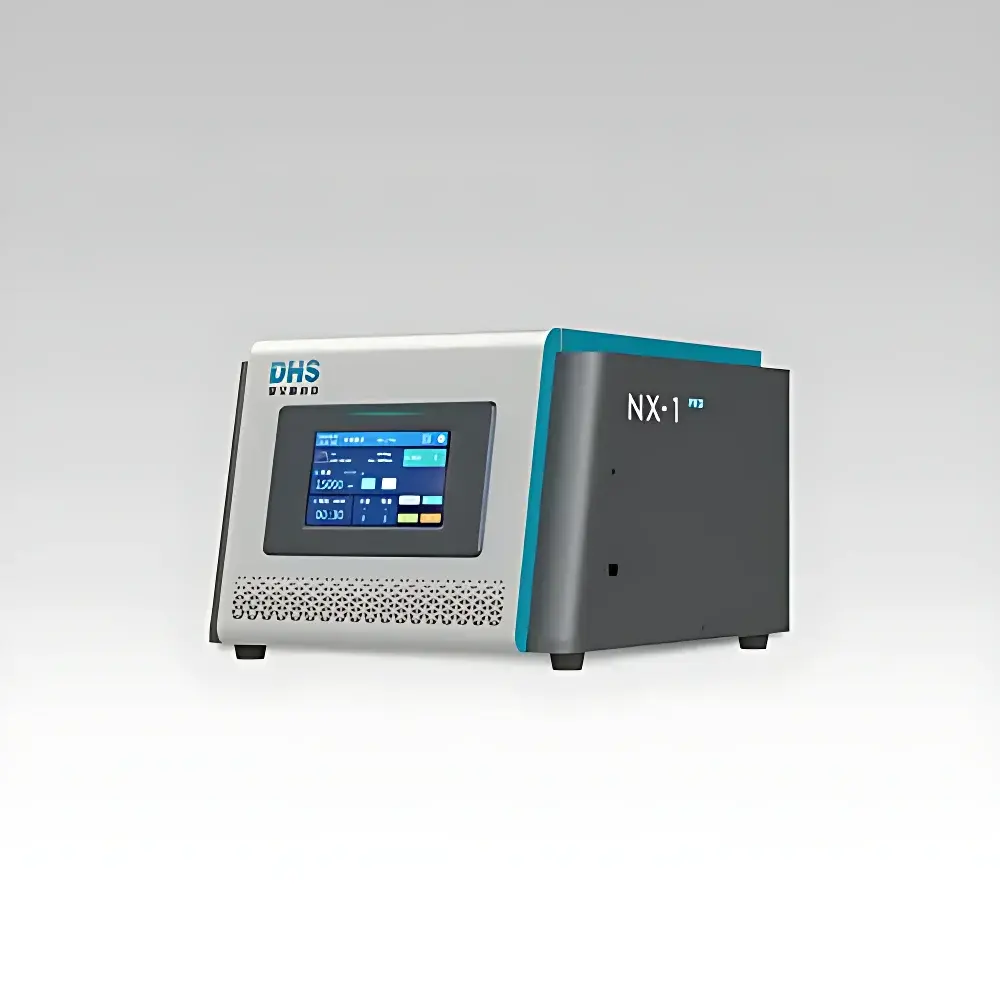
DHS NX-1 Pro High-Speed Microcentrifuge
| Brand | DHS |
|---|---|
| Origin | Tianjin, China |
| Model | NX-1 Pro |
| Centrifuge Type | Benchtop High-Speed Microcentrifuge |
| Speed Range | 200–17,500 rpm |
| Max RCF | 23,300 × g |
| Max Capacity | 24 × 1.5/2.0 mL tubes |
| Rotor Type | Fixed-Angle |
| Separation Target | Organelles, Viruses, Macromolecular Complexes |
| Dimensions (W×D×H) | 295 × 227 × 395 mm |
| Cooling | None (Non-refrigerated) |
| Compliance | CE, ISO 13485 (Manufacturing), IEC 61010-1 |
Overview
The DHS NX-1 Pro is a precision-engineered benchtop high-speed microcentrifuge designed for rapid, reproducible separation of biological macromolecules, subcellular organelles, and viral particles from small-volume samples. Operating on the principle of centrifugal sedimentation under controlled rotational acceleration, the NX-1 Pro delivers consistent RCF (relative centrifugal force) profiles essential for protocol-driven workflows in molecular biology, virology, and protein biochemistry laboratories. Its compact footprint and optimized rotor dynamics enable reliable operation at speeds up to 17,500 rpm—generating a maximum RCF of 23,300 × g—making it suitable for pelleting mitochondria, lysosomes, ribosomes, and enveloped/non-enveloped viruses from clarified lysates or supernatants. Unlike refrigerated variants, the NX-1 Pro is engineered for ambient-temperature applications where thermal stability of heat-labile analytes is not required, reducing energy consumption and maintenance complexity.
Key Features
- Robust brushless DC motor with electronic speed control ensures long-term rotational stability and minimal drift across repeated runs.
- Fixed-angle rotor (24-place, 1.5/2.0 mL tube capacity) fabricated from high-strength aluminum alloy with anodized surface finish for corrosion resistance and easy decontamination.
- Intuitive dual-mode interface: “Standard Mode” for direct parameter entry (time, speed, RCF); “Program Mode” supports up to 10 user-defined protocols with recall functionality and automatic rotor identification logic.
- Real-time RPM/RCF conversion display with automatic recalibration based on selected rotor geometry and tube position.
- Safety-certified lid interlock system compliant with IEC 61010-1, preventing operation when lid is unlatched or improperly seated.
- Low-noise design (<65 dB at 17,500 rpm) and vibration-dampening base accommodate shared lab environments without requiring dedicated isolation benches.
Sample Compatibility & Compliance
The NX-1 Pro accommodates standard conical-bottom microcentrifuge tubes (1.5 mL and 2.0 mL), including polypropylene and PCR-grade variants. It is validated for use with common biological matrices: cell lysates (HEK293, CHO, E. coli), serum/plasma fractions, nucleic acid preparations, and virus-containing supernatants (e.g., AAV, lentivirus, influenza). While not certified for clinical diagnostic use under FDA 21 CFR Part 820, the device adheres to ISO 13485-based quality management systems during manufacturing. All electrical and mechanical safety testing conforms to IEC 61010-1:2012 for laboratory equipment. The absence of active cooling precludes its use in protocols requiring temperature-sensitive pelleting (e.g., membrane protein complexes or cryo-EM sample prep); users requiring thermal control should evaluate the NX-1R Pro variant separately.
Software & Data Management
The NX-1 Pro operates via embedded firmware with no external PC dependency. Protocol storage and execution are managed internally with non-volatile memory retaining settings after power cycling. Audit-ready features include timestamped run logs (date/time, speed, duration, rotor ID, operator ID if configured via optional RFID badge integration), supporting GLP-aligned documentation requirements. Export of run history is available via USB-C port (FAT32-formatted drive) in CSV format for integration into LIMS or ELN platforms. Firmware updates are delivered through signed binary packages verified via SHA-256 checksums, ensuring integrity during field deployment.
Applications
- Routine pelleting of bacterial cells and inclusion bodies prior to solubilization.
- Clarification of mammalian cell lysates before immunoprecipitation or affinity chromatography.
- Isolation of extracellular vesicles (exosomes) using differential ultracentrifugation cascades (in combination with higher-speed ultracentrifuges).
- Concentration of low-titer viral vectors for transduction efficiency assays.
- Separation of nuclear vs. cytoplasmic fractions in subcellular fractionation workflows.
- RNA/DNA cleanup steps following phenol-chloroform extraction or column-based purification kits.
FAQ
What is the maximum recommended run time at 17,500 rpm?
Continuous operation at maximum speed is rated for ≤30 minutes per cycle. For extended protocols, intermittent cooling intervals (≥5 min rest between runs) are advised to maintain bearing longevity.
Can the NX-1 Pro accommodate PCR strip tubes or 0.5 mL tubes?
No—only 1.5 mL and 2.0 mL conical microcentrifuge tubes are supported. Adapters for smaller formats are not supplied or validated by DHS.
Is rotor imbalance detection automated?
Yes. The unit performs dynamic imbalance assessment during acceleration and will halt operation if vibration exceeds ISO 1940-1 G2.5 tolerance thresholds.
Does the NX-1 Pro meet electromagnetic compatibility (EMC) standards for use near sensitive instrumentation?
It complies with EN 61326-1:2013 Class B emission limits, making it suitable for proximity to electrophysiology rigs, mass spectrometers, and optical microscopes.
How frequently should the rotor be inspected for fatigue or corrosion?
Visual inspection is recommended before each use; formal non-destructive testing (NDT) via dye-penetrant analysis is advised every 12 months or after 10,000 cycles—whichever occurs first.



