
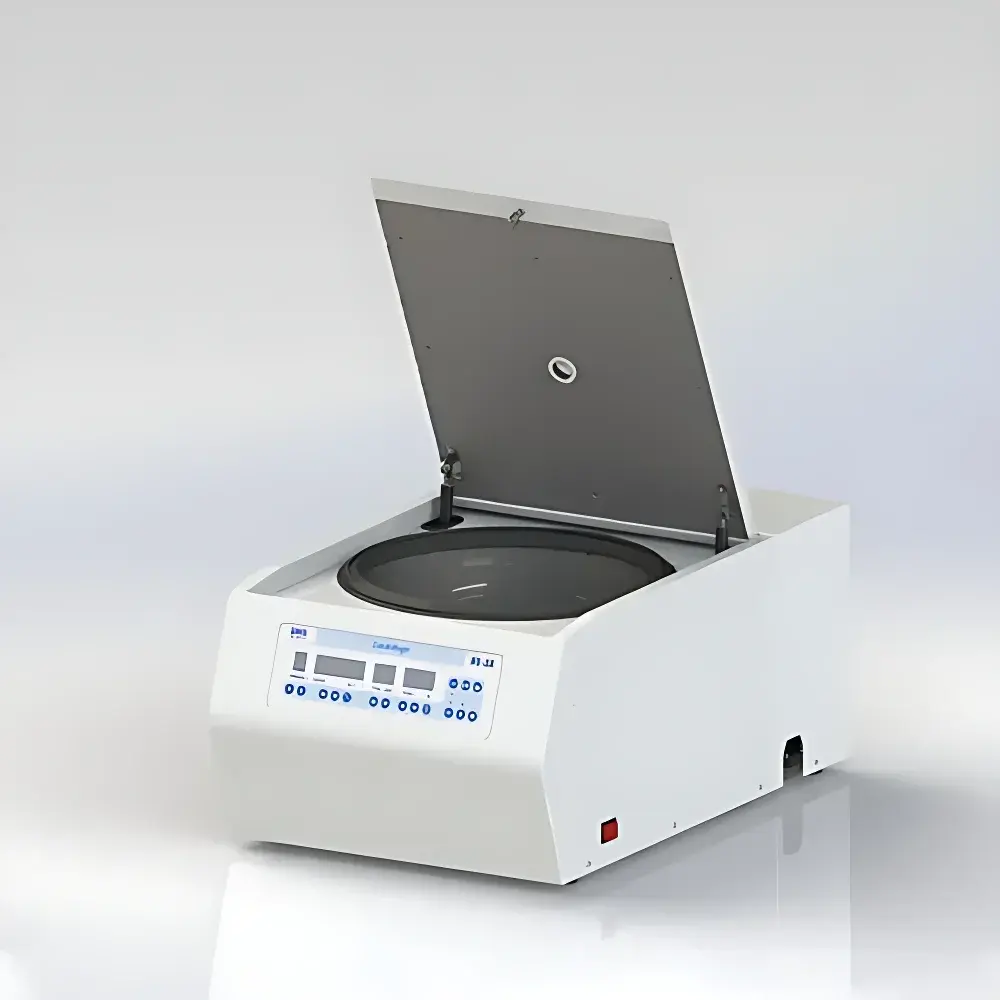
DHS NX-3R High-Speed Refrigerated Benchtop Centrifuge
| Brand | DHS |
|---|---|
| Origin | Tianjin, China |
| Model | NX-3R |
| Instrument Type | Benchtop Centrifuge |
| Category | High-Speed Refrigerated Centrifuge (10,000–30,000 rpm) |
| Max. Capacity | 6 × 250 mL |
| Max. Speed | 18,500 rpm |
| Max. RCF | 26,500 × g |
| Temperature Range | −20 °C to +40 °C (1 °C increment) |
| Dimensions (W×H×D) | 450 × 325 × 720 mm |
| Net Weight | 68 kg |
| Rotor Recognition | Automatic |
| Programmable Memory | 10 user-defined protocols |
| Speed Range | 300–18,500 rpm (100 rpm increment) |
| Time Setting | 1 s–99 min (1 s or 1 min increment), continuous mode, soft-start/soft-stop |
| Power Supply | 220 V / 50 Hz |
Overview
The DHS NX-3R is a high-performance refrigerated benchtop centrifuge engineered for precision separation of biological macromolecules—including nucleic acids, proteins, organelles, and viral particles—in research, clinical diagnostics, and quality control laboratories. It operates on the principle of sedimentation under controlled gravitational force (RCF), leveraging high-speed rotor dynamics and active thermoelectric cooling to maintain sample integrity during prolonged or temperature-sensitive runs. With a maximum rotational speed of 18,500 rpm and an RCF of up to 26,500 × g, the NX-3R meets the performance requirements for ultracentrifugation-grade applications while retaining the ergonomic footprint and operational simplicity of a benchtop platform. Its integrated refrigeration system maintains chamber temperatures between −20 °C and +40 °C with ±1 °C stability, ensuring reproducible thermal conditions critical for enzyme assays, RNA isolation, and cell lysate clarification.
Key Features
- Automatic rotor recognition system prevents mismatched rotor operation and enforces safety interlocks based on certified maximum speed and load limits.
- Dual-mode temperature control: rapid pre-cooling function reduces chamber temperature to −20 °C in under 15 minutes; real-time thermal monitoring triggers automatic shutdown if internal temperature exceeds 45 °C.
- High-brightness LED display with intuitive menu navigation supports multi-step protocol programming, including ramp-up/down profiles, time-controlled braking, and pause/resume functionality.
- Brushless frequency-controlled motor delivers low-vibration, high-efficiency operation across the full speed range (300–18,500 rpm), minimizing mechanical stress on sensitive samples and extending service life.
- Robust stainless-steel chamber and reinforced rotor housing meet IEC 61010-1 safety standards for laboratory equipment, with CE marking and compliance to ISO 13485–aligned manufacturing practices.
- 10 programmable method slots allow users to store and recall standardized workflows—ideal for GLP-compliant environments where traceability and repeatability are essential.
Sample Compatibility & Compliance
The NX-3R accommodates a comprehensive suite of interchangeable rotors and adapters, supporting diverse sample formats from microcentrifuge tubes (0.2–2.0 mL) to large-volume conical tubes (250 mL), as well as standardized labware including PCR plates (up to 66 mm height), deep-well plates, microtiter plates, and blood collection tubes. The optional H-type horizontal rotor enables high-throughput plate-based separations without manual tube transfer, reducing contamination risk and operator fatigue. All rotors are dynamically balanced and certified per ISO 21501-4 for particulate cleanliness and dimensional tolerance. The instrument complies with key regulatory frameworks applicable to clinical and pharmaceutical labs, including FDA 21 CFR Part 11 readiness (when paired with validated LIMS integration), ISO 15189 pre-analytical requirements, and EU In Vitro Diagnostic Regulation (IVDR) Annex I general safety provisions.
Software & Data Management
While the NX-3R operates via standalone embedded firmware, its parameter logging architecture supports audit-trail generation for critical run parameters—including speed, RCF, temperature, duration, rotor ID, and timestamp—exportable via USB interface in CSV format. Each stored program includes metadata fields for operator ID, sample type, and purpose, facilitating alignment with internal SOPs and external accreditation audits (e.g., CAP, CLIA, or CNAS). Firmware updates are delivered through secure OEM-signed packages, maintaining version control and cybersecurity integrity. Optional RS-232 or Ethernet modules (sold separately) enable remote monitoring and integration into centralized laboratory automation systems compliant with ASTM E1384 and HL7 standards.
Applications
- Purification of plasmid DNA, genomic DNA, and total RNA using silica-membrane or phenol-chloroform extraction protocols.
- Preparation of subcellular fractions (mitochondria, nuclei, lysosomes) via differential centrifugation cascades.
- Clarification of bacterial and mammalian cell lysates prior to chromatography or electrophoresis.
- Concentration of virus particles and exosomes from culture supernatants or biofluids.
- Routine processing of clinical specimens including serum, plasma, cerebrospinal fluid, and urine for diagnostic biomarker analysis.
- High-throughput plate-based assays requiring uniform pelleting of adherent cells or precipitation of assay reagents.
FAQ
What is the minimum temperature achievable, and how quickly does the chamber reach it?
The NX-3R achieves a stable −20 °C setpoint within 12–15 minutes under standard ambient conditions (25 °C, no load). Pre-cooling may be initiated independently of rotor installation.
Does the centrifuge support GMP/GLP documentation requirements?
Yes—run logs include immutable timestamps, rotor identification, and parameter verification flags. When used with validated data export procedures, it satisfies ALCOA+ principles for data integrity.
Can I use third-party rotors or adapters?
No. Only DHS-certified rotors and adapters are approved for use. Unauthorized components void warranty and compromise safety certification.
Is continuous operation supported, and what is the duty cycle limitation?
The NX-3R permits uninterrupted runs up to 99 minutes. For extended protocols (>3 hours cumulative daily usage), a 15-minute cooldown interval between cycles is recommended to sustain thermal and mechanical reliability.
How is rotor imbalance detected and managed during operation?
Vibration sensors continuously monitor axial and radial displacement. Exceeding threshold values triggers immediate deceleration and visual/audible alerts, with error codes logged for root-cause analysis.



