
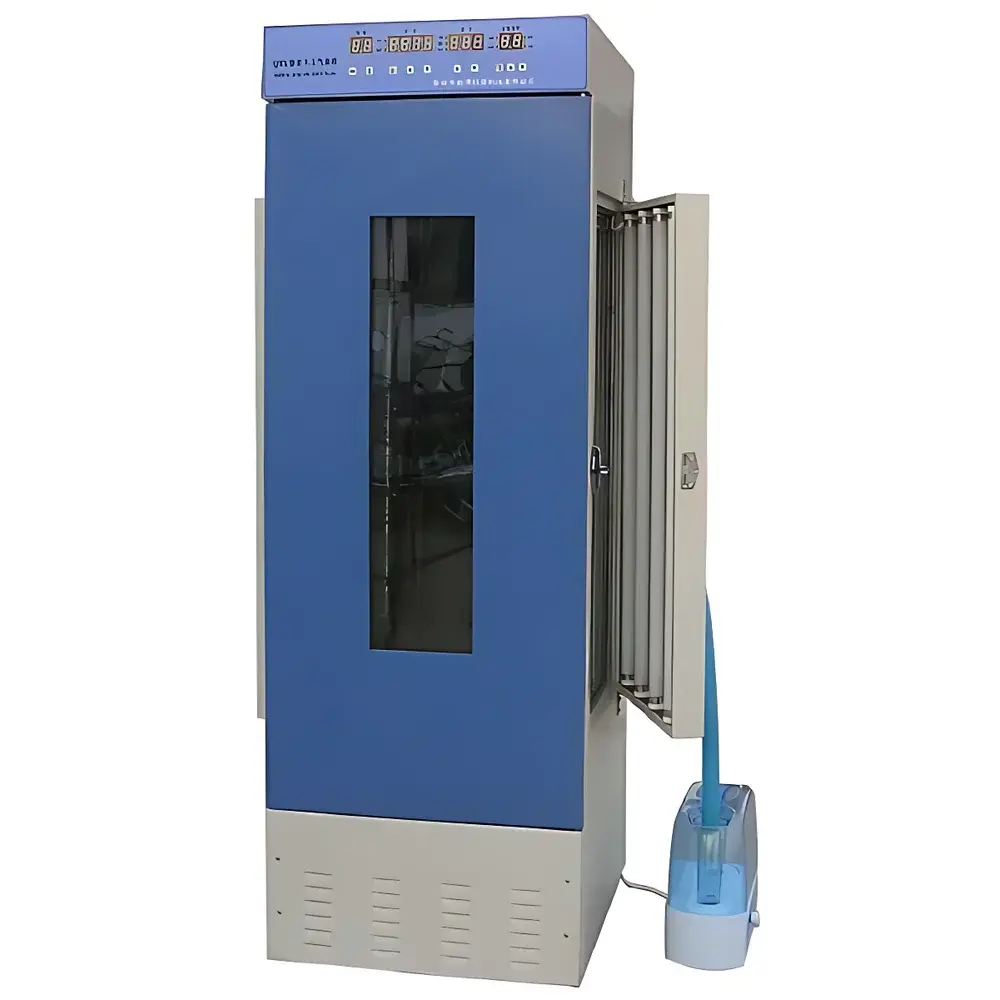
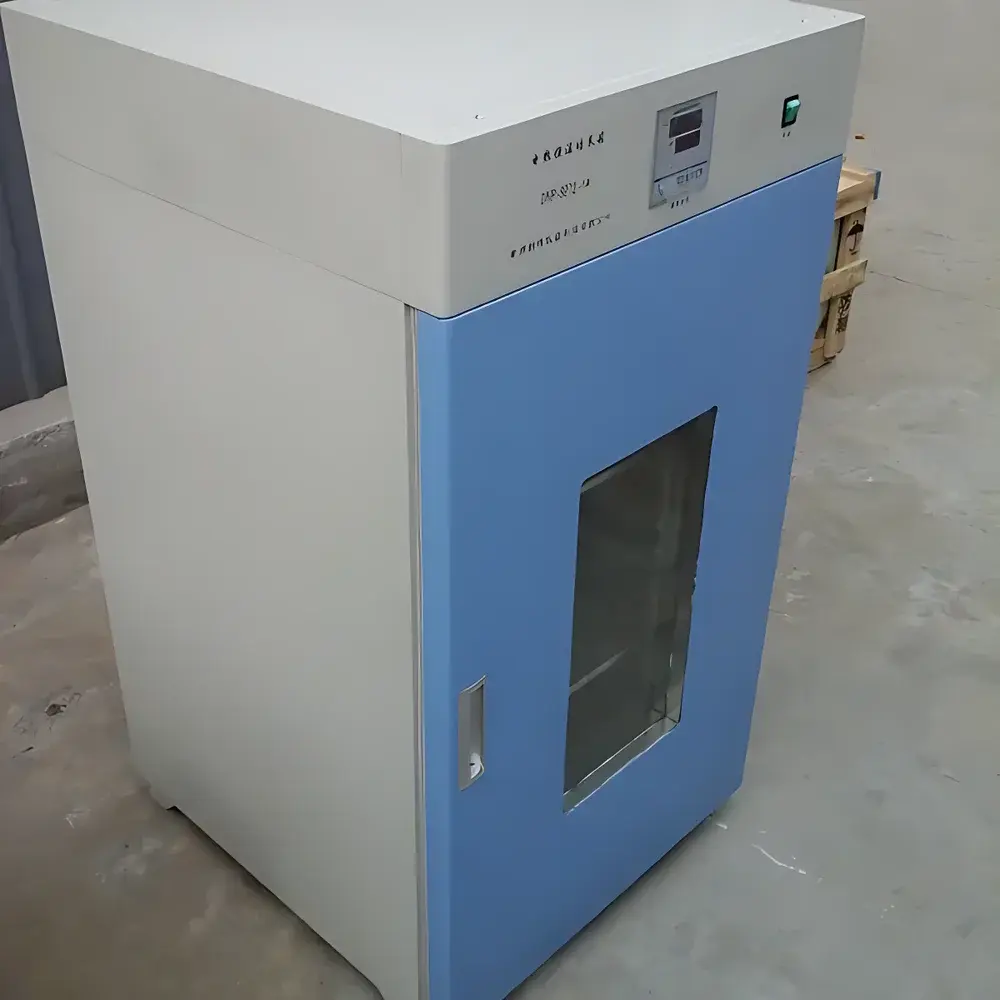
Langbo QHX-300BS Intelligent Climate Chamber
| Brand | Langbo |
|---|---|
| Origin | Jiangsu, China |
| Model | QHX-300BS |
| Chamber Type | Upright |
| Cooling Method | Air-cooled |
| Temperature Range | 0–60 °C (dark), 5–60 °C (with illumination) |
| Humidity Range | 50–95 %RH |
| Temperature Uniformity | ±2 °C |
| Temperature Deviation | ±1 °C |
| Temperature Fluctuation | ±1 °C |
| Humidity Deviation | 5–8 %RH |
| Humidity Fluctuation | 3–5 %RH |
| Illuminance Range | 0–15,000 lx |
| Internal Chamber Dimensions | 600 × 500 × 1000 mm (W × D × H) |
| Internal Volume | 300 L |
| Temperature Resolution | 0.1 °C |
| Construction | Stainless steel interior, powder-coated steel exterior, polyurethane insulation |
| Viewing Window | Large-angle tempered glass |
| Air Circulation | Forced convection via stainless steel ductwork |
| Safety | Independent over-temperature protection circuit |
Overview
The Langbo QHX-300BS Intelligent Climate Chamber is a precision-engineered environmental test chamber designed for long-term stability studies, seed germination testing, plant growth simulation, microbial culture incubation, and material aging assessments under controlled temperature and humidity conditions. It operates on a dual-parameter control principle—employing PID-regulated heating/cooling circuits and solid-state humidity generation via steam injection or evaporative saturation—ensuring reproducible environmental profiles across extended operational cycles. The chamber’s 300 L internal volume accommodates standard ISO-compliant sample racks and multi-tier shelving configurations, while its upright architecture optimizes laboratory floor space without compromising thermal mass or air exchange efficiency. Engineered for continuous operation in GLP-compliant laboratories, the QHX-300BS maintains traceable environmental parameters within defined tolerances per ASTM E145-22 (Standard Specification for Gravity-Convection and Forced-Ventilation Ovens) and ISO 17025-accredited calibration frameworks.
Key Features
- Stainless steel interior chamber with seamless welded corners and corrosion-resistant surface finish—designed for repeated cleaning, sterilization, and high-humidity resilience.
- High-efficiency air-cooled refrigeration system with independent compressor and condenser assembly—enabling stable operation at ambient temperatures up to 35 °C without performance degradation.
- Forced-air circulation via a stainless steel ducted airflow path—ensuring uniform temperature distribution (±2 °C) and minimizing stratification effects across the full working volume.
- Large-format, low-emissivity tempered observation window with anti-fog coating—providing unobstructed visual monitoring while maintaining thermal integrity.
- Dual-mode illumination system (0–15,000 lx) with adjustable photoperiod programming—compatible with phytochrome-sensitive assays and photobiological stress testing per ISO 8573-1 and CIE S 026/E:2019 spectral guidelines.
- Independent over-temperature safety cutoff with mechanical backup—compliant with IEC 61000-4-2 and EN 61000-6-2 electromagnetic immunity standards.
Sample Compatibility & Compliance
The QHX-300BS supports diverse sample formats including Petri dishes, multi-well plates, tissue culture flasks, botanical trays, polymer specimens, and pharmaceutical stability batches. Its stainless steel interior meets USP requirements for non-reactive surfaces in pharmaceutical storage validation. Humidity control is validated per ISO 12780-2 for relative humidity uncertainty estimation, and temperature mapping is performed using NIST-traceable Class A PT100 sensors. The unit complies with CE marking directives (2014/30/EU EMC, 2014/35/EU LVD), and its operational log data structure conforms to FDA 21 CFR Part 11 audit trail requirements when integrated with optional Ethernet-enabled data logging modules.
Software & Data Management
The embedded controller features a 7-inch capacitive touchscreen interface with multilingual support (English, German, French, Spanish) and real-time parameter visualization. All setpoints, actual values, alarms, and event timestamps are stored internally for ≥30 days and exportable via USB 2.0 to CSV or PDF formats. Optional LAN connectivity enables remote monitoring through Langbo’s L-Cloud platform—supporting role-based user access, electronic signature workflows, and automated report generation aligned with ISO/IEC 17025 clause 7.7 documentation requirements. Data integrity safeguards include write-protected memory partitions and cyclic redundancy checksum verification for all logged records.
Applications
- Pharmaceutical stability testing per ICH Q1A(R3) and USP under long-term and accelerated conditions.
- Seed viability and germination rate analysis in agronomy research (ISTA-certified protocols).
- Microbial growth kinetics studies for QC microbiology labs—especially for mesophilic fungi and bacteria requiring precise RH modulation.
- Polymer and composite material aging per ASTM D3045 and ISO 4892-2 (xenon-arc exposure pre-conditioning).
- Photoperiod-controlled plant phenotyping in academic and commercial horticultural facilities.
- Environmental stress screening of electronic components per MIL-STD-810H Method 507.6 (humidity soak).
FAQ
What is the maximum allowable ambient operating temperature for the QHX-300BS?
The chamber is rated for continuous operation at ambient temperatures up to 35 °C, provided minimum clearance (≥100 mm) is maintained around rear ventilation grilles.
Does the unit support programmable ramp-and-soak temperature/humidity profiles?
Yes—up to 32 segments per program, with adjustable ramp rates (0.1–10 °C/min), dwell times (1 min–999 h), and humidity transition constraints.
Is third-party calibration certification available?
Factory-installed NIST-traceable sensors are supplied with individual calibration certificates; on-site IQ/OQ/PQ validation services are offered separately by Langbo’s certified field engineers.
Can the illumination system be disabled during dark-cycle phases?
Yes—the lighting module operates independently from climate control and can be scheduled or manually overridden without affecting temperature or humidity regulation.
What maintenance intervals are recommended for optimal performance?
Compressor oil inspection every 24 months; condenser coil cleaning every 6 months; humidity reservoir descaling every 3 months in hard-water regions.



