
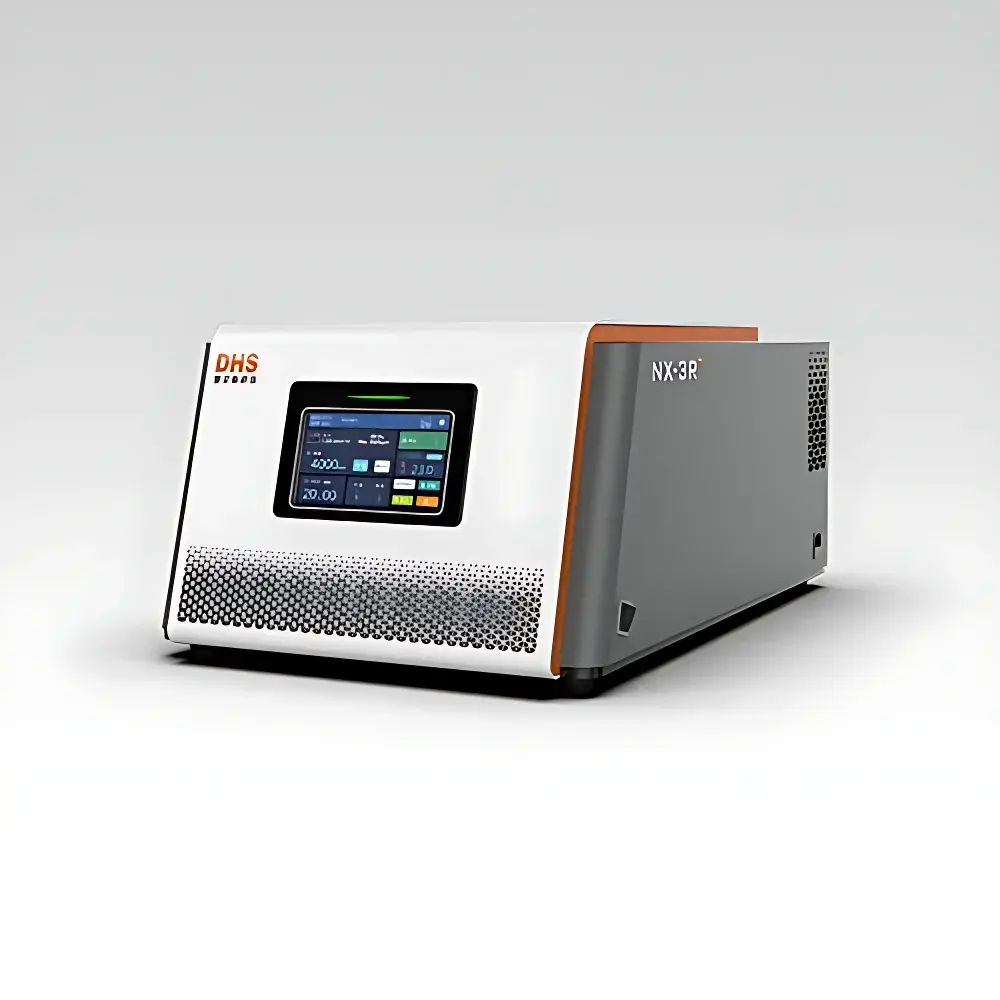
DHS NX-3R Pro High-Speed Refrigerated Benchtop Centrifuge
| Brand | DHS |
|---|---|
| Model | NX-3R Pro |
| Type | Refrigerated Benchtop Centrifuge |
| Max Speed | 21,000 rpm |
| Max RCF | 33,500 × g |
| Max Capacity | 6 × 250 mL |
| Temperature Range | −20 °C to 40 °C (1 °C increments) |
| Acceleration | 9 levels |
| Deceleration | 10 levels |
| Programmable Methods | 100 stored protocols |
| Rotor Recognition | Automatic |
| Display | 7-inch color touchscreen |
| Dimensions (W × D × H) | 470 × 740 × 325 mm |
| Net Weight | 64 kg |
| Power Supply | 220 V / 50 Hz |
| Safety Cutoff | Thermal shutdown at >45 °C |
Overview
The DHS NX-3R Pro is a high-performance refrigerated benchtop centrifuge engineered for precision separation of subcellular components—including large organelles, ribosomal subunits, and enveloped viruses—under controlled thermal conditions. It operates on the principle of sedimentation under high gravitational force generated by rapid rotor rotation, with precise temperature regulation maintained via a dual-stage compressor-based cooling system. Designed for routine and method-critical workflows in molecular biology, virology, and clinical diagnostics laboratories, the NX-3R Pro delivers reproducible RCF (relative centrifugal force) profiles across extended run durations while maintaining sample integrity at temperatures as low as −20 °C. Its compact footprint (470 × 740 × 325 mm) enables integration into space-constrained biosafety cabinets or shared core facility benches without compromising mechanical stability or acoustic performance.
Key Features
- Automatic rotor recognition system ensures correct parameter enforcement and prevents operational errors during method execution.
- Programmable acceleration and deceleration profiles (9 acceleration levels, 10 deceleration levels) minimize shear-induced resuspension and support gentle pelleting of fragile particles such as exosomes or viral capsids.
- 7-inch full-color capacitive touchscreen interface with intuitive icon-driven navigation supports multi-user access and real-time monitoring of speed, RCF, temperature, time remaining, and rotor status.
- Integrated thermal management includes active pre-cooling, ambient temperature compensation, and automatic thermal cutoff at >45 °C to protect both samples and drive electronics.
- Robust brushless frequency-controlled motor provides high torque at low speeds and stable operation up to 21,000 rpm with minimal vibration and noise (<65 dB(A) at 20,000 rpm).
- Comprehensive protocol memory stores up to 100 user-defined methods—including speed, time, temperature, ramp profiles, and brake settings—for rapid recall and GLP-compliant workflow repeatability.
Sample Compatibility & Compliance
The NX-3R Pro accommodates a broad range of tube formats and microplate types through interchangeable rotors, including fixed-angle, swing-bucket, and specialized H-type plate carriers compatible with PCR plates (up to 66 mm height), deep-well plates, ELISA microplates, and cell culture plates. Its maximum capacity of 6 × 250 mL allows scalable processing for preparative applications without requiring floor-standing instrumentation. All rotors are certified to ISO 15882:2021 (centrifuge safety) and undergo dynamic balancing per ISO 21501-4. The unit complies with IEC 61010-1:2010 for laboratory electrical equipment safety and meets electromagnetic compatibility requirements per EN 61326-1. Optional audit trail logging and electronic signature modules support alignment with FDA 21 CFR Part 11 and EU Annex 11 for regulated environments.
Software & Data Management
While the NX-3R Pro operates autonomously via its embedded firmware, optional USB export functionality enables transfer of run logs—including timestamped start/stop events, actual vs. setpoint deviations, rotor ID, and error codes—to external LIMS or ELN systems. Each stored protocol retains metadata such as operator ID (manually entered), date of creation, and modification history. Firmware updates are performed via secure USB key with version checksum verification. Data retention follows ALCOA+ principles (Attributable, Legible, Contemporaneous, Original, Accurate, Complete, Consistent, Enduring, Available), supporting traceability in GMP/GLP audits.
Applications
- Isolation of mitochondria, lysosomes, and peroxisomes from tissue homogenates using differential centrifugation protocols.
- Purification of influenza A virus, SARS-CoV-2 pseudovirions, and retroviral vectors via sucrose or iodixanol density gradient ultracentrifugation (with compatible swing-bucket rotors).
- Clarification of bacterial lysates prior to chromatographic purification of recombinant proteins.
- Processing of whole blood, PBMCs, and plasma-derived extracellular vesicles under temperature-stabilized conditions to prevent RNA degradation.
- Routine nucleic acid pellet consolidation following ethanol precipitation steps in genomic DNA or total RNA isolation workflows.
FAQ
What is the minimum operating temperature, and how quickly does the chamber reach −20 °C?
The chamber achieves −20 °C in ≤15 minutes when starting from 25 °C ambient, with pre-cool functionality activated prior to lid closure.
Does the NX-3R Pro support validation documentation for IQ/OQ/PQ protocols?
Yes—factory calibration certificates for speed, temperature, and timer accuracy are provided; optional third-party qualification packages include installation, operational, and performance qualification templates aligned with ISO/IEC 17025 requirements.
Can the centrifuge be integrated into a networked lab environment?
Currently, the NX-3R Pro does not feature Ethernet or Wi-Fi connectivity; however, USB-based data export and firmware updates maintain compatibility with centralized IT asset management policies.
Are rotors individually serialized and traceable?
Yes—each rotor carries a permanent laser-etched serial number linked to its certified maximum speed, material fatigue cycle count, and maintenance log within the instrument’s internal registry.
What safety interlocks prevent operation with improperly seated rotors or open lids?
Mechanical lid lock detection, rotor presence sensing, and imbalance vibration monitoring trigger immediate deceleration and audible/visual alerts if thresholds exceed ISO 15882-defined limits.



