
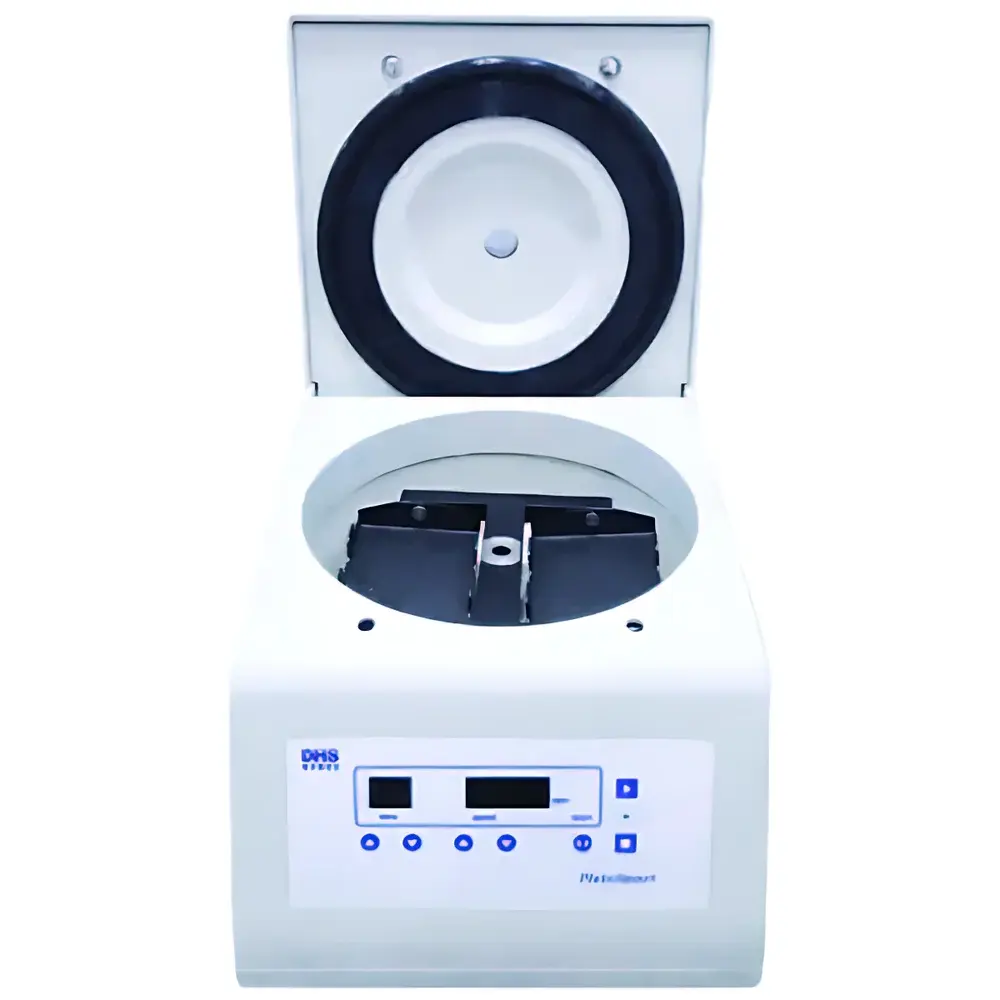
DHS PlateSmart Low-Speed Microplate Centrifuge
| Brand | DHS |
|---|---|
| Origin | Tianjin, China |
| Model | PlateSmart |
| Instrument Type | Benchtop Centrifuge |
| Speed Range | 0–2500 rpm |
| Max RCF | 650 × g |
| Max Capacity | 4 × 96-well microplates (e.g., ELISA, cell culture plates) or 2 × deep-well/PCR plates |
| Rotor Type | Fixed-angle horizontal microplate rotor (38 mm plate height clearance) |
| Motor | Brushless DC direct-drive torque motor |
| Control | Microprocessor-based digital display for time and speed |
| Timer Range | 1 s – 99 min 59 s |
| Spin Function | Instant centrifugation (Spin key) |
| Safety | Automatic rotor stop upon lid opening, mechanical safety lock |
| Noise Level | ≤55 dB(A) |
| Dimensions (W×D×H) | 300 × 310 × 380 mm |
| Weight | <12 kg |
| Compliance | Designed per IEC 61010-1 for laboratory equipment safety |
Overview
The DHS PlateSmart Low-Speed Microplate Centrifuge is an engineered benchtop solution optimized for gentle, high-throughput sedimentation of liquid samples in standard microplate formats. Operating on the principle of radial acceleration-induced sedimentation, it delivers precise, reproducible low-g forces (up to 650 × g) suitable for pelleting cells, precipitating assay reagents, removing air bubbles from PCR master mixes, and consolidating lysates in 96-well, 384-well, deep-well, and PCR plates. Unlike high-speed centrifuges intended for subcellular fractionation, the PlateSmart is purpose-built for microplate compatibility—eliminating the need for tube-to-plate transfers and minimizing cross-contamination risk. Its compact footprint (300 × 310 × 380 mm) and sub-12 kg mass enable seamless integration into biosafety cabinets, cold rooms, and high-density lab benches without compromising structural stability or thermal management.
Key Features
- Brushless DC direct-drive motor: Ensures maintenance-free operation, extended service life (>20,000 h MTBF), and acoustic performance ≤55 dB(A) at 2500 rpm—critical for open-lab environments.
- Horizontal fixed-angle microplate rotor: Accommodates up to four standard 96-well plates (ELISA, cell culture) or two deep-well/PCR plates simultaneously, with 38 mm vertical clearance for plate stack compatibility including barcoded and skirted variants.
- Digital microprocessor control: Real-time display of set and actual speed (rpm) and elapsed time; resolution of 1 rpm and 1 s; programmable timer range from 1 second to 99 minutes 59 seconds.
- Instant spin function (“Spin” key): Enables rapid, unprogrammed centrifugation at user-defined speed for quick settling prior to pipetting or imaging—no timer setup required.
- Integrated mechanical safety interlock: Lid-mounted switch ensures immediate rotor deceleration (<2 s stop time) upon door opening, compliant with IEC 61010-1 Clause 7.3.2 for operator protection.
- Low-inertia rotor design: Achieves full speed in <12 s and decelerates to rest in <15 s, reducing cycle time without inducing excessive vibration or plate displacement.
Sample Compatibility & Compliance
The PlateSmart supports all ANSI/SBS-standard microplates (127.76 × 85.48 mm footprint), including non-skirted, semi-skirted, fully skirted, and PCR-optimized plates with varying well depths (up to 25 mm). It is routinely validated for use with aqueous buffers, serum-containing media, enzymatic reaction mixtures, and viscous lysis solutions (up to 15 mPa·s). While not certified for clinical diagnostics under ISO 13485, its construction and operational parameters align with GLP-compliant workflows for preclinical assay development. The device meets electromagnetic compatibility (EMC) requirements per IEC 61326-1 and carries CE marking for conformity with EU Directive 2014/30/EU (EMC) and 2014/35/EU (LVD).
Software & Data Management
The PlateSmart operates as a standalone instrument with no embedded data logging or USB connectivity. All operational parameters are retained in volatile memory only during active use and are not stored post-power-down. For laboratories requiring audit trails—particularly those adhering to FDA 21 CFR Part 11 or ISO/IEC 17025—external documentation (e.g., electronic lab notebooks or LIMS entries) must be manually generated for each run. No firmware updates or remote diagnostics are supported; calibration verification is performed via external tachometer and stopwatch against displayed values at three points (500, 1500, and 2500 rpm) per annual preventive maintenance.
Applications
- PCR/qPCR workflow preparation: Removing air bubbles from master mixes and ensuring uniform bottom-layer contact in optical plates.
- ELISA and immunoassay processing: Pelleting residual conjugate or substrate precipitates before plate reading.
- Cell-based assays: Gentle sedimentation of adherent or suspension cells in culture plates prior to medium aspiration or fixation.
- High-throughput screening (HTS): Consolidating compound library stocks in deep-well plates prior to dispensing.
- Nucleic acid purification: Accelerating binding buffer penetration in silica-membrane filter plates during vacuum or centrifugal protocols.
- Quality control in biomanufacturing: Verifying plate fill consistency and meniscus uniformity across production batches.
FAQ
Is the PlateSmart compatible with 384-well microplates?
Yes—provided the plate height does not exceed 38 mm and the footprint conforms to ANSI/SBS standards. Performance validation is recommended for plates with elevated rims or integrated lids.
Does the centrifuge support temperature control?
No. The PlateSmart is a non-refrigerated model intended for ambient-temperature applications only.
Can it be used for centrifuging tubes?
No. The rotor geometry and clamping mechanism are exclusively designed for flat-bottomed microplates; tube adapters are neither supplied nor supported.
What maintenance is required?
None beyond periodic wiping of the rotor chamber and lid seal with 70% ethanol; the brushless motor requires no lubrication or carbon brush replacement.
Is calibration traceable to national standards?
Factory calibration uses NIST-traceable tachometry; users may perform in-house verification using ISO 17025-accredited handheld tachometers.



