
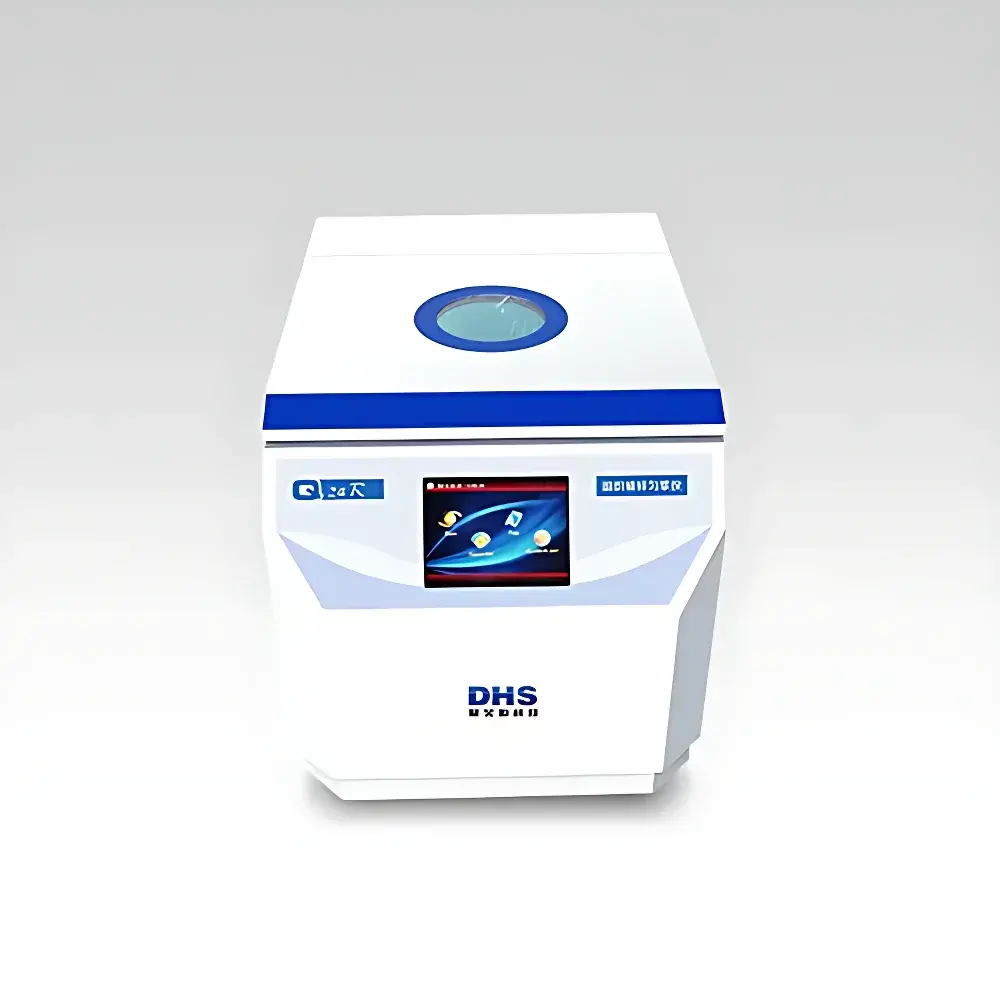
DHS Q24R Cryo-Grinding and Homogenization System
| Brand | DHS |
|---|---|
| Origin | Tianjin, China |
| Model | Q24R |
| Instrument Type | Cryogenic Benchtop Bead Mill Homogenizer |
| Sample Compatibility | Frozen Biological Tissues & Cells |
| Maximum Feed Size | < 8 mm |
| Final Particle Size | < 5 µm |
| Throughput | 24 × 2.0 mL tubes or 4 × 15 mL tubes |
| Grinding Velocity | 2.0–6.5 m/s (adjustable in 0.05 m/s increments) |
| Temperature Control Range | 0–35 °C (compressor-cooled) |
| Programmable Protocols | 99 stored methods |
| Maximum Cycle Duration | 99 min 59 sec |
| Cycles per Run | up to 99 |
| Noise Level | ≤ 54 dB(A) |
| Display | 5.7″ capacitive touchscreen |
| Power Supply | 200–240 V, 50/60 Hz |
| Dimensions (L×W×H) | 510 × 370 × 360 mm |
| Weight | 30 kg |
| Chamber Material | Stainless Steel 304 |
| Motor Type | Brushless Frequency-Controlled AC Motor |
| Safety Features | Lid-interlocked operation, automatic shutdown on abnormal vibration or overheating |
| Data Interface | RS-232 or USB (configurable) |
| Regulatory Compliance | Designed for GLP-compliant laboratories |
Overview
The DHS Q24R Cryo-Grinding and Homogenization System is an engineered solution for high-integrity mechanical lysis of biological samples under precisely controlled low-temperature conditions. Utilizing high-frequency oscillatory motion transmitted through stainless-steel or ceramic beads within sealed tubes, the system achieves rapid, reproducible cell disruption via impact and shear forces—principles grounded in bead-beating mechanics. Unlike conventional rotor-stator homogenizers or ultrasonic probes, the Q24R avoids localized thermal spikes by integrating a built-in compressor-based cooling system that actively maintains sample chamber temperature between 0 °C and 35 °C throughout operation. This thermal management is critical for preserving labile biomolecules—including genomic DNA, intact mRNA, native proteins, and post-translational modifications—during lysis. The system operates on a dual-axis horizontal shaking platform with adjustable velocity (2.0–6.5 m/s), enabling optimization across diverse tissue densities and cellular architectures without requiring cryogenic solvents such as liquid nitrogen.
Key Features
- Compressor-driven active cooling ensures stable sub-ambient processing temperatures, minimizing enzymatic degradation and thermal denaturation during homogenization.
- Brushless frequency-controlled AC motor delivers consistent torque and eliminates carbon dust contamination—eliminating routine brush replacement and extending service intervals.
- 5.7″ industrial-grade capacitive touchscreen interface enables intuitive protocol configuration, real-time parameter monitoring, and secure user-level access control.
- 99 programmable methods support method standardization across shifts and operators; each includes configurable velocity, duration, cycle count, and rest intervals.
- Robust stainless-steel processing chamber (AISI 304) resists corrosion from organic solvents and cleaning agents, facilitating rapid decontamination between runs.
- Lid-safety interlock prevents operation unless the chamber is fully closed and sealed, meeting IEC 61000-6-2 electromagnetic compatibility and mechanical safety standards.
- No cross-contamination risk: all samples remain fully enclosed in certified RNase/DNase-free tubes throughout processing; no open-vessel handling required.
Sample Compatibility & Compliance
The Q24R accommodates a broad spectrum of biological matrices—including fibrous plant tissues (roots, stems, seeds), soft and lipid-rich animal organs (liver, brain, adipose), microbial pellets (Gram-positive bacteria, yeasts, spores), and composite materials such as pharmaceutical tablets or food matrices. Its ability to process samples up to 8 mm pre-grind size and deliver final particle distributions below 5 µm makes it suitable for downstream applications demanding high nucleic acid yield and integrity—e.g., whole-genome sequencing library preparation, ChIP-seq, and proteomic digestion workflows. The system conforms to ISO/IEC 17025 calibration traceability frameworks when used with NIST-traceable temperature validation tools. It supports GLP and GMP-aligned documentation practices when integrated with compliant laboratory information management systems (LIMS) featuring electronic signatures and audit trails per FDA 21 CFR Part 11.
Software & Data Management
While the Q24R operates autonomously via its embedded microcontroller, it provides standardized serial (RS-232) and USB interfaces for external data logging and remote protocol deployment. Optional firmware upgrades enable timestamped run logs—including date/time, operator ID, selected program, actual velocity profile, chamber temperature history, and fault codes—to be exported in CSV format for quality assurance review. When deployed in regulated environments, the instrument can be validated using IQ/OQ protocols aligned with ASTM E2500 and ISO 13485 guidelines. All firmware revisions undergo version-controlled release testing per IEEE 1012 standards.
Applications
- High-yield genomic DNA extraction from tough plant tissues without phenol-chloroform steps.
- RNA isolation from RNase-rich tissues (e.g., pancreas, spleen) with RIN values > 8.5.
- Preparation of native protein lysates for co-immunoprecipitation and structural mass spectrometry.
- Homogenization of frozen tumor biopsies for spatial transcriptomics and single-nucleus RNA-seq.
- Cell wall disruption of yeast and mycobacteria for metabolite profiling and antibiotic susceptibility assays.
- Particle size reduction of excipients and active pharmaceutical ingredients (APIs) for dissolution testing per USP <711>.
FAQ
Does the Q24R require liquid nitrogen or dry ice for cryogenic operation?
No. The integrated compressor-based cooling system maintains sample temperature between 0 °C and 35 °C without external cryogens.
Can the Q24R process samples in 50 mL tubes?
No. It is configured exclusively for 24 × 2.0 mL tubes or 4 × 15 mL tubes; adapter kits for other formats are not supported.
Is the instrument compatible with third-party lysis kits?
Yes. As an open-platform homogenizer, it accepts commercially available bead-based lysis kits—provided tube dimensions and bead composition comply with mechanical stress limits.
What maintenance is required beyond routine cleaning?
None. The brushless motor, sealed bearings, and stainless-steel chamber eliminate scheduled wear-part replacement; only periodic verification of temperature calibration and vibration damping is recommended.
How is method reproducibility ensured across multiple instruments?
Velocity calibration is traceable to rotary encoder feedback; inter-unit CV for identical protocols is ≤ 2.3% (n = 12, tested per ISO 5725-2).
Related Products



