
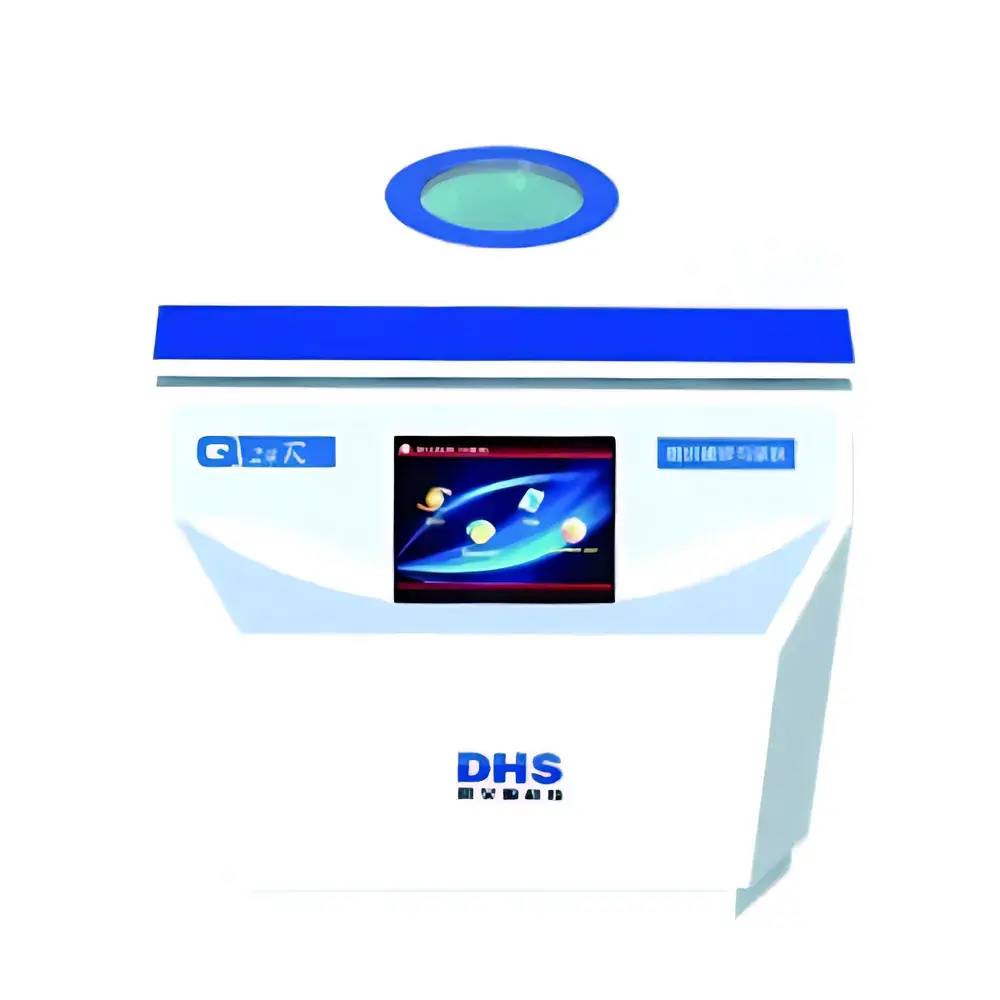
DHS Q24RC/Q24R/Q24 Cryogenic High-Throughput Tissue Grinder
| Brand | DHS |
|---|---|
| Origin | Tianjin, China |
| Model | Q24RC / Q24R / Q24 |
| Instrument Type | Cryogenic High-Throughput Tissue Grinder |
| Sample Compatibility | Frozen & Fresh Biological Tissues |
| Maximum Input Size | ≤8 mm |
| Final Particle Size | ≤5 µm |
| Throughput | 24 × 2.0 mL Tubes per Batch |
| Operating Temperature Range | −20 °C to +4 °C (Q24R/Q24RC) |
| Centrifugation Capability | Up to 6,000 rpm (Q24RC only) |
| Noise Level | ≤56 dB(A) |
| Control Interface | 5.7″ Color Touchscreen |
| Programmable Methods | 99 Presets |
| Continuous Operation Mode | Up to 30 min |
| Compliance | Designed for GLP-compliant labs |
Overview
The DHS Q24RC/Q24R/Q24 Cryogenic High-Throughput Tissue Grinder is an engineered solution for rapid, reproducible, and temperature-controlled mechanical lysis of biological samples. Based on high-frequency oscillatory motion combined with cryogenic stabilization, the system delivers uniform shear and impact forces across up to 24 samples simultaneously—enabling efficient cell wall disruption while preserving labile biomolecules. Unlike conventional bead-beating or rotor-stator homogenizers, this platform employs a four-dimensional grinding mechanism (horizontal, vertical, rotational, and vibrational axes), minimizing localized thermal accumulation and ensuring minimal degradation of nucleic acids and native proteins. The Q24RC variant integrates refrigerated centrifugation (−20 °C to +4 °C, up to 6,000 rpm) directly following grinding, eliminating manual transfer steps and reducing exposure to ambient conditions—a critical advantage for RNA integrity (RIN > 8.5) and post-translational protein stability.
Key Features
- Cryogenic operation: Integrated Peltier cooling maintains sample chamber temperatures between −20 °C and +4 °C during grinding, suppressing enzymatic activity and thermal denaturation.
- Four-axis grinding dynamics: Simultaneous horizontal shaking, vertical vibration, rotational tumbling, and micro-impact action ensure homogeneous particle size reduction without hotspots.
- High-throughput capacity: Processes 24 × 2.0 mL tubes in a single run—compatible with standard skirted PCR tubes, deep-well plates, and proprietary lysing kits.
- Programmable control: 5.7″ capacitive touchscreen interface supports 99 user-defined protocols; parameters include oscillation frequency (100–2,000 rpm equivalent), duration (10 s–30 min), pause intervals, and cooling setpoint.
- Integrated centrifugation (Q24RC only): Post-grinding spin step at up to 6,000 rpm enables immediate supernatant separation—eliminating pipetting errors and cross-contamination risks.
- Sealed-tube processing: All samples remain fully enclosed in certified low-binding tubes throughout grinding and centrifugation, meeting ISO 554 and CLSI EP25-A2 requirements for contamination control.
- Durable architecture: Stainless-steel chamber interior, brushless frequency-controlled motor (no carbon dust generation), and tool-free sample tray locking mechanism ensure long-term reliability and ease of decontamination.
Sample Compatibility & Compliance
The Q-series accommodates diverse biological matrices—including fibrous plant tissues (roots, stems, leaves), dense animal organs (liver, brain, muscle, bone), microbial cells (yeast, spores, Gram-positive bacteria), and environmental specimens (soil, sediment, fossilized material). Its ≤5 µm final particle size distribution supports downstream applications requiring high-surface-area lysates, such as magnetic-bead-based nucleic acid isolation or proteomic digestion efficiency. The system complies with key regulatory frameworks: its closed-tube workflow aligns with FDA 21 CFR Part 11 data integrity expectations when paired with validated LIMS integration; temperature logging functionality satisfies GLP audit requirements per OECD Series 100; and mechanical consistency meets ASTM E2917-22 criteria for inter-laboratory reproducibility in sample prep.
Software & Data Management
Each instrument logs timestamped operational records—including actual chamber temperature, motor duty cycle, run duration, and program ID—to internal flash memory (16 GB). Export options include CSV via USB port or Ethernet-connected network share. Optional software modules support remote monitoring, electronic signature-enabled method validation, and audit trail generation compliant with ISO/IEC 17025:2017 Clause 7.7. All firmware updates are digitally signed and version-tracked, ensuring traceability per ICH GCP E6(R3) Annex 11 principles.
Applications
- Genomic library preparation: Enables high-yield, fragmentation-controlled DNA extraction suitable for Illumina NovaSeq and PacBio Revio workflows.
- Single-cell RNA-seq sample prep: Preserves transcript integrity from low-input tissues (e.g., mouse hypothalamus, human biopsy fragments).
- Proteomics: Delivers consistent subcellular fractionation for LC-MS/MS analysis without urea-induced carbamylation artifacts.
- Pharmaceutical QA/QC: Supports pharmacopeial grinding protocols for herbal matrix standardization (USP , EP 2.8.27).
- Environmental microbiology: Facilitates metagenomic DNA recovery from clay-rich soils and biofilm-coated surfaces.
- Veterinary diagnostics: Processes formalin-fixed paraffin-embedded (FFPE) tissue sections after dewaxing for companion diagnostic assay development.
FAQ
What types of tubes are compatible with the Q24 series?
Standard 2.0 mL skirted PCR tubes, 2.0 mL deep-well plates, and DHS-certified stainless-steel grinding vials (with ceramic or zirconia beads) are supported. Tube height must not exceed 55 mm.
Can the Q24R be used without active cooling?
Yes—the refrigeration system can be disabled for ambient-temperature protocols, though biomolecule preservation is optimized under cryogenic conditions.
Is the centrifugation function available on all models?
Only the Q24RC model includes integrated refrigerated centrifugation. The Q24R provides cooling-only; the base Q24 offers ambient grinding only.
How is cross-contamination prevented between runs?
Each tube remains sealed throughout processing; the chamber is cleaned using 70% ethanol followed by UV-C irradiation (optional add-on module), validated per ISO 15223-1 Annex B.
Does the system support 21 CFR Part 11 compliance?
When operated with optional audit trail software and role-based access controls, full electronic record integrity—including operator ID, timestamp, and parameter change history—is achievable.



