
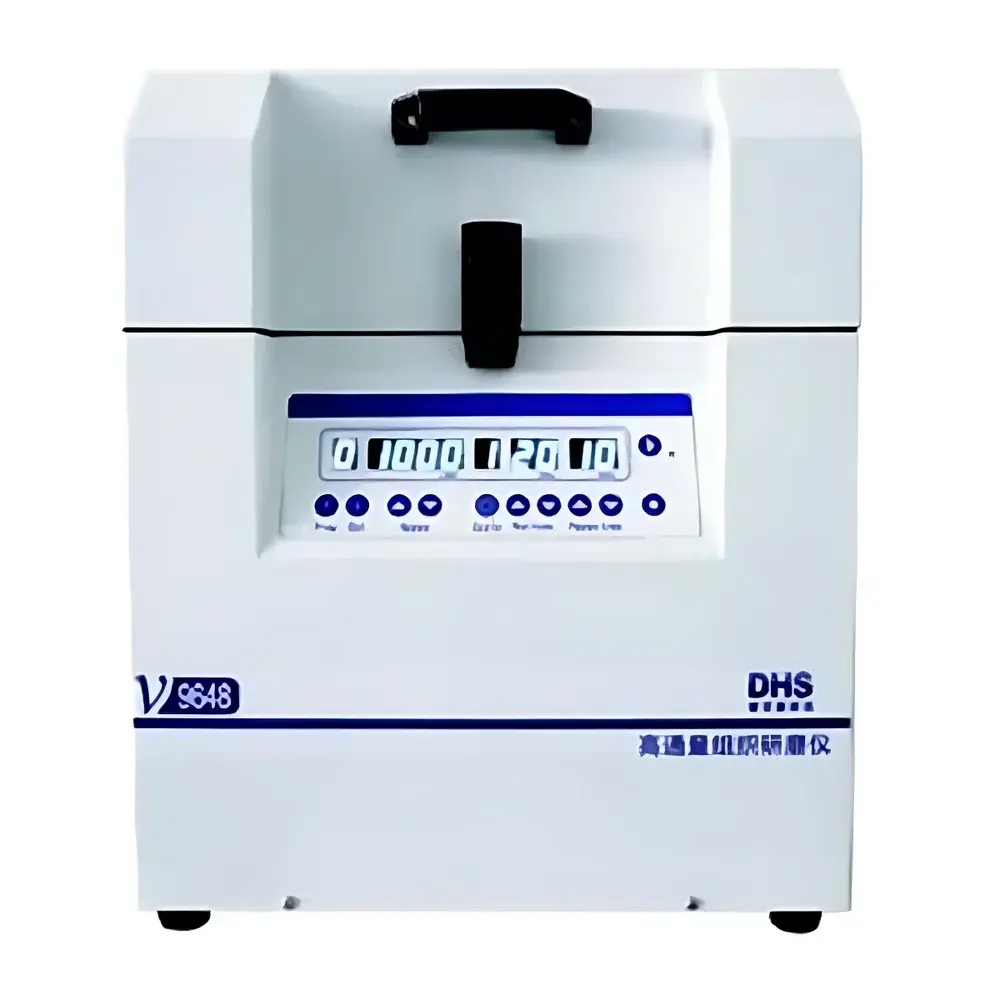
DHS V4800/V9648 Vertical 3D High-Throughput Tissue Grinder
| Brand | DHS |
|---|---|
| Origin | Tianjin, China |
| Model | V4800/V9648 |
| Instrument Type | High-Throughput Tissue Grinder |
| Sample Type | Hard and Tough Biological Tissues |
| Final Particle Size | ≤5 µm |
| Feed Particle Size | Adjustable via Adapter Selection |
| Batch Capacity | 2 × 50 mL grinding jars |
| Maximum Oscillation Frequency | 2100 cycles/min |
| Operating Principle | Vertical 3D reciprocating oscillation generating impact, shear, and friction forces |
Overview
The DHS V4800/V9648 Vertical 3D High-Throughput Tissue Grinder is an engineered solution for rapid, reproducible mechanical homogenization of hard, fibrous, or resilient biological samples—including frozen animal tissues, plant roots, bone, cartilage, and microbial cell pellets. Unlike horizontal bead mills or rotary grinders, this system employs a precisely controlled vertical 3D oscillation mechanism: the platform moves in high-frequency reciprocating motion along the Z-axis while introducing subtle lateral displacement, inducing multi-directional kinetic energy transfer to grinding media (e.g., stainless steel, tungsten carbide, or ceramic beads) within sealed tubes. This motion generates simultaneous impact, shear, and abrasive forces—enabling complete cellular disruption and subcellular fractionation without significant thermal buildup. Designed for laboratories requiring consistent sample preparation prior to nucleic acid extraction, protein solubilization, metabolite profiling, or histological embedding, the V4800/V9648 delivers high reproducibility across batches and operators.
Key Features
- Vertical 3D oscillation architecture with programmable frequency range up to 2100 cycles per minute—optimized for efficient energy transfer while minimizing tube resonance and sample heating.
- Dual-mode operation: V4800 supports dual 50 mL jar configuration for bulk tissue processing; V9648 accommodates up to 96 × 2 mL tubes simultaneously—ideal for high-throughput genomics or biobanking workflows.
- Patented anti-loosening locking mechanism ensures secure clamping of adapters under high-frequency vibration, preventing tube ejection or cross-contamination during operation.
- Acoustically damped housing and balanced drive assembly reduce operational noise to <55 dB(A) at 1 m distance—enabling placement in shared lab spaces without acoustic interference.
- Modular adapter system compatible with standard microcentrifuge tubes (2 mL, 5 mL), cryo-tubes, stainless steel grinding vessels (4–15 mL), and custom-configured racks—supporting both single-use and reusable protocols.
- Integrated safety interlock prevents operation unless lid is fully closed and all adapters are correctly seated—compliant with IEC 61000-6-2/6-4 electromagnetic compatibility and mechanical safety requirements.
Sample Compatibility & Compliance
The V4800/V9648 is validated for use with hard-to-lyse biological matrices, including but not limited to: murine liver and spleen (frozen), human tumor biopsies, woody plant stems, fungal mycelia, and Gram-positive bacterial pellets. It supports cryogenic grinding when used with pre-chilled adapters and liquid nitrogen-cooled tubes. All contact surfaces are constructed from medical-grade stainless steel (AISI 316) or autoclavable polymer alloys, meeting ISO 13485 material traceability standards. The instrument does not require hazardous reagents or consumables beyond standard grinding beads, aligning with green laboratory principles. While not certified as an IVD device, its performance characteristics support GLP-compliant sample prep workflows referenced in ISO/IEC 17025-accredited testing laboratories.
Software & Data Management
The V4800/V9648 operates via a front-panel LCD interface with non-volatile memory storing up to 20 user-defined protocols—including time (1 s–99 min), frequency (500–2100 cpm), and pause intervals. No proprietary software is required for basic operation; however, optional USB data logging enables export of run timestamps, cycle counts, and error codes for internal audit trails. The system supports integration into LIMS environments via RS-232 serial output (ASCII protocol), permitting automated job dispatch and result correlation with downstream analytical platforms (e.g., qPCR, LC-MS, NGS library prep systems). Audit trail functionality meets minimum ALCOA+ criteria for raw data integrity in regulated research settings.
Applications
- RNA/DNA extraction from fibrous or lipid-rich tissues where enzymatic lysis fails to achieve complete homogenization.
- Preparation of uniform tissue powders for quantitative proteomics—minimizing protein degradation through rapid, low-heat mechanical disruption.
- Homogenization of environmental soil or sediment samples containing embedded microbial aggregates prior to metagenomic DNA isolation.
- Cell wall disruption of yeast and filamentous fungi for intracellular metabolite recovery in pharmaceutical fermentation QC.
- Standardized sample comminution for ASTM D7429-22 (standard practice for preparing solid waste samples for chemical analysis).
FAQ
What types of grinding media are recommended for optimal tissue disruption?
Stainless steel beads (2–5 mm diameter) are recommended for hard tissues; tungsten carbide beads provide higher density for dense samples like bone or seeds; ceramic beads are preferred for RNA work to minimize metal-induced nuclease activity.
Can the instrument be operated inside a cold room or -80°C freezer?
No—the electronic control unit and motor are rated for ambient operation only (10–30°C, <80% RH). Cryogenic grinding must be performed using pre-chilled tubes and adapters outside the instrument chamber.
Is validation documentation available for regulatory submissions?
DHS provides factory calibration reports and mechanical performance verification data (oscillation amplitude ±0.2 mm, frequency accuracy ±1%). Full IQ/OQ documentation packages are available upon request for GMP-aligned installations.
How often does the drive belt require replacement?
Under normal usage (≤8 hrs/day, 5 days/week), the reinforced polyurethane timing belt is rated for ≥15,000 hours of service life with no scheduled maintenance required.
Are third-party adapters supported?
Yes—mechanical dimensions conform to ANSI/SLAS 1-2014 footprint standards; however, DHS validates only OEM adapters for torque transmission integrity and vibration damping performance.



