
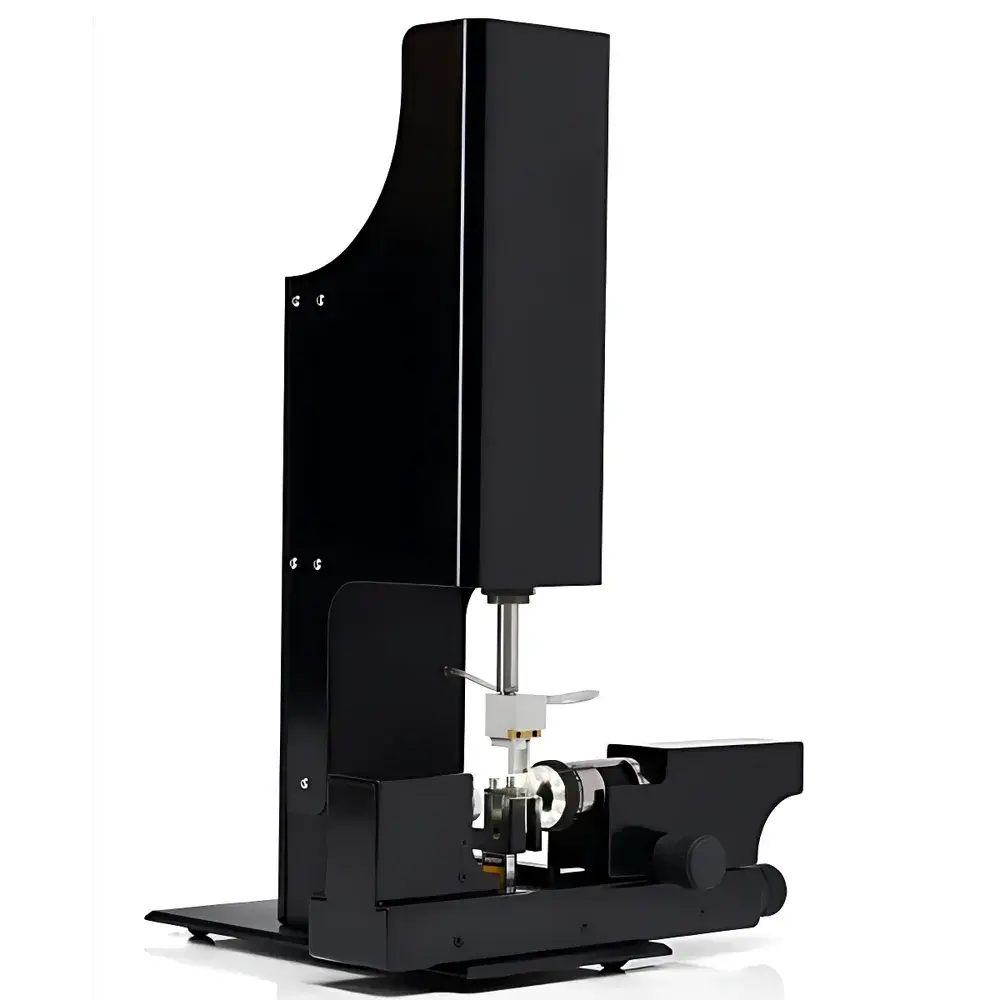
Dia-stron IFSS Micro-Debonding Tester
| Brand | Dia-stron |
|---|---|
| Origin | United Kingdom |
| Model | IFSS |
| Application | Interfacial Shear Strength Measurement on Single Fibers and Filaments |
| Optical Imaging | Integrated High-Resolution Camera and Adjustable LED Illumination System |
| Sample Compatibility | Glass, Carbon, Ceramic, Aramid, Basalt, and Natural Fibers |
| Compliance | Designed for ASTM D3379, ISO 11359, and ISO 16284-aligned testing protocols |
Overview
The Dia-stron IFSS Micro-Debonding Tester is a precision-engineered instrument designed to quantify interfacial shear strength (IFSS) between a single fiber or filament and its surrounding matrix material via controlled micro-debonding. Operating on the principle of axial pull-out with simultaneous optical monitoring, the system applies a calibrated tensile force to a micro-droplet–coated fiber segment while measuring the critical load at which interfacial failure initiates. This method adheres to fundamental micromechanical test paradigms widely accepted in composite materials science, particularly for evaluating fiber–matrix adhesion in thermoset, thermoplastic, and bio-based composites. The IFSS tester delivers high reproducibility in sub-millinewton force resolution and enables direct correlation between mechanical debonding behavior and morphological failure signatures observed in real time.
Key Features
- High-precision motorized actuation system with closed-loop force control, optimized for sub-10 µN resolution in the low-force regime (0.1–50 mN range).
- Integrated coaxial optical path featuring a high-magnification telecentric lens, adjustable monochromatic LED illumination, and 5-megapixel CMOS camera capable of 60 fps video capture at full resolution.
- Modular sample stage with XYZ micropositioning (1 µm step resolution) and thermal stabilization plate (±0.5 °C), supporting both ambient and conditioned environmental testing.
- Real-time synchronization of force–displacement data with video acquisition, enabling frame-accurate annotation of crack initiation, interfacial slip, and final debonding events.
- Tool-free fiber clamping mechanism compatible with diameters from 5 µm to 50 µm, including brittle ceramic and high-modulus carbon filaments.
Sample Compatibility & Compliance
The IFSS platform accommodates a broad spectrum of reinforcing fibers—glass, carbon, aramid (e.g., Kevlar®), basalt, silicon carbide, alumina, flax, jute, and cellulose nanocrystals—without requiring surface metallization or conductive coating. Each test configuration follows standardized specimen preparation guidelines aligned with ASTM D3379 (tensile properties of single-filament composites), ISO 11359 (thermomechanical analysis of polymers), and ISO 16284 (determination of interfacial adhesion in fiber-reinforced plastics). Data output meets GLP-compliant documentation requirements, with timestamped metadata, operator ID logging, and audit-trail-enabled file export (CSV, TIFF, MP4). The system architecture supports optional 21 CFR Part 11 compliance packages for regulated R&D environments.
Software & Data Management
The proprietary Dia-stron IFSS Control Suite provides intuitive workflow-driven operation: automated droplet positioning, adaptive force ramping profiles (linear, stepwise, dwell-hold), and synchronized multi-channel data acquisition. Post-test analysis includes automatic detection of peak debonding force, calculation of IFSS using established analytical models (e.g., Kelly–Tyson, Strong’s equation), and quantitative assessment of interfacial work-of-adhesion. All images and videos are embedded with EXIF metadata and linked directly to corresponding force–displacement curves. Export formats include FAIR-compliant HDF5 containers, ensuring long-term data integrity and interoperability with MATLAB, Python (via h5py), and commercial finite-element preprocessing tools.
Applications
- Quantitative evaluation of coupling agent efficacy in silane-, titanate-, or plasma-treated fibers.
- Screening of thermoplastic matrix compatibility with natural fibers under hygrothermal aging conditions.
- Fundamental investigation of interfacial degradation mechanisms during accelerated UV/oxidative exposure.
- Validation of multiscale modeling assumptions in micromechanical finite element simulations.
- Quality assurance in high-performance composite preform manufacturing, especially for aerospace-grade carbon/epoxy systems.
FAQ
What fiber diameter range is supported by the IFSS system?
The standard configuration supports fibers from 5 µm to 50 µm in diameter; custom fixtures are available for ultrafine (75 µm) filaments upon request.
Can the IFSS tester operate under elevated temperature or humidity conditions?
Yes—when equipped with the Environmental Chamber Accessory (ECA), the system maintains stable operation from –20 °C to +120 °C and relative humidity up to 85% RH, with active dew-point control.
Is video analysis software included for failure mode classification?
Yes—the bundled IFSS Video Analytics Module provides semi-automated segmentation, edge tracking, and temporal registration of interfacial displacement fields against force history.
How is calibration traceability maintained?
Force transducers are factory-calibrated against NPL-traceable deadweight standards; annual recalibration services include full uncertainty budget documentation per ISO/IEC 17025.
Does the system support third-party scripting for automated batch testing?
Yes—Python API access is provided via COM interface, enabling integration with LIMS, MES, or custom test sequence schedulers.






