
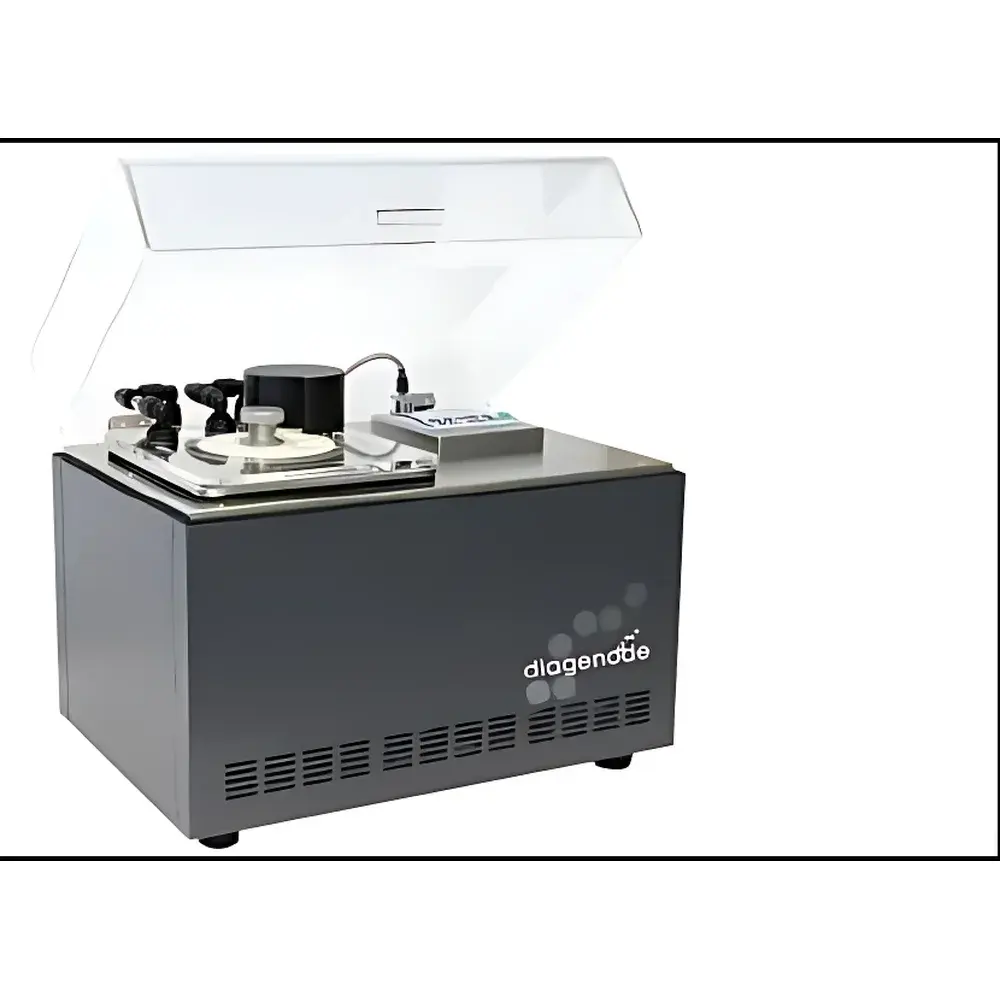
Diagenode Bioruptor Pico Ultrasonic Sonicator
| Brand | Diagenode |
|---|---|
| Origin | Belgium |
| Model | Bioruptor Pico |
| Instrument Type | Ultrasonic Cell Disruptor |
| Ultrasonic Power | 300 W |
| Operating Frequency | 20 kHz |
| Temperature Range | 4 °C to ambient |
| Sample Volume | 5 µL – 2 mL |
| Maximum Sample Capacity | 18 tubes (depending on adapter) |
| Cooling System | Integrated electromagnetic valve-controlled recirculating chiller |
Overview
The Diagenode Bioruptor Pico is a high-precision, water-bath-based ultrasonic sonicator engineered for reproducible and scalable chromatin shearing, DNA fragmentation, and cell lysis in epigenetic, genomic, and molecular biology workflows. Unlike probe-based sonicators, the Bioruptor Pico employs indirect ultrasonic energy transmission via a temperature-controlled water bath—eliminating cross-contamination, aerosol generation, and probe-induced sample heating or degradation. Its 20 kHz transducer generates controlled cavitation fields within the bath, enabling uniform energy distribution across multiple samples simultaneously. The system is optimized for applications requiring stringent fragment size control (e.g., ChIP-seq, ATAC-seq, CUT&RUN), where consistency between replicates and minimal thermal bias are critical for downstream library quality and sequencing fidelity.
Key Features
- Indirect ultrasonication in a sealed, temperature-regulated water bath—no probe insertion, no aerosols, no sample contamination.
- Programmable dual-timer architecture: independent ON/OFF cycle control (1–99 cycles) with user-defined sonication duration (1–99 s) and pause interval (1–99 s).
- Integrated real-time monitoring: automatic self-diagnostic at startup, operational status tracking, and overheat protection with automatic shutdown.
- Rotating sample holder: ensures uniform exposure of all tubes to the acoustic field, minimizing positional bias and improving inter-sample reproducibility.
- Electromagnetically actuated cooling system: synchronized with ultrasonic operation—chiller pauses during sonication to prevent interference with cavitation efficiency, then resumes during pauses to maintain precise bath temperature (4 °C minimum).
- Noise-dampening lid with safety interlock: sonication halts immediately upon lid lift; resumes automatically when closed—enabling precise timing control and operator safety compliance.
- Modular adapter system supporting standardized tube formats: 0.1 mL, 0.2 mL, 0.65 mL, 1.5 mL, and 15 mL centrifuge tubes—no specialized consumables required.
Sample Compatibility & Compliance
The Bioruptor Pico accommodates standard polypropylene microcentrifuge tubes without modification or proprietary consumables, reducing cost-per-experiment and enhancing protocol portability. Each adapter features mechanical locking mechanisms (e.g., rotary clamps) to prevent tube ejection under cavitation stress. The system supports fragmentation of native chromatin into 100 bp–1 kb fragments—ideal for next-generation sequencing library preparation. It complies with laboratory safety standards for biosafety level 2 (BSL-2) environments due to its closed-tube operation and absence of infectious aerosols. While not certified as medical device or IVD equipment, its design aligns with GLP-aligned documentation practices and supports audit-ready operation logs when integrated with validated lab information management systems (LIMS).
Software & Data Management
The Bioruptor Pico operates via an embedded digital interface with non-volatile memory for protocol storage (up to 10 user-defined methods). All timing parameters, cycle counts, and operational events—including temperature deviations, overheat alerts, and lid-open interruptions—are logged internally with timestamps. These logs can be exported via USB for traceability in regulated environments. Though it does not include cloud connectivity or FDA 21 CFR Part 11-compliant electronic signatures out-of-the-box, its deterministic behavior, hardware-based timing accuracy, and event-driven logging support integration into validated workflows under ISO/IEC 17025 or CLIA frameworks when paired with appropriate SOPs and change control documentation.
Applications
- Chromatin immunoprecipitation (ChIP) sample preparation with consistent fragment size distribution across biological replicates.
- ATAC-seq library generation requiring narrow fragment size profiles (< 150 bp peaks) and low mitochondrial DNA contamination.
- Shearing of high-molecular-weight genomic DNA for long-read sequencing platforms (e.g., PacBio, Oxford Nanopore).
- Cell lysis of bacteria, yeast, and cultured mammalian cells under non-denaturing conditions.
- Preparation of subcellular fractions (e.g., nuclear extracts) with preserved protein–DNA interactions.
- Routine nucleic acid shearing in QC/QA labs performing reference material characterization per ISO 20387 or ASTM E3147 guidelines.
FAQ
What is the minimum and maximum recommended sample volume per tube?
The system supports volumes from 5 µL (in 0.1 mL tubes with dedicated adapter) up to 2 mL (in 15 mL tubes), with optimal performance observed between 100 µL and 1 mL depending on tube format and application.
Can the Bioruptor Pico be used for protein extraction without denaturation?
Yes—when operated at 4 °C with appropriate buffer composition and short pulse durations, it enables gentle lysis while preserving native protein conformation and complex integrity.
Is calibration required before use?
No routine calibration is mandated; however, periodic verification of bath temperature stability and timer accuracy against NIST-traceable references is recommended for GxP environments.
How does the cooling system interact with the ultrasonic cycle?
The electromagnetic valve decouples chiller flow during active sonication to avoid damping of acoustic pressure waves; circulation resumes only during OFF intervals, ensuring both thermal control and cavitation efficiency.
Does Diagenode provide validation documentation for regulated laboratories?
Diagenode supplies IQ/OQ documentation templates and technical specifications compliant with ISO 9001; full PQ validation must be performed in-house per site-specific SOPs and regulatory requirements (e.g., FDA, EMA).




