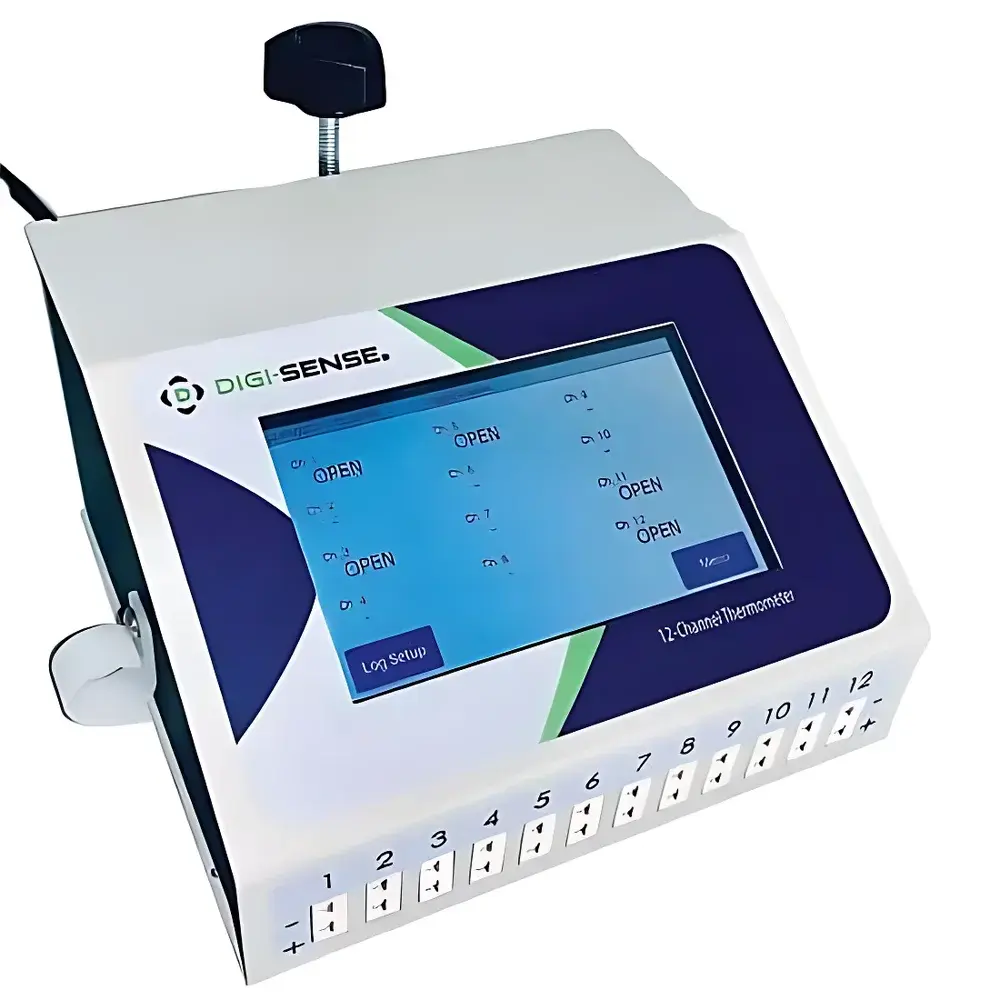
Digi-Sense 92000-02 12-Channel Scanning Thermocouple Temperature Meter
| Brand | Digi-Sense |
|---|---|
| Origin | USA |
| Model | 92000-02 |
| Temperature Range | -200 °C to 1768 °C |
| Accuracy | ±1% of full scale or ±1 °C (whichever is greater) |
| Resolution | 0.1 °C |
| Display | 5-inch full-color capacitive touchscreen LCD |
| Power Supply | 100–250 VAC, 50/60 Hz |
| Data Storage | Internal non-volatile memory (up to 320,000 points across 10 log files) |
| Interface | Micro-USB (3 m cable included) |
| Compliance | CE-marked |
Overview
The Digi-Sense 92000-02 is a benchtop 12-channel scanning thermocouple temperature meter engineered for high-fidelity, multi-point thermal monitoring in controlled laboratory, quality assurance, and process validation environments. It operates on the principle of cold-junction compensation (CJC) with programmable thermocouple type selection (J, K, T, E, R, S, B, N, C, and L), enabling precise voltage-to-temperature conversion per ASTM E230/E230M and IEC 60584 standards. Unlike single-channel instruments requiring manual probe swapping, the 92000-02 performs automated sequential scanning across all 12 inputs at user-defined intervals (100 ms to 60 s), maintaining traceable thermal data continuity across heterogeneous sample zones — such as furnace zones, environmental chambers, or multi-vessel bioreactor arrays.
Key Features
- Independent per-channel configuration: Each input supports selectable thermocouple type, measurement units (°C/°F), high/low alarm thresholds, and hysteresis settings — essential for mixed-sensor deployments (e.g., Type K for ambient zones, Type R/S for high-temperature crucibles).
- 5-inch full-color capacitive touchscreen interface: Enables intuitive navigation, real-time channel status visualization (color-coded by temperature band), and on-device log review without external software.
- Dual-mode data handling: Operates as both a live-scanning monitor and an autonomous data logger — storing up to 320,000 total readings across 10 independent log files in internal non-volatile memory (retains data during power loss).
- Configurable visual alarm system: LED indicators adjacent to each channel activate when measured values exceed programmable upper/lower limits; alarm events are timestamped and embedded in CSV export logs.
- Robust industrial-grade architecture: Aluminum front panel, reinforced chassis, and wide-input universal AC power supply (100–250 VAC) ensure stable operation in fluctuating facility power conditions common in manufacturing labs.
Sample Compatibility & Compliance
The 92000-02 interfaces exclusively with standard miniature, subminiature, and sheathed thermocouple probes (sold separately), supporting industry-standard connectors (mini-TC, TC-Mini, or bare-wire termination via screw terminals). It does not support RTDs, thermistors, or infrared sensors. Calibration traceability aligns with NIST-traceable practices; users may perform field verification using certified reference junctions or dry-block calibrators. The instrument meets CE marking requirements under the Low Voltage Directive (2014/35/EU) and Electromagnetic Compatibility Directive (2014/30/EU); its design adheres to IEC 61000-4-2 (ESD), -4-3 (radiated RF), and -4-4 (electrical fast transients) immunity criteria. While not FDA 21 CFR Part 11–certified out-of-the-box, audit-ready CSV exports (with timestamps, channel IDs, and alarm flags) support GLP/GMP documentation workflows when paired with validated PC-based acquisition software.
Software & Data Management
The included Windows-compatible data acquisition software enables real-time streaming, configurable scan rate adjustment, alarm logging, and synchronized multi-channel graphing. All logged data export natively to comma-separated values (CSV) — a format compatible with Excel, MATLAB, Python (pandas), and LIMS platforms. Each CSV file contains headers identifying channel number, thermocouple type, timestamp (YYYY-MM-DD HH:MM:SS.mmm), raw mV, compensated temperature, and alarm state (TRUE/FALSE). No proprietary binary formats or vendor-locked databases are used. USB flash drive (4 GB) and micro-USB cable facilitate offline transfer; no cloud dependency or subscription licensing is required. Firmware updates are delivered via downloadable HEX files and executed through the onboard bootloader — ensuring long-term maintainability without hardware obsolescence.
Applications
- Thermal mapping of autoclaves, ovens, and stability chambers per ISO 13485 and USP guidelines.
- Process validation in pharmaceutical manufacturing — monitoring jacket temperatures, reactor exotherms, and lyophilizer shelf gradients.
- Materials testing labs tracking phase transitions (e.g., glass transition, melting point) across multiple specimens simultaneously.
- Calibration laboratories performing simultaneous comparison tests between reference and working thermocouples.
- Academic research setups requiring synchronized thermal profiling of multi-zone experimental rigs (e.g., catalytic reactors, battery thermal runaway studies).
FAQ
Does the 92000-02 support thermocouple calibration offset adjustment per channel?
Yes — users can apply individual channel-specific offset corrections (±9.9 °C range) during setup, enabling post-hoc compensation for known probe drift or extension wire errors.
Can alarm notifications be exported with timestamped event logs?
Yes — all alarm triggers (high/low limit breaches) are recorded with millisecond-precision timestamps and stored alongside temperature data in the same CSV file.
Is the internal memory retained during power cycling or firmware update?
Yes — the non-volatile flash memory preserves all logged data across power interruptions, resets, and firmware upgrades.
What thermocouple types are supported, and how is cold-junction compensation implemented?
J, K, T, E, R, S, B, N, C, and L types are supported. CJC uses a precision onboard thermistor array located at the terminal block, conforming to NIST ITS-90 interpolation algorithms.
Is the touchscreen operable with gloves or in high-humidity lab environments?
The capacitive display requires direct skin contact or specialized conductive styluses; it is not rated for glove operation. The unit’s IP20 enclosure is intended for indoor, climate-controlled environments only.