
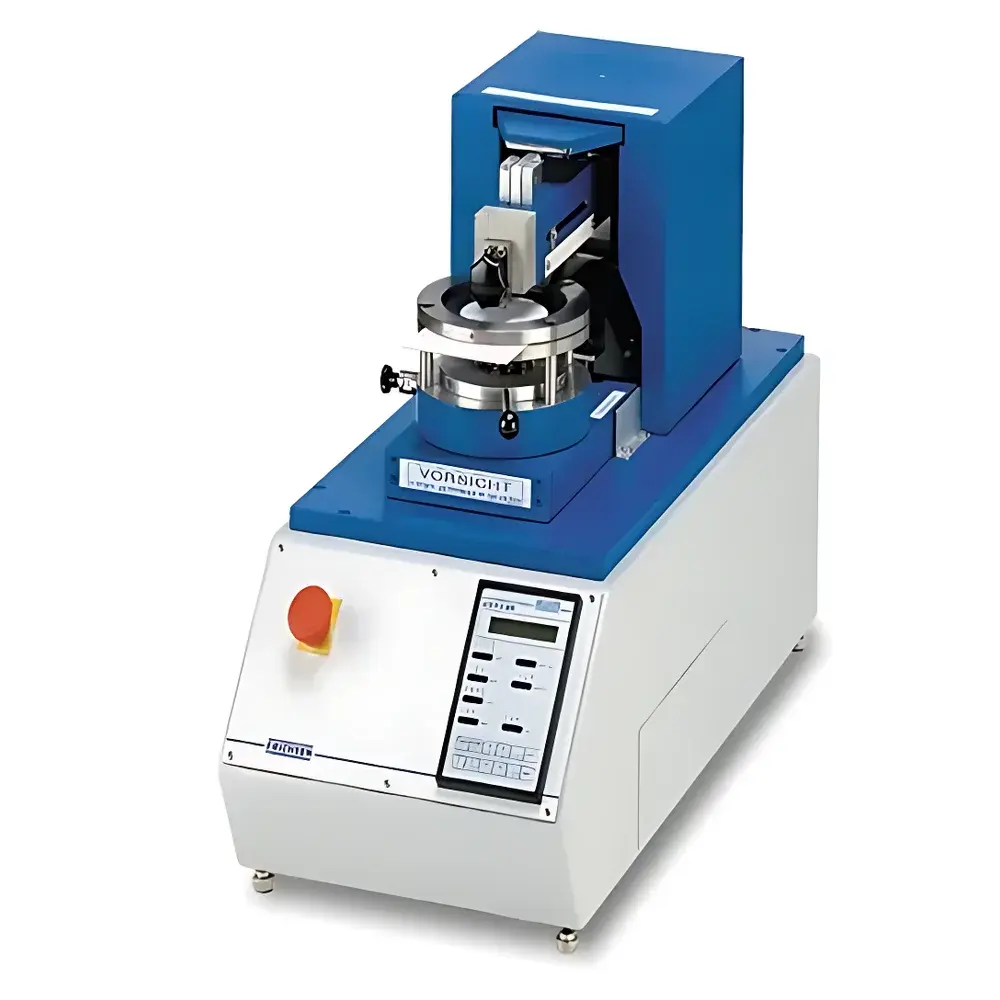
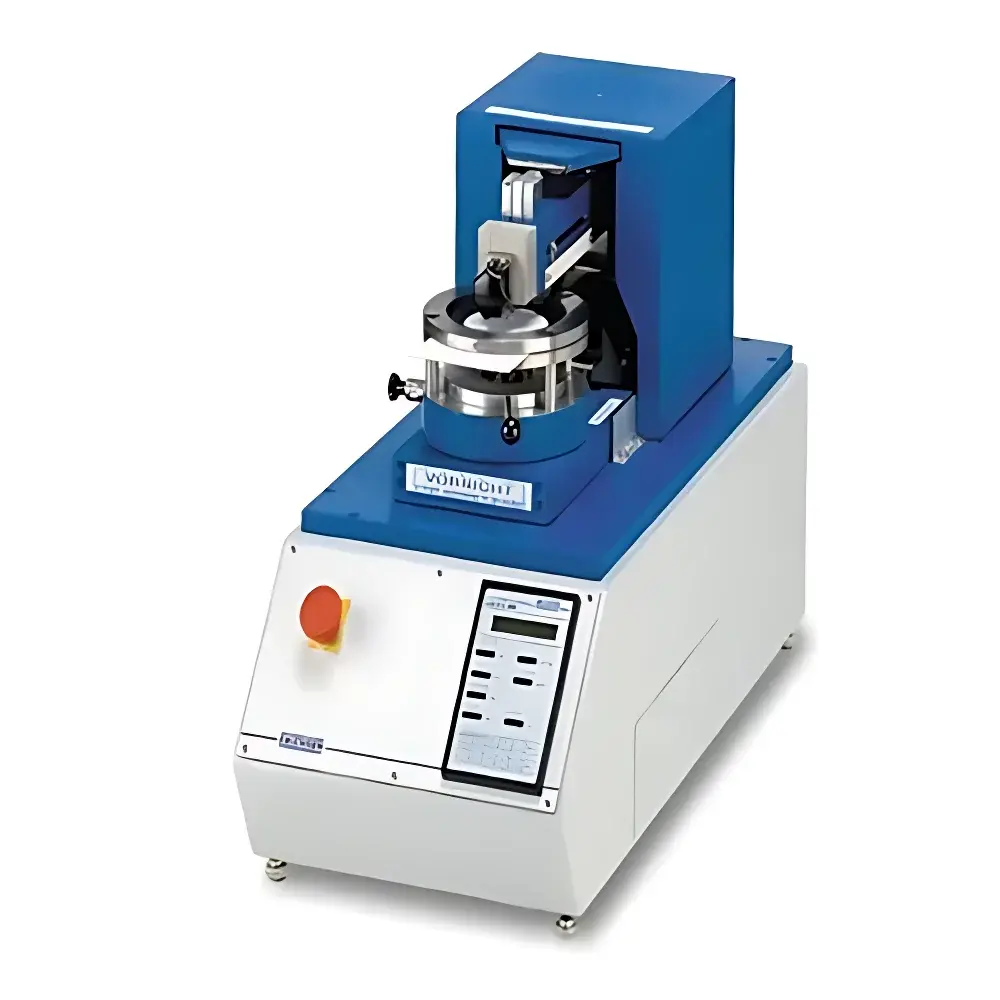
ERICHSEN 430P Automated Cross-Cut and Scratch Tester
| Brand | ERICHSEN |
|---|---|
| Origin | Germany |
| Model | 430P |
| Instrument Type | Tribological Tester for Adhesion & Scratch Resistance Evaluation |
| Load Range | 1–50 N (1 N or 2 N increments) |
| Scratch Speed | 40 mm/s or 1 m/min |
| Scratch Length | 25 mm or 45 mm |
| Cross-Cut Patterns | 9 pre-programmed + 1 user-defined |
| Sample Thickness | 0.5–20 mm |
| Max Sample Width | 105 mm |
| Power Supply | 115/230 VAC, 50/60 Hz |
| Weight | ~40 kg |
| Dimensions (W×H×D) | 330×460×750 mm |
Overview
The ERICHSEN 430P Automated Cross-Cut and Scratch Tester is a precision-engineered benchtop tribological instrument designed for standardized evaluation of coating adhesion and surface scratch resistance on painted, lacquered, and plastic substrates. Based on controlled mechanical indentation and orthogonal incision principles, the 430P implements ISO 2409, ASTM D3359, GME 60280, and other internationally recognized test protocols. Its operation relies on deterministic motion control: a hardened steel or carbide-tipped stylus applies calibrated normal force while traversing the sample surface at constant velocity; for cross-cut testing, the specimen is rotated 90° to generate orthogonal incisions, forming a grid pattern. The system’s core architecture integrates PLC-based sequencing with independent stepper motor actuation for specimen translation, stylus positioning, and load application—ensuring high reproducibility and minimal operator influence across repeated trials.
Key Features
- Two selectable scratch speeds (40 mm/s and 1 m/min) and two scratch lengths (25 mm and 45 mm), configurable in combination for method-specific compliance.
- Nine factory-preset cross-cut patterns aligned with major standards: e.g., 2×5, 6×1, 6×2, 6×3, 8×1, 8×2, 11×1, 11×2 (number of cuts × cut spacing in mm), plus one fully programmable pattern for custom grid geometries.
- Dual-load configuration options: 430P-I uses manual force adjustment (range 2–50 N, 2 N steps); 430P-II adds motor-driven force ramping for incremental scratch testing to determine critical delamination load.
- Low-force extension via optional 5-piece weight set (1–10 N, 1 N increments), enabling precise evaluation of thin-film systems and soft substrates.
- Integrated detection circuitry signals when stylus penetration breaches insulating layers to reach conductive base material—critical for multilayer automotive or electronics coatings.
- Rapid-action clamping system accommodates specimens from 80×50 mm minimum to 105 mm width (unlimited length), with thickness tolerance 0.5–20 mm.
- Modular tooling interface supports interchangeable cutting heads: standard hardened steel (0564.01.32), van Laar (φ0.5 mm, 0539.01.32), Bosch (φ0.75 mm, 0539.02.32), ISO 1518 (φ1.0 mm, 0539.03.32), and φ3.0 mm (0539.04.32) variants.
Sample Compatibility & Compliance
The 430P is validated for use on rigid flat panels including cold-rolled steel, aluminum alloys, thermoplastics (e.g., PP, ABS, PC), and coated composites. It meets functional requirements of EN ISO 2409 (cross-cut adhesion), ASTM D3359 (tape test), GME 60280 (automotive scratch resistance), and VW TL 226 (scratch behavior under defined load profiles). For GME 60280 testing, the instrument supports φ1.0 mm stylus, 2 mm inter-cut spacing (20-cut array), 5 N load, and 1 m/min speed—outputting scratch tracks suitable for ΔL* assessment under D65 illumination (d/8 geometry, 27 mm aperture) using external spectrophotometry. Optional EN ISO 2409-compliant pressure-sensitive tape (25 mm wide, 10 ±1 N adhesion) and 2.5× magnifier are supplied for visual rating per ISO 2409 scale.
Software & Data Management
While the 430P operates via embedded PLC logic without PC dependency, its parameter memory retains up to 10 user-defined test programs—including force profile, speed, length, and pattern geometry—with non-volatile storage. All operational sequences log timestamped execution data (e.g., actual applied load, stylus travel distance, cycle completion status) accessible via front-panel display. For GLP/GMP environments, audit trails can be manually recorded; full electronic records and 21 CFR Part 11 compliance require integration with third-party LIMS or laboratory documentation systems. Firmware updates are performed via USB interface using manufacturer-provided utilities.
Applications
The 430P serves quality control laboratories in automotive OEMs (e.g., BMW, Mercedes-Benz, VW Group), Tier-1 suppliers, paint formulators, and plastics processors. Typical use cases include: qualification of primer-surfacer-topcoat systems on body panels; validation of scratch resistance for interior trims (dashboard, door panels); comparative testing of UV-cured vs. thermally cured clearcoats; R&D screening of nano-reinforced polymer coatings; and failure analysis of delamination events post-thermal cycling or humidity exposure. Its ability to decouple mechanical incision from adhesive failure enables correlation studies between scratch morphology (via optical microscopy) and interfacial energy metrics derived from complementary techniques (e.g., pull-off adhesion per ISO 4624).
FAQ
What standards does the ERICHSEN 430P support out-of-the-box?
It natively executes EN ISO 2409, ASTM D3359 Method B, GME 60280, and VW TL 226 without software modification. Predefined patterns and default parameters align directly with these specifications.
Can the 430P perform progressive load scratch testing?
Only the 430P-II variant supports motorized force ramping; the 430P-I requires manual load adjustment between sequential test runs.
Is calibration traceable to national standards?
Force transducers are factory-calibrated against DAkkS-accredited reference standards (certificates provided). Users must perform periodic verification using certified deadweight sets (e.g., optional 0567.01.32 kit).
How is specimen alignment ensured before cross-cutting?
The instrument includes precision-machined locating pins and a zero-reference datum edge on the stage; alignment is verified visually using the supplied 2.5× magnifier prior to clamping.
What maintenance intervals are recommended?
Stylus tip inspection after every 50 test cycles; lubrication of linear guides every 6 months; annual verification of stepper motor torque and PLC timing accuracy by authorized ERICHSEN service engineers.



