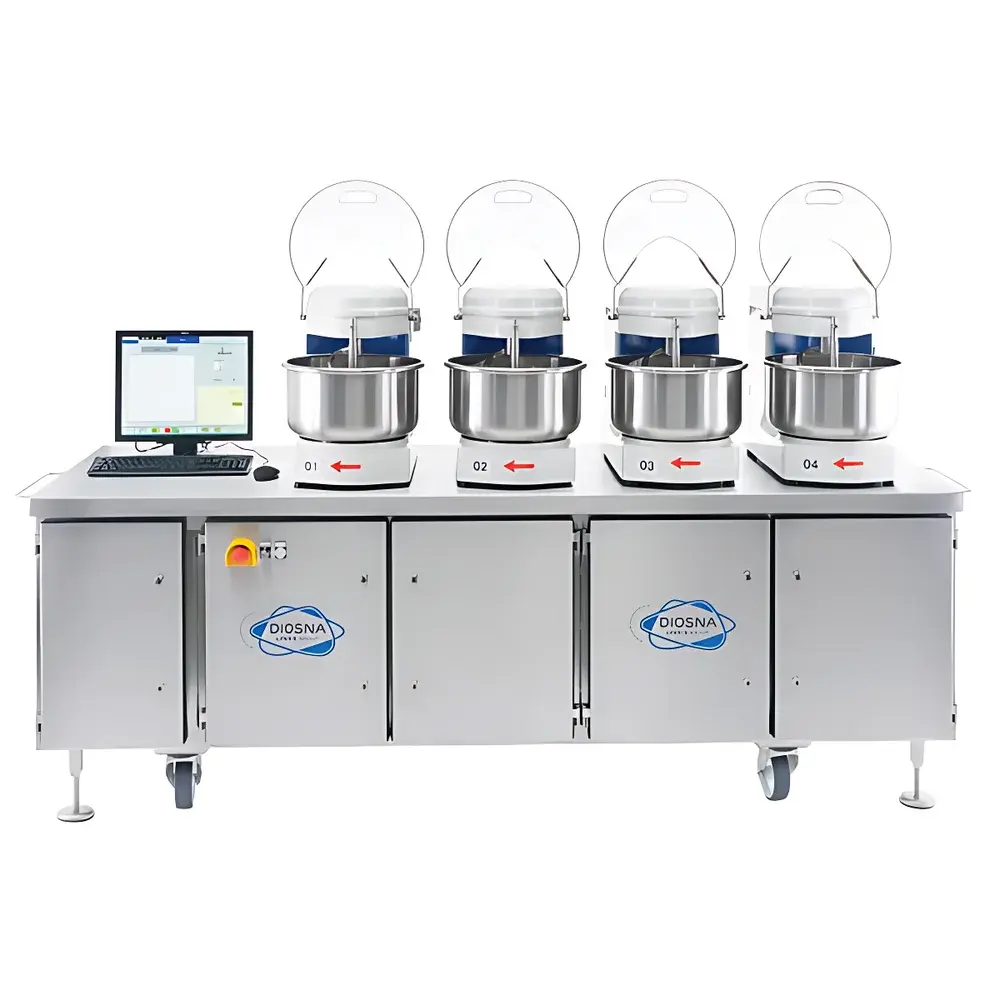
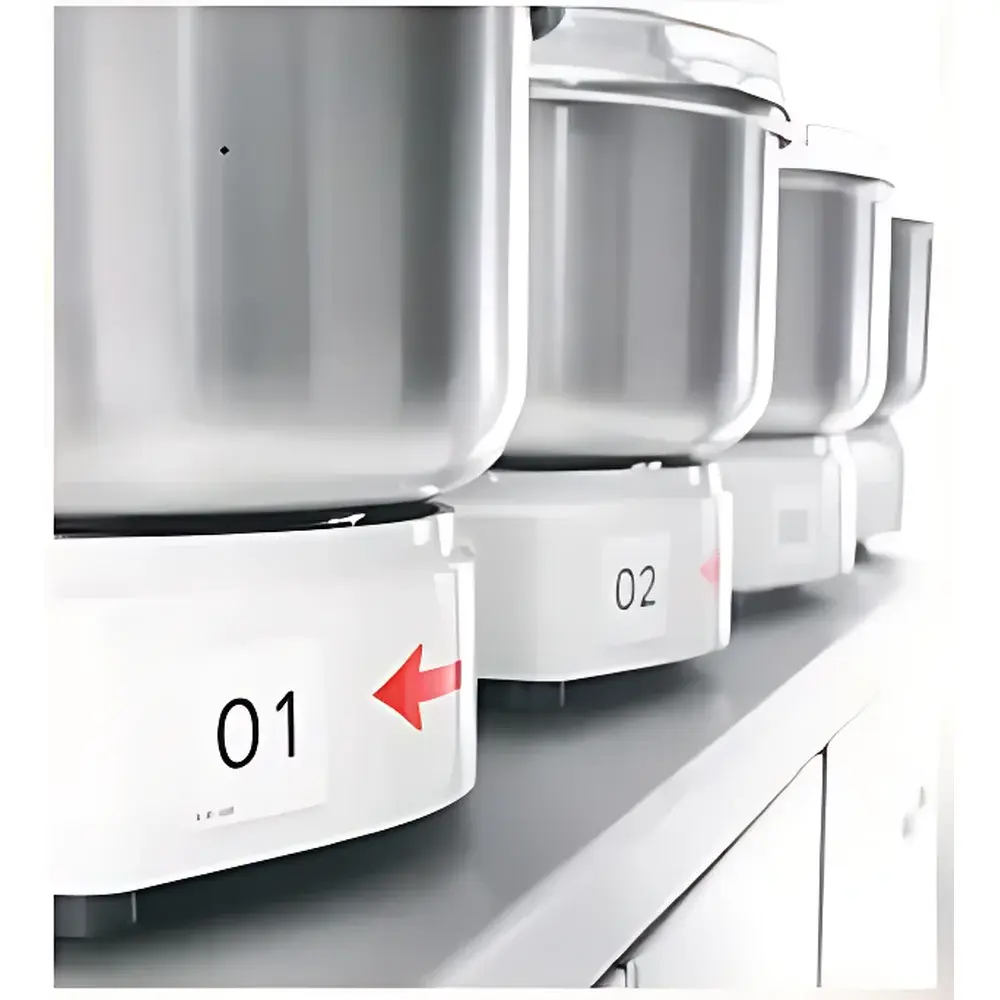
Diosna SP-12-Plant Integrated Dough Mixer
| Brand | Diosna |
|---|---|
| Origin | Germany |
| Model | SP-12-Plant |
| Control System | Siemens S7 PLC |
| Operating Software | Windows-based HMI with Excel integration |
| Mobility | Integrated mobile laboratory cabinet |
| Cleaning Options | Local washdown and CIP-capable |
| Temperature Sensing | PT-100 sensor embedded in stainless-steel mixing arm |
| Drive | Inverter-controlled motor |
| Scalability | Supports up to six SP-12 spiral mixers under centralized PLC control |
| Compliance | Designed for GLP-compliant food R&D environments |
Overview
The Diosna SP-12-Plant Integrated Dough Mixer is a modular, PLC-controlled pilot-scale mixing platform engineered for reproducible, data-rich dough development studies in food research and product development laboratories. Unlike standalone benchtop mixers, the SP-12-Plant implements Couette-type shear mechanics within a precision-engineered spiral mixing chamber, enabling controlled energy input, real-time torque monitoring, and thermally stabilized kneading—critical parameters governing gluten network formation, starch gelatinization onset, and dough rheological maturation. Its architecture bridges the gap between fundamental ingredient characterization and scalable process validation, supporting systematic investigation of flour hydration kinetics, enzyme activity modulation, and additive interaction effects under defined mechanical and thermal boundary conditions.
Key Features
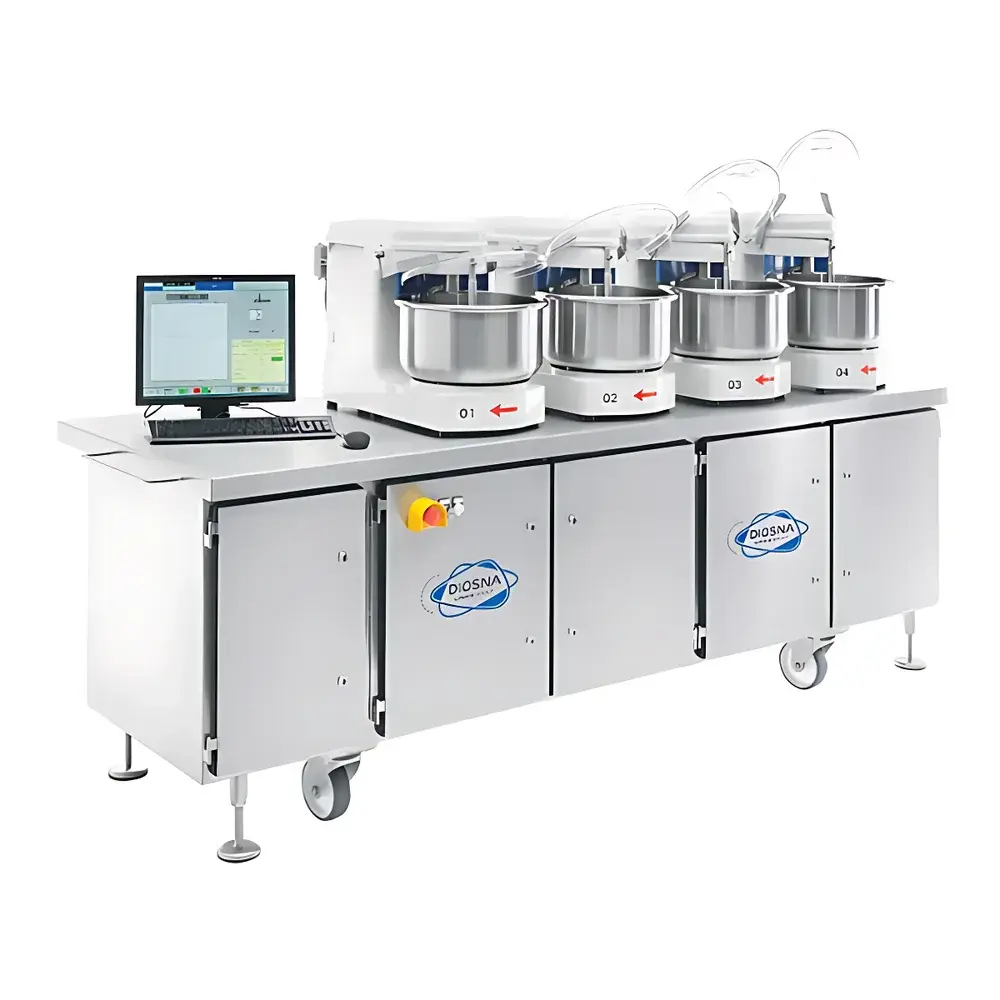
- Centralized Siemens S7 PLC control system coordinating up to six individual SP-12 spiral mixers, ensuring synchronized operation, interlock safety logic, and harmonized batch sequencing.
- Windows-based Human-Machine Interface (HMI) software installed on an integrated industrial PC, providing real-time visualization of torque, power consumption, mixing time, and jacket temperature—with native export to CSV and direct compatibility with Microsoft Excel for statistical analysis.
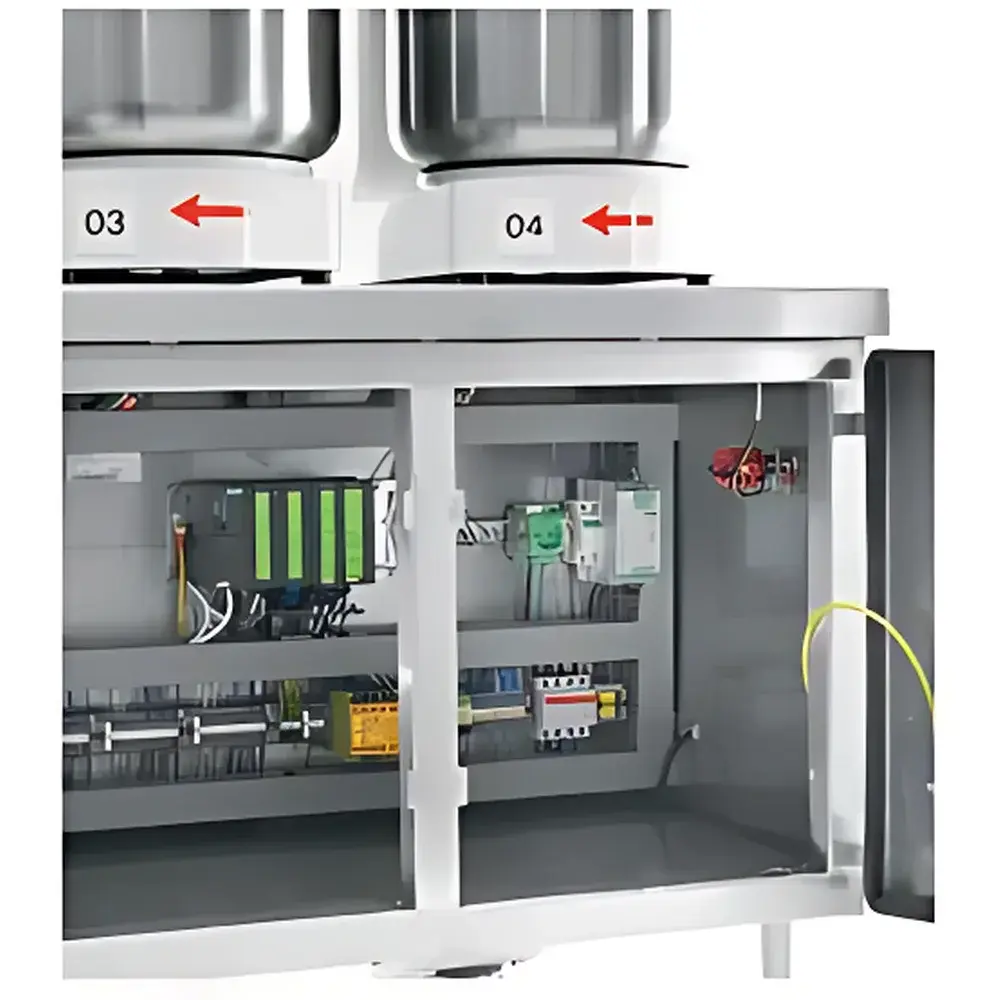
- Mobile laboratory cabinet housing the mixer unit, PLC cabinet, operator PC, and I/O modules—pre-wired and pre-calibrated for rapid deployment in ISO 17025-accredited labs or GMP-aligned pilot facilities.
- PT-100 temperature sensor embedded directly into the stainless-steel mixing arm, delivering spatially representative dough temperature feedback with ±0.3 °C accuracy across the 10–45 °C operational range.
- Inverter-driven main motor enabling precise speed regulation (0.1–120 rpm) and closed-loop energy dosing—essential for correlating specific mechanical energy (SME, kJ/kg) with dough microstructure evolution.
- CIP-ready design with full drainability, sanitary fittings (ISO 2852), and electropolished 316L stainless-steel contact surfaces meeting EHEDG Guideline Doc. 8 and 3-A Sanitary Standards 12-01.
Sample Compatibility & Compliance
The SP-12-Plant accommodates dough batches from 2.5 kg to 12 kg (adjustable via bowl fill-level calibration), supporting wheat, rye, spelt, gluten-free blends, and high-fiber formulations with variable hydration (45–85% w/w). Its mechanical design conforms to EN 1935:2021 (safety requirements for food processing machinery) and EN 61000-6-2/6-4 (EMC immunity/emission standards). Data acquisition meets ALCOA+ principles: attributable, legible, contemporaneous, original, accurate, complete, consistent, enduring, and available—enabling audit readiness for FDA 21 CFR Part 11 compliance when paired with validated electronic signature modules and system access controls.
Software & Data Management
The proprietary HMI application logs timestamped process variables—including absolute torque (N·m), rotational speed (rpm), cumulative energy (kJ), jacket temperature (°C), and ambient humidity—at 100 ms intervals. Raw datasets are stored locally in encrypted SQLite databases with SHA-256 hash verification; automated daily backups can be directed to network-attached storage (NAS) or cloud repositories via configurable SMB/FTP protocols. Audit trails record all user actions (login/logout, parameter edits, recipe loads, manual overrides) with immutable timestamps and operator IDs. Export functions support ASTM E2500-18–aligned metadata tagging, facilitating traceability from raw material lot numbers to final dough rheogram outputs.
Applications
- Flour quality benchmarking via standardized mixing curves (e.g., Brabender Farinograph equivalents) under controlled SME and thermal profiles.
- Formulation optimization: quantifying the impact of enzyme dosing, oxidant reduction, or hydrocolloid substitution on dough stability, peak time, and breakdown index.
- Process window definition: mapping critical thresholds for overmixing, thermal denaturation, or phase separation across varying water absorption rates and resting times.
- Scale-up correlation studies: generating empirical transfer functions between lab-scale SP-12-Plant energy inputs and commercial twin-screw extruder or continuous mixer outputs.
- Regulatory dossier preparation: generating GLP-compliant reports for EFSA health claim substantiation or FDA GRAS notifications requiring mechanistic dough behavior documentation.
FAQ
Is the SP-12-Plant suitable for gluten-free dough development?
Yes—the low-shear spiral geometry and programmable energy dosing enable gentle incorporation of fragile hydrocolloid networks without excessive shear degradation.
Can historical mixing protocols be reused across different SP-12 units in a multi-mixer configuration?
Yes—recipes are stored centrally in the PLC memory and synchronized across all linked mixers; version-controlled recipe libraries support ISO/IEC 17025 method validation requirements.
Does the system support third-party sensor integration (e.g., inline NIR or dielectric sensors)?
Yes—the PLC features open Modbus TCP and OPC UA interfaces, allowing seamless integration with external analytical probes for real-time moisture, protein, or starch crystallinity monitoring.
What cleaning validation documentation is provided?
Diosna supplies a CIP validation template aligned with ASME BPE-2022 Annex D, including flow velocity calculations, hold-time verification protocols, and residue testing guidance for ATP and total organic carbon (TOC) swab assays.