
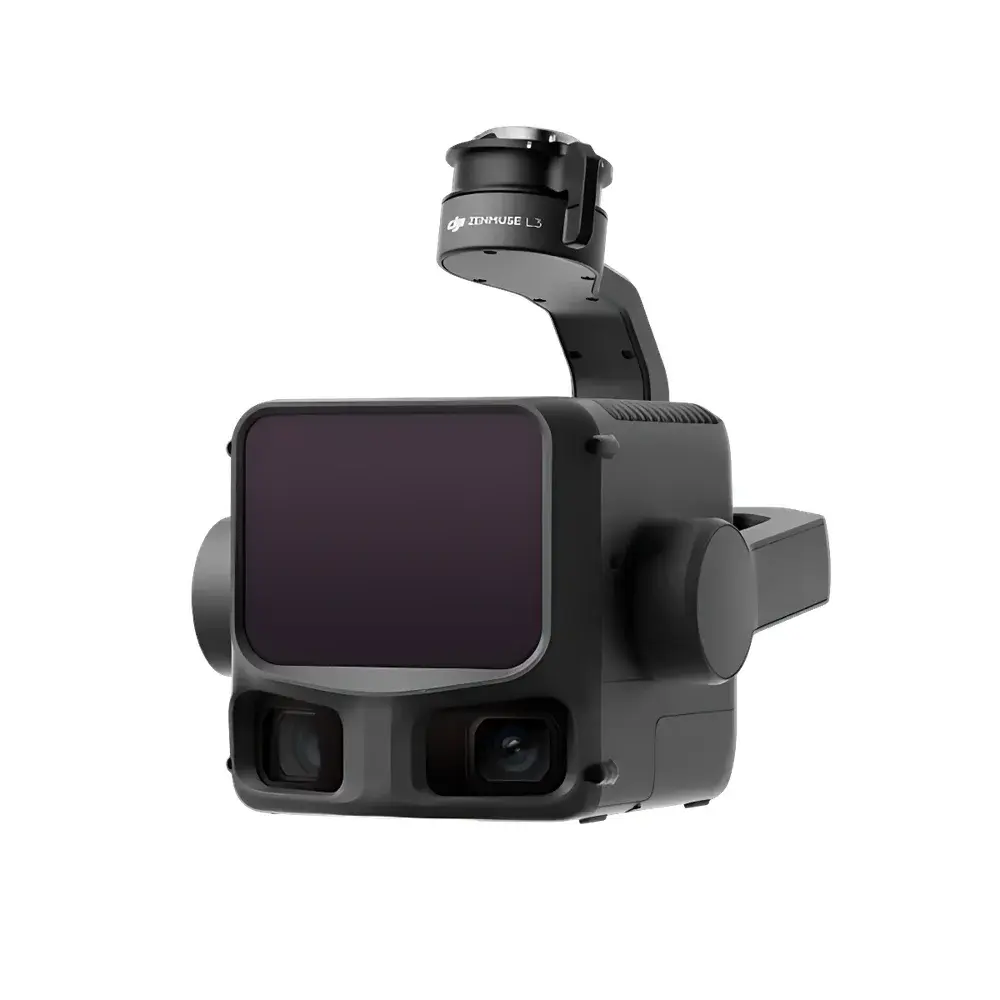
DJI Zenmuse L3 LiDAR System
| Brand | DJI |
|---|---|
| Origin | Shenzhen, China |
| Manufacturer Type | Authorized Distributor |
| Origin Category | Domestic (China) |
| Model | L3 |
| Price Range | USD 14,000 – 21,500 (based on ¥100,000–¥150,000 at 7.15 CNY/USD) |
| Dimensions | 192 × 162 × 202 mm |
| Weight | 1.60 kg (excluding single-gimbal mount) |
| Power Consumption | 64 W (typical), 100 W (max) |
| IP Rating | IP54 |
| Operating Temperature | −40 °C to +70 °C |
| Compatible Platform | DJI Matrice 400 series (with Zenmuse L3 single-gimbal mount) |
| Max Range | 450 m (50% reflectivity, 0 klx), 250 m (10% reflectivity, 100 klx) |
| Point Cloud Rate | 240,000 pts/s (single return), 1,200,000 pts/s (multi-return) |
| Planar Accuracy | ±5 cm @ 150 m |
| Height Accuracy | ±4 cm @ 150 m |
| Range Accuracy (RMS 1σ) | ±10 mm (absolute), <5 mm (repeatability) |
| Return Modes | 4/8/16 returns (100/350 kHz), 4/8 returns (1000 kHz), 4 returns (2000 kHz) |
| Scan Patterns | Linear repetitive (H 80° × V 3°), Cross-shaped repetitive (H 80° × V 80°), Non-repetitive (H 80° × V 80°) |
| Minimum Range | 10 m |
| Laser Divergence | 0.25 mrad (1/e²) |
| Wavelength | 1535 nm |
| Spot Size | Φ41 mm @ 120 m, Φ86 mm @ 300 m (1/e²) |
| Pulse Repetition Frequencies | 100 kHz (<500 m AGL), 350 kHz (<300 m AGL), 1000 kHz (<100 m AGL), 2000 kHz (<50 m AGL) |
| Laser Safety Class | Class 1 (IEC 60825-1:2014) |
| IMU Update Rate | 200 Hz |
| Accelerometer Range | ±6 g |
| Gyroscope Range | ±300 dps |
| Heading Accuracy (RMS 1σ) | 0.2° real-time, 0.05° post-processed |
| Pitch/Roll Accuracy (RMS 1σ) | 0.05° real-time, 0.025° post-processed |
| Horizontal Positioning (RTK FIX) | 1 cm + 1 ppm |
| Vertical Positioning (RTK FIX) | 1.5 cm + 1 ppm |
| Camera Sensor | 4/3" CMOS |
| Equivalent Focal Length | 28 mm |
| FOV | 73.3° (diagonal), 62° (horizontal), 41.2° (vertical) |
| Aperture | f/2.0–f/11 |
| Mechanical Shutter Speed | 2 s – 1/1500 s (f/2.0), 2 s – 1/2000 s (f/2.8–f/11) |
| Electronic Shutter Speed | 2 s – 1/16000 s |
| Shutter Lifetime | 500,000 actuations |
| Image Resolution | 12288 × 8192 (100 MP), 6144 × 4096 (25 MP) |
| Video Encoding | MP4 (HEVC/H.265) |
| Video Resolutions | 4K (3840 × 2160 @30 fps), FHD (1920 × 1080 @30 fps) |
| File System | exFAT |
| Image Formats | JPEG, DNG (RAW) |
| Video Format | MP4 (AVC/H.264) |
| Gimbal Stabilization | 3-axis (pitch, roll, yaw) |
| Angular Jitter | ±0.01° |
| Mounting Interface | DJI SKYPORT quick-release |
| Mechanical Rotation Limits | Pitch −135° to +73°, Roll −90° to +60°, Yaw −105° to +105° |
| Controllable Range | Pitch −120° to +60°, Yaw −80° to +80° |
| Self-Check Method | Roll — none required |
| Data Storage | Raw images, IMU, point cloud, GNSS logs, calibration files |
| Onboard Storage | CFexpress™ Type B card (min. sequential write speed: 1500 MB/s) |
| Included Reader | >900 MB/s read/write speed |
| Post-Processing Software | DJI Terra (formerly DJI PhantomFlight / DJI SmartMap) |
| Exportable Point Cloud Formats | PTS, LAS, PLY, PCD, S3MB |
| Primary Applications | Topographic mapping, engineering surveying, emergency response mapping, law enforcement operations, energy infrastructure inspection, forestry and agricultural resource assessment |
Overview
The DJI Zenmuse L3 LiDAR System is a high-performance, integrated aerial survey payload engineered for professional-grade geospatial data acquisition from unmanned aerial platforms. Designed specifically for the DJI Matrice 400 series, the L3 combines a Class 1, eye-safe 1535 nm pulsed time-of-flight (ToF) LiDAR sensor with a high-resolution 4/3” CMOS visual camera and a tightly coupled inertial navigation system (INS) featuring dual-frequency RTK GNSS. Its architecture adheres to core principles of direct georeferencing—leveraging synchronized timestamping across LiDAR pulses, IMU measurements, and GNSS observables—to deliver centimeter-level absolute positioning without ground control points (GCPs) under RTK FIX conditions. The system operates across multiple pulse repetition frequencies (100–2000 kHz), enabling adaptive mission planning based on platform altitude, target reflectivity, and required point density. With a maximum range of 450 m under low ambient light and nominal reflectivity, and sub-5 cm vertical repeatability at 150 m, the L3 meets the accuracy and reliability requirements of ISO 19157-compliant quality assurance workflows in topographic and cadastral applications.
Key Features
- Integrated multi-sensor architecture: Co-aligned LiDAR, RGB camera, and high-fidelity IMU enable robust direct georeferencing and photogrammetric augmentation.
- Multi-return capability supporting up to 16 echoes per pulse (at lower PRFs), facilitating penetration through vegetation canopy and accurate bare-earth modeling in forestry and terrain classification tasks.
- Adaptive scanning patterns—including linear, cross-shaped repetitive, and non-repetitive modes—allow optimization for corridor mapping, wide-area coverage, or structural detail capture.
- IP54-rated enclosure ensures operational resilience in variable field environments, including light rain, dust exposure, and thermal extremes from −40 °C to +70 °C.
- Real-time point cloud coloring via four modalities: intensity (reflectance), elevation, range, and true-color fusion—enabling immediate visual validation during flight and rapid QA/QC in post-processing.
- Dual-frequency RTK GNSS with 1 cm + 1 ppm horizontal and 1.5 cm + 1 ppm vertical accuracy (RTK FIX) supports compliance with national mapping standards such as ASPRS Accuracy Standards for Digital Geospatial Data and ASTM E2843.
Sample Compatibility & Compliance
The Zenmuse L3 is validated exclusively for use with DJI Matrice 400-series aircraft equipped with the dedicated Zenmuse L3 single-gimbal mount. It is not compatible with legacy M200 or M300 platforms without hardware modification. All optical and mechanical interfaces conform to DJI’s SKYPORT specification, ensuring repeatable mounting alignment and vibration isolation. The 1535 nm laser source complies with IEC 60825-1:2014 Class 1 safety requirements, eliminating need for operator laser safety training or controlled airspace coordination under most civil aviation authorities’ regulations. Data output formats—including LAS, PLY, and PTS—align with Open Geospatial Consortium (OGC) best practices and are ingestible into industry-standard GIS and CAD environments (e.g., Esri ArcGIS Pro, Bentley ContextCapture, Trimble Business Center). The system supports audit-ready metadata logging per ISO 19115-1, including sensor calibration parameters, IMU bias estimates, and GNSS solution status flags.
Software & Data Management
Raw data acquisition and initial processing are managed through DJI Terra, a desktop application supporting full workflow automation—from flight planning with terrain-aware altitude constraints, to real-time kinematic (RTK) base station configuration, to batch point cloud classification and digital surface model (DSM) generation. Terra implements rigorous quality control metrics, including point cloud density maps, trajectory residuals, and reprojection error heatmaps. Exported point clouds retain full georeferencing metadata and support standard metadata schemas required for GLP/GMP-aligned documentation in regulated sectors such as utility corridor monitoring or environmental impact assessments. While Terra does not natively enforce FDA 21 CFR Part 11 electronic signature controls, its structured log export (CSV-based event timelines, SHA-256 checksummed archives, and deterministic processing pipelines) facilitates integration into validated laboratory information management systems (LIMS) when deployed within auditable QA frameworks.
Applications
- Topographic Mapping: Generation of high-density DEMs/DSMs compliant with USGS National Map Accuracy Standards (NMAS) for 1:1000-scale deliverables.
- Engineering Surveying: As-built verification of civil infrastructure (bridges, tunnels, dams), volume calculations for stockpiles and cut/fill analysis.
- Emergency Response Mapping: Rapid post-disaster terrain change detection, landslide boundary delineation, and flood extent modeling using differential point cloud subtraction.
- Law Enforcement & Forensics: Crime scene reconstruction with millimeter-level spatial fidelity, evidence documentation under chain-of-custody protocols.
- Energy Infrastructure Monitoring: Corridor inspection of transmission lines, pipeline right-of-way clearance analysis, and thermal anomaly correlation via fused RGB-LiDAR datasets.
- Agricultural & Forestry Resource Assessment: Canopy height models (CHMs), biomass estimation, species segmentation, and precision silviculture planning.
FAQ
Is the Zenmuse L3 compatible with non-DJI flight platforms?
No. The L3 requires DJI’s proprietary SKYPORT interface, real-time telemetry synchronization, and firmware-level integration with Matrice 400-series flight controllers. Third-party integrations are not supported.
Does the system support post-processed kinematic (PPK) workflows?
Yes. Raw GNSS observables (RINEX 3.x) and IMU logs are recorded onboard and can be processed externally using commercial PPK software (e.g., NovAtel Inertial Explorer, APX-20 PPK Suite) for enhanced accuracy in areas with limited RTK base station coverage.
What is the minimum recommended flying height for optimal point cloud density?
For 1000 kHz operation, the recommended maximum altitude is 100 meters AGL; for 2000 kHz, it is 50 meters AGL. Lower altitudes increase point density but reduce swath width—mission planning must balance resolution requirements against coverage efficiency.
Can the L3 perform simultaneous LiDAR and photogrammetric data collection?
Yes. The synchronized trigger mechanism ensures temporal alignment between LiDAR returns and image exposures, enabling pixel-level registration for texture-mapped point clouds and hybrid reality modeling.
Is firmware update capability available over-the-air (OTA)?
Firmware updates require connection to DJI Assistant 2 (Enterprise Edition) via USB-C and are subject to version-controlled release cycles aligned with DJI’s enterprise support policy.






