
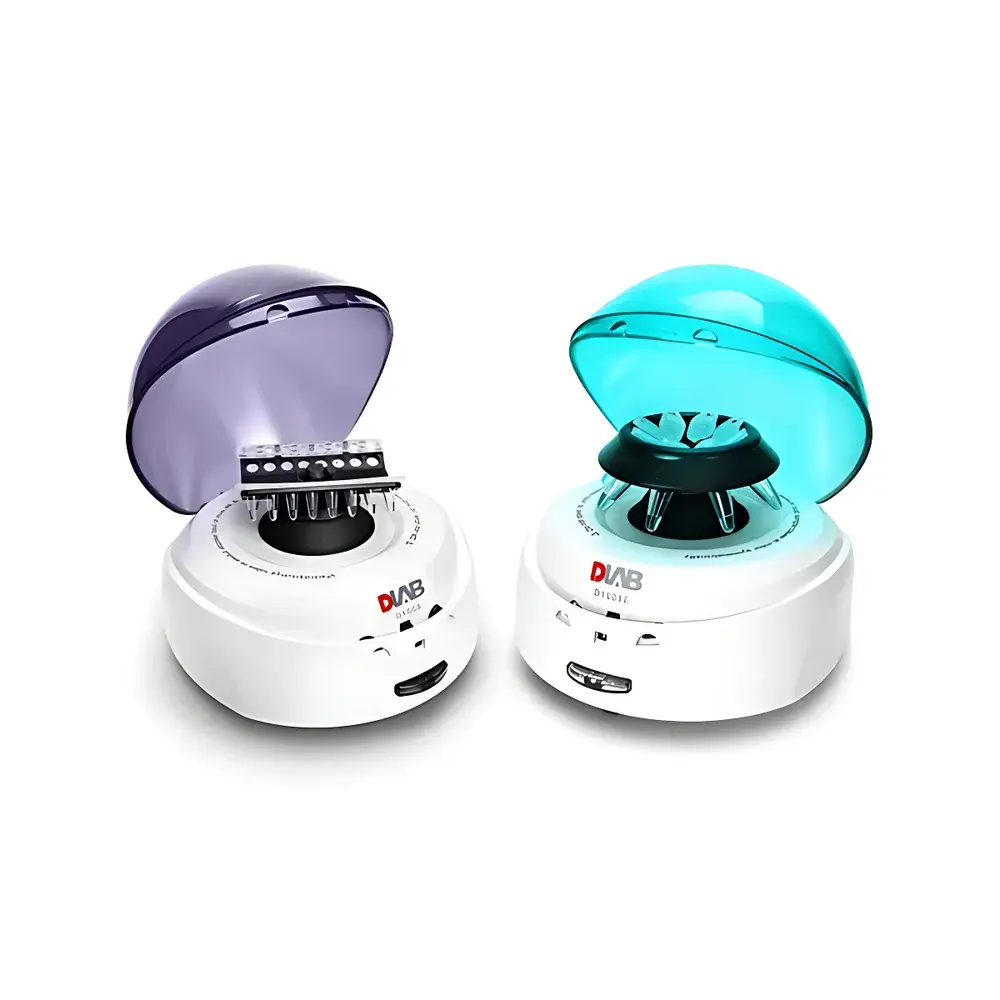
DLAB D1008/D1008E Palm-Sized Centrifuge
| Brand | DLAB |
|---|---|
| Origin | Beijing, China |
| Manufacturer Type | Direct Manufacturer |
| Product Category | Domestic |
| Model | D1008 / D1008E |
| Instrument Type | Palm-Sized Centrifuge |
| Speed Class | Low-Speed Centrifuge (up to 7000 rpm) |
| Function | General-Purpose Centrifuge |
| Configuration | Fixed-Angle Rotor Centrifuge |
| Maximum Capacity | 2 × 8 tubes |
| Maximum Speed | 7000 rpm (D1008) / 5000 rpm (D1008E) |
| Maximum RCF | 2680 × g (D1008) / 1360 × g (D1008E) |
| Dimensions (L×W×H) | 160 × 170 × 122 mm (D1008) / 156 × 170 × 122 mm (D1008E) |
| Noise Level | ≤45 dB(A) |
| Power Supply | AC 100–240 V, 50/60 Hz, 20 W |
| Motor | Brushless DC Motor |
| Certifications | CE, cTUVus, FCC, MCA |
Overview
The DLAB D1008 and D1008E are compact, palm-sized centrifuges engineered for rapid, reliable microcentrifugation in resource-constrained or high-throughput laboratory environments. Designed around a brushless DC motor architecture, these instruments operate on the principle of fixed-angle rotor sedimentation—generating controlled centrifugal force to separate suspended particles, cellular components, or precipitated biomolecules based on density differentials. With maximum rotational speeds of 7000 rpm (D1008) and 5000 rpm (D1008E), and corresponding RCF values up to 2680 × g, they deliver sufficient force for routine pelleting of bacteria, yeast, mammalian cells, nucleic acids, and protein aggregates from small-volume samples (0.2–2.0 mL). Their ultra-compact footprint—under 160 mm in length and weighing only 0.5 kg—enables deployment on crowded benchtops, inside biosafety cabinets, or in field-deployable mobile labs without compromising mechanical stability or thermal management.
Key Features
- Dual interlock safety system: Mechanical and electronic lid locks ensure automatic rotor deceleration upon lid opening, meeting IEC 61010-2-020 requirements for centrifuge safety.
- Wide-input voltage regulation: Integrated switching-mode power supply maintains consistent rotational speed across AC input fluctuations (100–240 V, 50/60 Hz), ensuring reproducible RCF delivery independent of local grid conditions.
- Ultra-low acoustic signature: Optimized rotor dynamics and vibration-damping housing limit operational noise to ≤45 dB(A)—comparable to quiet library ambient levels—supporting use in open-plan labs and teaching environments.
- Intuitive one-touch operation: Lid-actuated start/stop logic enables immediate acceleration upon closure and instantaneous braking (<2 s stop time) upon opening, minimizing procedural delay and enhancing workflow continuity.
- Quick-release snap-fit rotor: Precision-machined aluminum rotor with balanced geometry accommodates eight 0.2–2.0 mL microtubes or dual 0.2 mL PCR strip configurations; optional adapters support 0.5 mL tubes without hardware modification.
- Continuous-duty rating: Rated for indefinite operation under standard ambient conditions (15–35 °C, <80% RH), eliminating duty-cycle limitations common in entry-level centrifuges.
Sample Compatibility & Compliance
The D1008/D1008E supports standardized microcentrifuge tube formats including 0.2 mL PCR strips (16-well or dual 8-well configuration), 0.5 mL, 1.5 mL, and 2.0 mL conical tubes—compatible with most commercially available polypropylene and polyethylene variants. Rotor balance tolerance is maintained within ±0.1 g per position, enabling robust handling of partially loaded configurations. The device complies with multiple international safety and electromagnetic compatibility standards: CE marking per Directive 2014/30/EU (EMC) and 2014/35/EU (LVD); cTUVus certification to UL 61010-1 and CAN/CSA C22.2 No. 61010-1; FCC Part 15 Class B; and Australian MCA RCM requirements. While not designed for clinical diagnostics under ISO 13485 or FDA 21 CFR Part 820, its performance consistency supports GLP-aligned documentation workflows when paired with lab-specific SOPs.
Software & Data Management
As a standalone benchtop instrument, the D1008/D1008E operates without embedded firmware-based control software or digital interfaces. All operational parameters—including speed, run time, and status—are managed via tactile push-button controls and LED indicators. This design eliminates cybersecurity attack surfaces and ensures deterministic behavior across decades of service life. For laboratories requiring audit trails, integration into electronic lab notebooks (ELNs) is achieved manually via timestamped operator logs or through external USB-connected data loggers interfacing with the unit’s analog tachometer output (available on request). No proprietary drivers, cloud connectivity, or remote access capabilities are implemented—aligning with IT security policies in regulated academic and industrial settings.
Applications
- Routine microsample pelleting: Harvesting E. coli, S. cerevisiae, or HEK293 cells from 0.5–2.0 mL cultures prior to lysis or storage.
- PCR setup and cleanup: Rapid spin-down of reaction mixtures, primer stocks, and post-amplification purification columns.
- Biomolecule concentration: Precipitating DNA, RNA, or plasmid preps using ethanol/isopropanol protocols.
- Clinical point-of-care prep: Pre-analytical processing of capillary blood drops or saliva swabs in decentralized testing environments.
- Teaching laboratories: Demonstrating centrifugal separation principles with minimal infrastructure requirements and inherent safety features.
- Quality control in manufacturing: Verifying homogeneity of suspensions, emulsions, or colloidal formulations during batch release testing.
FAQ
Is the D1008 compatible with 0.5 mL microtubes without adapters?
Yes—the rotor accepts 0.5 mL tubes directly alongside 0.2 mL, 1.5 mL, and 2.0 mL formats without requiring additional accessories.
Does the D1008E offer lower RCF to accommodate temperature-sensitive samples?
Yes—the D1008E’s 5000 rpm maximum speed yields 1360 × g, reducing shear stress on fragile organelles or protein complexes compared to the D1008’s 2680 × g.
Can the centrifuge be operated inside a CO₂ incubator or cold room?
It is rated for ambient operation between 15–35 °C and relative humidity below 80%; extended use below 15 °C may affect motor efficiency and bearing lubrication.
What maintenance is required beyond routine cleaning?
No scheduled maintenance is specified; periodic visual inspection of rotor integrity and lid latch function is recommended per institutional biosafety guidelines.
Are spare rotors or adapters available as consumables?
DLAB offers certified replacement rotors (P/N: D1008-ROTOR) and universal adapter kits (P/N: ADP-02051520) through authorized distribution channels.



