
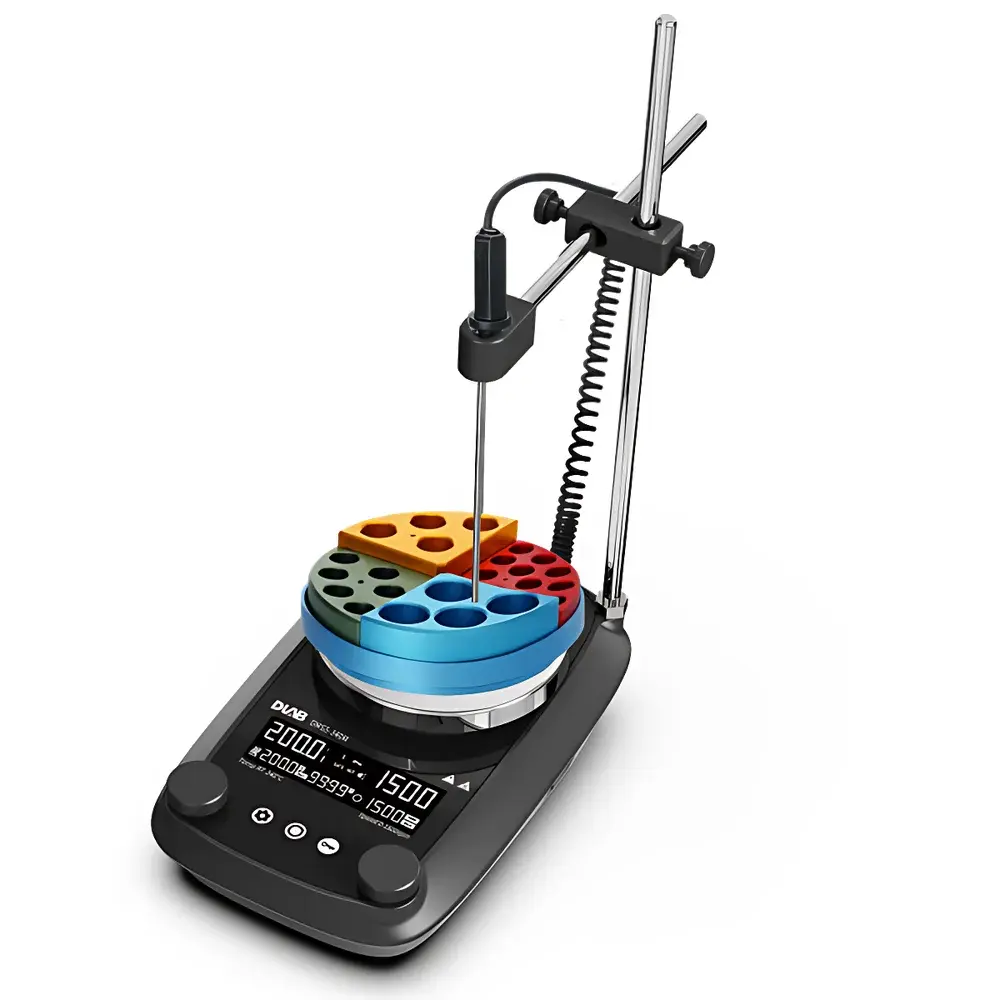
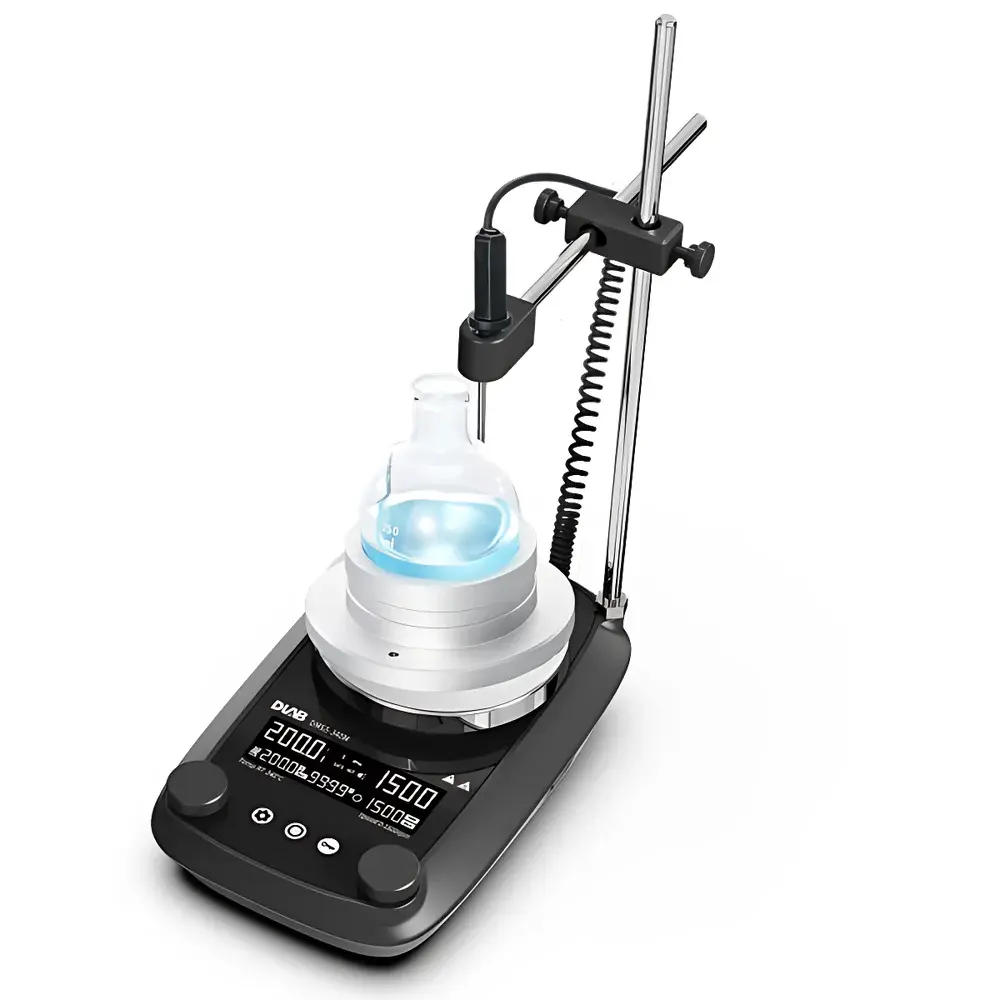
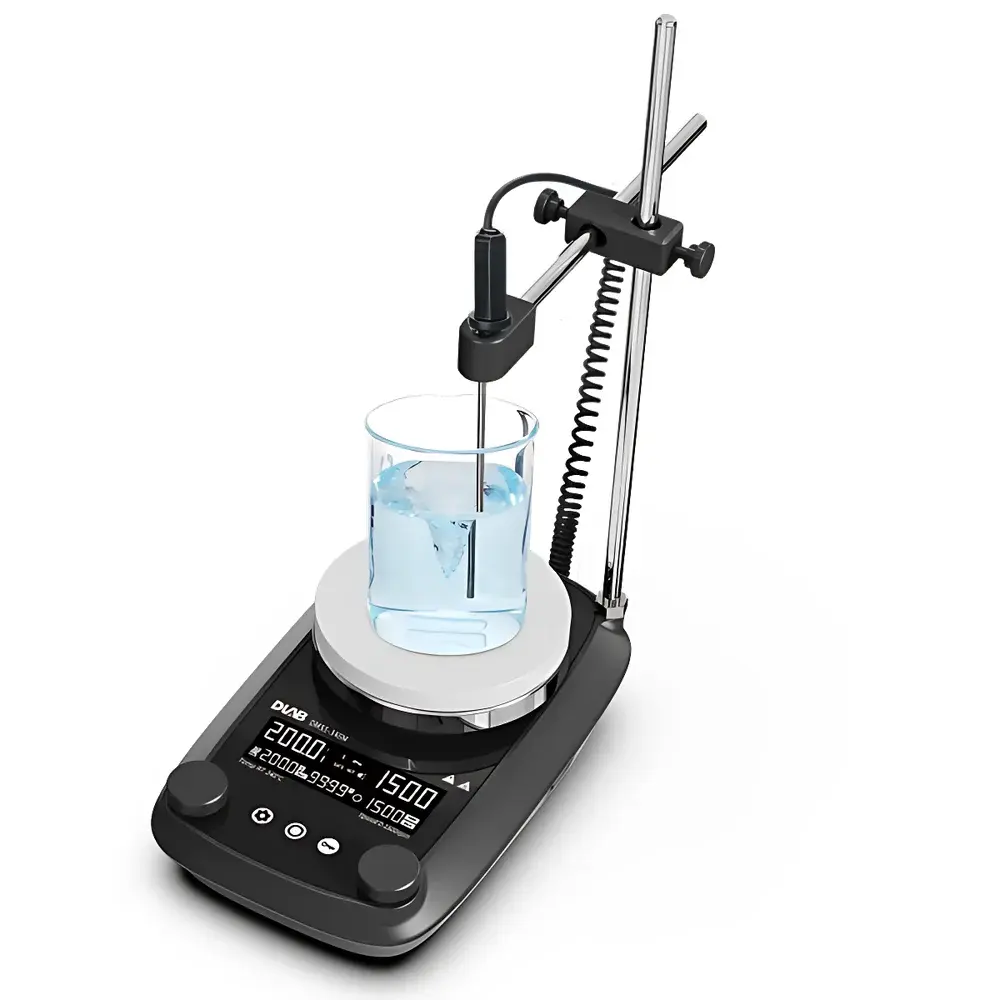
DLAB DMS5-340M LCD Digital Programmable 5-Inch Magnetic Stirrer with Heating and Dual-Safety Circuit Protection
| Brand | DLAB |
|---|---|
| Origin | Beijing, China |
| Manufacturer Type | Direct Manufacturer |
| Instrument Type | Magnetic Stirrer |
| Max Stirring Volume | 20 L (water) |
| Speed Range | 50–1500 rpm (1-rpm increment) |
| Temperature Control Range | Ambient to 340 °C (1 °C increment) |
| Heating Accuracy | ±1 °C (<100 °C) / ±1% (>100 °C) |
| Temperature Display Resolution | ±0.1 °C |
| External Sensor | PT1000 (±0.2 °C) |
| Hot-Surface Warning Threshold | >50 °C |
| Overtemperature Cutoff | 420 °C |
| Motor | Brushless DC (10 W output, 650 W total power, 600 W heating power) |
| Plate Diameter | Ø135 mm (5 inch) |
| Plate Material | Ceramic-coated aluminum |
| IP Rating | IP42 |
| Timer Range | 1 min – 99 h 59 min |
| Interface | RS232 |
| Max Stir Bar Length | 80 mm |
| Dimensions (L×W×H) | 270 × 175 × 98 mm |
| Weight | 2.2 kg |
| Operating Environment | 5–40 °C, ≤80% RH |
Overview
The DLAB DMS5-340M is a high-performance, programmable magnetic stirrer engineered for precision thermal control and robust mechanical agitation in demanding laboratory environments. Designed around Couette flow principles, it employs a strong permanent magnet array driven by a brushless DC motor to induce rotational motion in magnetic stir bars immersed in liquid samples. Its integrated ceramic-coated aluminum heating plate delivers uniform thermal distribution across the 135-mm work surface, enabling stable temperature maintenance from ambient up to 340 °C—critical for applications requiring extended thermal exposure, such as reflux synthesis, solvent evaporation, or polymerization kinetics studies. The device complies with IEC 61010-1:2010 safety standards for laboratory electrical equipment and incorporates dual independent thermal monitoring circuits to meet GLP-aligned operational integrity requirements.
Key Features
- Brushless DC motor ensures spark-free operation, low acoustic emission (<45 dB(A)), and extended service life with zero routine maintenance.
- Ceramic-coated aluminum plate offers exceptional chemical resistance against acids, bases, and organic solvents, facilitating rapid decontamination and minimizing cross-contamination risk.
- Triple-mode heating control (A: rapid ramp-up; B: standard linear ramp; C: ultra-stable plateau mode) allows users to optimize thermal profiles for sensitive reaction systems.
- Dual-safety architecture includes real-time plate temperature sensing plus redundant overtemperature cutoff at 420 °C—automatically disabling heating while preserving stirring function during fault conditions.
- IP42-rated enclosure provides protection against solid objects ≥1 mm and vertically dripping water, supporting safe use in shared lab spaces with variable environmental conditions.
- LCD interface displays simultaneous real-time values for speed (50–1500 rpm, 1-rpm resolution), set/actual temperature (0.1 °C display resolution), and countdown timer—enabling unambiguous parameter verification without external instrumentation.
- Configurable hot-surface warning: persistent “HOT” indicator flashes when plate surface exceeds 50 °C—even after main power disconnection—to prevent accidental contact burns during cooldown periods.
Sample Compatibility & Compliance
The DMS5-340M supports single-point stirring of volumes up to 20 L of aqueous or low-viscosity organic media, and maintains effective torque transmission in moderately viscous systems (e.g., ethylene glycol, silicone oils, or polymer solutions) using stir bars up to 80 mm in length. Its magnetic field strength is calibrated to sustain consistent rotation under thermal load and viscosity gradients typical of synthetic chemistry workflows. The unit meets CE marking requirements per Directive 2014/30/EU (EMC) and 2014/35/EU (LVD), and its temperature control algorithm adheres to ASTM E220-22 guidelines for calibration of thermal instrumentation. Optional PT1000 external probe integration enables closed-loop feedback control compliant with ISO/IEC 17025 traceability frameworks.
Software & Data Management
Equipped with an RS232 serial interface, the DMS5-340M supports bidirectional communication with host PCs running custom LabVIEW VIs or third-party SCADA platforms. Firmware-level command protocols permit remote configuration of all operational parameters—including speed setpoint, target temperature, timer duration, and heating mode selection—as well as real-time data logging of speed, temperature, and elapsed time at user-defined intervals (1–60 s). Audit trail functionality records timestamped events such as parameter changes, fault triggers (e.g., sensor disconnect, overtemperature), and power-cycle history—supporting 21 CFR Part 11 compliance when deployed with validated software environments.
Applications
- Organic synthesis requiring precise thermal ramping and inert-atmosphere stirring (e.g., Grignard reactions, Suzuki couplings).
- Materials science workflows involving nanoparticle dispersion, sol-gel processing, or precursor solution homogenization prior to spin-coating.
- Pharmaceutical QC testing where USP and recommend controlled heating/stirring for dissolution medium preparation.
- Environmental analysis labs performing EPA Method 3510C (separation funnel extraction) or acid digestion protocols requiring elevated temperatures and continuous mixing.
- Academic teaching laboratories where durability, intuitive interface design, and multi-user programmability enhance pedagogical utility and instrument uptime.
FAQ
Does the DMS5-340M support external temperature feedback control?
Yes—it accepts input from a calibrated PT1000 sensor (±0.2 °C accuracy) for closed-loop regulation, enabling tighter thermal stability than open-loop plate-sensor-only operation.
Can the timer be configured to stop both heating and stirring upon completion?
No—the timer halts heating automatically but continues stirring to prevent thermal shock or sedimentation; this behavior is fixed per safety design to protect sample integrity.
What is the maximum permissible ambient humidity for continuous operation?
The unit is rated for operation at ≤80% relative humidity at 40 °C, verified per IEC 60068-2-30 condensation testing protocols.
Is the RS232 interface optically isolated?
Yes—galvanic isolation is implemented to prevent ground-loop interference and ensure signal integrity in electrically noisy lab environments.
How does the dual-safety circuit architecture satisfy institutional safety audits?
Independent thermal sensors feed separate monitoring paths: one governs active PID control, the other acts as a hardwired fail-safe cutoff—documented in the included Factory Acceptance Test (FAT) report for GxP validation.



